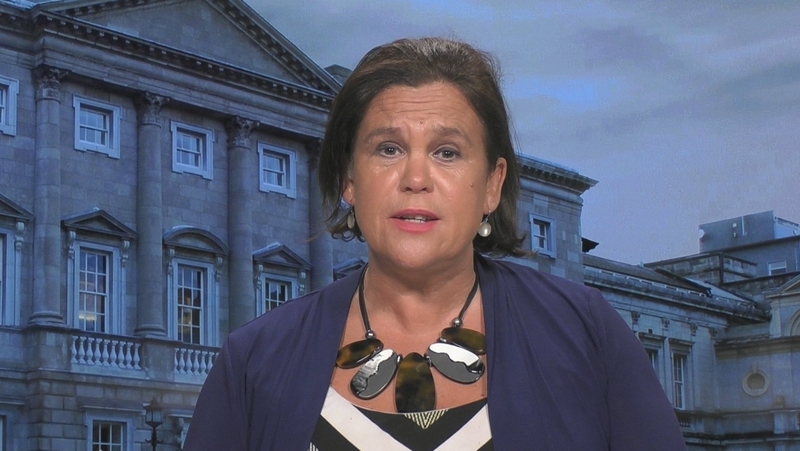

Care services for people with disabilities have been severely impacted by the pandemic, Sinn Féin leader Mary Lou McDonald has told the Dáil during Leaders' Questions.
She said that the groups providing these services have not got the funding to provide care in a way that meets public health requirements
Ms McDonald read from correspondence received from the families of those with disabilities.
One read: "Those with disabilities are being swept under the carpet. We are the forgotten people of this pandemic."
Ms McDonald said when Budget day comes these people cannot be given mere crumbs from the table.
Taoiseach Micheál Martin said he accepts the difficulties people with disabilities have faced during the pandemic.
He said the need for additional funding in the budget has been discussed.
"I am determined that this Government will respond in a comprehensive way to the needs of the disability sector," he said.
He said the State will have to take a stronger role in the provision of services for those with disabilities.
While some day services have reopened, he said, it is not at the capacity that people need.
Concerns over access, capacity for mental health services
The CEO of Mental Health Ireland, Martin Rogan, has told the Oireachtas Joint Committee on Health that that there are significant concerns around access and capacity for mental health services.
Mr Rogan said Ireland has the lowest bed to population ratio in Europe for mental health supports.
Mental Health Ireland told the committee members that the World Health Organisation recommends that 12% of public spending be allocated to provision of mental health services. However, in Ireland less than 7% of finances are dedicated to mental health, he said.
Mr Rogan said it is ''unrealistic'' that staff in the sector can deliver all the services required with less than 60% of the recommended funding.
He said Covid-19 has exposed the underlying fragilities in Ireland's mental health services.
Mr Rogan said the ''crushing effects'' of isolation have been hard to bear for many.
He called for additional investment promoting a ''more inclusive, hopeful'' agenda.
Mental Health Ireland said Irish people are concerned about mental health and want all citizens to be treated equally and respectfully.
Mr Rogan said Irish mental health services are patchy and poorly resourced and there has been uneven investment in different parts of the country.
He said timely access to services is important.
The CEO of Jigsaw, the National Centre for Youth Mental Health, told the committee there has been a 25% increase in demand recently for its clinical services.
The committee heard that the wait times for access to its services is now between four to ten weeks.
Dr Joseph Duffy, Jigsaw CEO, said demand for its services has been particularly high in Dublin South West, Dublin City and Co. Cork.
Dr Duffy said that the additional demand is ''not Covid specific but Covid has exacerbated some of the statistics''.
Dr Duffy said there has been a 400% increase in traffic to Jigsaw's online services and supports.
Jigsaw provides advice and support for young people across Ireland aged between 12 and 25 years old.
Dr Duffy said that research carried out nationally and internationally points to increased levels of psychological distress, disconnection, anxiety and depression.
Jigsaw told committee members that the WHO has reported that 93% of 130 surveyed countries have shown a decline in access to mental health support and an increase in demand for mental health services
He said 47% of young people have fears about the long-term impact on their mental health, based on research from 'Young Social Innovators'.
Dr Duffy said that research from the Irish Youth Foundation revealed that 53% of young people are feeling anxious, stressed or depressed.
''In Jigsaw we have seen a year on year increase in demand for support from young people, not just as a result of Covid-19.'' Dr Duffy said.
''What we are hearing is a real cause for concern.''
He highlighted that isolation, uncertainty and fear have left many without the core elements people value and need for our mental wellbeing.
Dr Duffy said a lack of connection is leading to high levels of anxiety, low mood and psychological distress
He also claimed that uncertainty is leading to a growing sense of hopelessness and fear for the future.
''Ireland has long needed more focus on mental health and more funding for this sector, not just as a result of Covid-19.''
In order for Jigsaw to continue providing key supports and services it said it needs to increase its clinical teams to cope with the increasing demand.
''By growing our frontline staff numbers, we are aiming to create a flexible pool of trained clinicians to be deployed to areas of greatest need across our network of services.''
Dr Duffy called for greater financial investment to allow Jigsaw to continue its work helping young people across the country.
Additional reporting Dimitri O'Donnell