


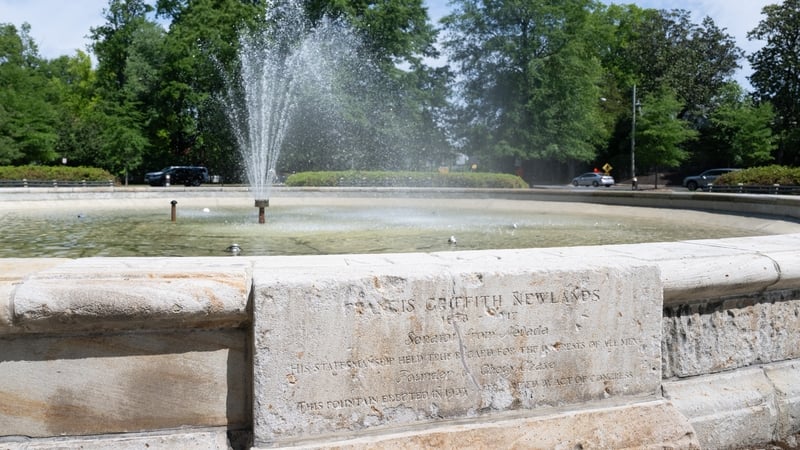
In a Washington suburb, a century-old fountain is dedicated to a long-dead, white supremacist senator. To placate modern-day residents, the National Park Service set up an interpretive panel that described his racist views.
That is until the Trump administration took the sign away.
An executive order from President Donald Trump on "restoring truth and sanity to American history" is changing how history is told at state-owned landmarks as the United States gears up for its 250th independence anniversary in July.
The March 2025 order decrees that all monuments and markers within the jurisdiction of the Interior Department - the parent agency of the park service - must focus on the "greatness" of US achievements and not "inappropriately disparage Americans past or living."
In effect, the government wants to present a shiny view of the nation's history - glossing over the ugly parts like racial tension and slavery, as well as airbrushing out references to climate change.
It requires custodians at more than 400 sites to review signage, videos and even books and souvenirs, then report back to headquarters.
That feedback leaked in March, opening a window on how American history is being remade.
For example, at the conserved Washington home of a prominent early Black historian, Carter Woodson, park service staff inquired whether they should change a video script to remove a reference to "white men" terrorising Black communities.
And at Harper's Ferry in West Virginia, guide literature mentions an 1837 incident when a "mob murders" a Presbyterian minister who supported abolishing slavery.
"Does this denigrate the murderers?" staff asked.
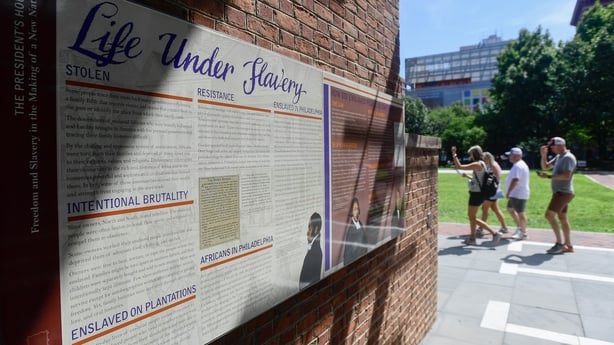
Most of these changes are still apparently pending or under review, but at the "President's House" in Philadelphia, one of the park service's most-visited sites, where George Washington lived in the early days of the US republic, signage about slavery was stripped in January.
That became the centre of a legal tussle after the city sued for its restoration and some panels have been restored, pending a court decision.
Fountain of contention
In Washington, attorney David Sobel last month sued to find out how the interpretive sign about Senator Francis Griffith Newlands was removed from the fountain near his home.
The placard, titled "What's in a Name?", had described Newlands's role in the late 19th century in developing the Chevy Chase neighbourhood, where property sales to Blacks and Jews were prohibited.
For years, politicians and residents in the wealthy neighbourhood sought to remove the original 1932 inscription that describes Newlands rather as a statesman who "held true regard for the interests of all men."
The interpretive sign was installed in 2022 as a compromise. But then, under Mr Trump, it was removed stealthily in late 2025, leaving just the original, weathered sandstone inscription.
Mr Sobel likened the sign's removal to "book burning" under Nazi Germany, but without the spectacle.
Here, "your information and history are being removed in the dead of night," he said. "And in some ways, I think that's even more frightening."
Asked about the removal, the Interior Department said it was implementing Mr Trump's executive order but provided no further details.
"The president has directed federal agencies to review interpretive materials to ensure accuracy, honesty, and alignment with shared national values," the department told AFP by e-mail.
Celebrating the Confederacy again
Mr Trump has also reverted to the previous titles of US military bases that were named for Confederate generals - the losing side that fought to keep slavery during the US Civil War.
Many such dedications and statues of Confederates were removed during the Biden administration in response to Black Lives Matters protests that rocked the country during Mr Trump's first term.
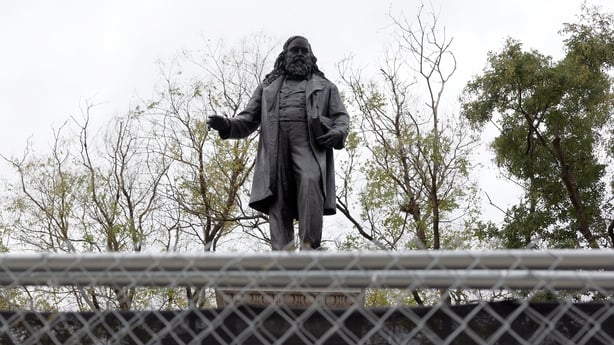
Last October, the only outdoor monument in Washington to honour a Confederate general - a statue of Albert Pike - was restored.
This April, a statue that had been removed in the state of Delaware in 2020 reappeared at Washington's central Freedom Plaza.
It depicts Caesar Rodney, who cast a clinching vote in the 1776 US Declaration of Independence from Britain but is viewed critically by some because he owned slaves.
The Interior Department said that as the 250th anniversary approaches on 4 July, the administration is committed to "acknowledging the full breadth of our nation's history."
But Alan Spears at the National Parks Conservation Association, an independent advocacy group, said the park service that has helped make history more accessible to Americans during the past quarter-century is now tasked with doctoring it.
"This notion of restoring truth and sanity is punitive. It's unnecessary. It's un-American, because great countries do not hide from their history. We learn from it," he said.
