


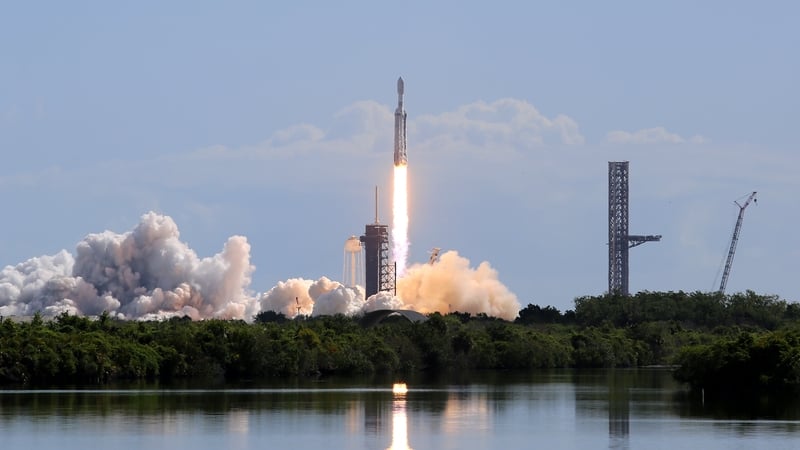
SpaceX has spent more than $15 billion developing its next-generation Starship rocket, according to the company's IPO registration reviewed by Reuters, a sum that dwarfs the cost of its workhorse Falcon rocket as Elon Musk’s space company nears a decade trying to perfect a fully reusable launch system.
The future of SpaceX’s most lucrative businesses as it sprints toward public markets at a $1.75 trillion valuation rests largely on Starship, a towering two-stage rocket system central to Musk’s ambitions to launch larger batches of Starlink satellites, carry humans to the moon and Mars, and eventually deploy thousands of artificial intelligence computing satellites as an alternative to power-hungry data centres on Earth.
The $15 billion figure, which has not been previously reported, eclipses the roughly $400 million SpaceX spent developing Falcon 9, the world's most frequently flown rocket.
Falcon 9 has underpinned SpaceX's commercial dominance, enabling rapid Starlink deployments and giving the company a wide lead over launch rivals.
"We have continued to invest significantly in further increasing our lead by pursuing full and rapid reusability at scale, including investing over $15 billion in our next-generation rocket, Starship," SpaceX said in its confidential IPO registration.
The company aims to begin launching its latest generation of Starlink satellites, known as V3, in the second half of 2026, according to the filing.
That is likely to be on Starship, whose payload bay was tailored for the upgraded satellites and can fit up to 60 of them in a single flight, SpaceX said in the filing.
That is a dramatic increase from the two dozen smaller Starlinks typically launched on Falcon, underscoring how tightly Starship's success is woven into the economics of Starlink.
Starship now consumes the bulk of the company’s development spending.
SpaceX devoted $3 billion to research and development in 2025 for its space segment, the entirety of which went to the Starship programme, the filing shows, a sharp jump from the $1.8 billion spent in that segment the prior year. The surge highlights how fundamentally different Starship is from Falcon and from any rocket that has come before it.
Starship suffers explosive failures
Since 2023, SpaceX has conducted 11 Starship test flights, producing both spectacular failures and eye-catching advances. Among the milestones was catching the rocket’s towering Super Heavy booster on its return to Earth using massive mechanical arms, a manoeuver designed to dramatically acceleratere usability.
Even with those gains, SpaceX acknowledged in its filing that several unprecedented hurdles remain before Starship can reach Musk's goal of "thousands of launches per year."
That launch rate, the company said, would be required to deploy 100 gigawatts of solar powered AI satellites annually, roughly a quarter of the energy consumed by the United States in a year.
"They’re getting really close," said Chris Quilty, president of Quilty Space, a space and satellite industry research firm. "But what we still don't know, and won't know for a while is, can they do it repeatedly?"
Among the most significant challenges facing Starship is building the vast ground infrastructure needed to support Musk's desired flight cadence, including fuel supplies, water systems and, for the core ship, a heat-shield capable of surviving repeated atmospheric re-entries.
A single Starship launch requires the equivalent of 244 tanker trucks of natural gas, according to a Federal Aviation Administration analysis. About one million gallons of water are used to suppress the rocket’s intense acoustic vibrations during liftoff.
"There is not enough water in the water system to support the launch of Starship" at such a scale, Quilty said.
Another formidable obstacle is in-orbit refueling, a risky and unproven process in which Starships dock with tanker versions of the vehicle to transfer fuel. The manoeuver would be essential for deep space missions and would itself require multiple Starship launches.
"That's probably the last big challenge," said Hans Koenigsmann, former SpaceX Vice President of Flight Reliability and one of the company’s earliest employees. "If that happens, then I think from then on it should be more or less, success."
The challenge is compounded by the propellant itself. Liquid oxygen must be kept at extremely low temperatures and tightly sealed to prevent it from seeping out into space.
"In-orbit refueling is complex, and we have not yet demonstrated or attempted it," SpaceX said in its filing.
"We may not be able to develop, commercialise, scale, or successfully implement these or other strategic initiatives on the timelines we currently anticipate, or at all," it added.
City of Stars
Over the past decade, SpaceX has built an extensive development site in South Texas, Starbase, dedicated to Starship. The facility supports a manufacturing push designed to produce rockets at a pace more akin to commercial aircraft than traditional space vehicles.
"When you build up your production before you actually have the product, you obviously run the risk that if you change your mind... every change on the rocket has a change on the factory now too," Koenigsmann said.
Testing failures have driven hundreds of design changes to the vehicle. Koenigsmann described Starship as "a totally different animal" from Falcon 9.
SpaceX is now preparing for its first Starship test launch since October, the programme's longest pause between flights. The mission will debut the Starship V3 prototype.
"Version 3 is basically a clean-sheet design of the ship," Charlie Cox, Director of Starship Engineering, said in a video SpaceX posted on X.
V3 Starship, with dozens of key upgrades, is tailored for orbital flight, longer-duration tests in space and crewed lunar landings, the rocket's most challenging type of mission for which NASA has paid SpaceX at least $3 billion under its Artemis moon programme.
"That Version 3 is what HLS is going to be based on," said Kent Chojnacki, Deputy Manager of NASA's Human Landing System programme. "A lot's gonna be dependent on this first flight."
