


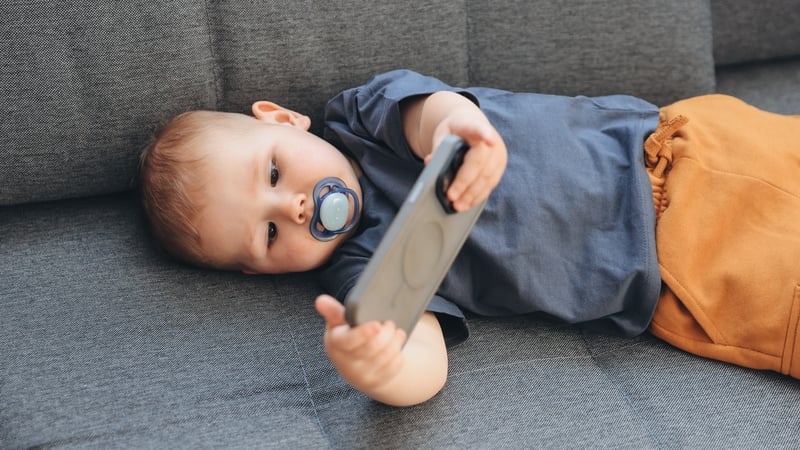
Nearly three in four (72%) nine-month-old babies have at least some screen time each day, a study has found.
Infants at this age who are only children are even more likely (80%) to experience at least some screen time, research from the UK's Education Policy Institute (EPI) found.
It comes as parents are set to be issued with British government guidance on how children under five should be using screens.
The EPI analysis found infants in single-parent households are watching for an average of 47 minutes a day, compared with 39 minutes a day for infants with two parents at home.
The average screen time reported for infants in the study was 41 minutes, but a small minority (2%) exceed three hours of screen time a day.
The infants in the latter group were significantly less likely to regularly experience things like going on trips outside, being read to or singing.
The study, which uses data from more than 8,000 families that took part in the Children of the 2020s cohort study, found a relationship between family income and the amount of screen time.
However, no pattern was found by family income and whether babies watch screens at all, or never do.
The average likelihood of parents looking at pictures in books with their infants daily was the same depending on whether the baby experiences no screen time, up to an hour or up to two hours.
The likelihood of looking at books together only falls when screen time exceeds two hours.
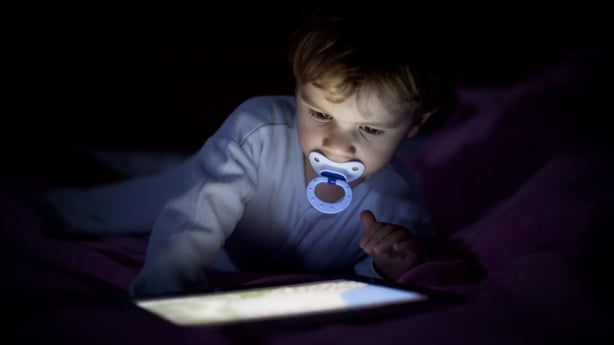
Four in five (80%) of babies with no daily screen time go on trips outside every day, compared with 76% who watch up to two hours.
This falls to three in five (60%) for babies with over three hours of daily screen time.
Dr Tammy Campbell, director for early years, inequalities and wellbeing at EPI, said the research suggests screen time and a healthy, active childhood are not necessarily mutually exclusive.
"Therefore a large part of the conversation needs to shift from 'how much' to ‘what’, and ‘why’. It’s about how and when a screen is being used for shared, interactive play, or for passive viewing.
"It’s about why use is high among the very small group of babies experiencing over three hours a day. Instead of simply focusing on demonising any use, and cutting minutes, policy-making and guidance should help families use digital tools to enhance development, bonding, and enjoyment of babyhood."
The UK government is expected to publish guidance on screen time for under-fives in April.
Announcing the research, the government said around 98% of children were watching screens on a daily basis by the age of two, and parents and teachers warned they were finding it harder to concentrate on learning when they started school.
Research has also found children with the highest screen time - around five hours a day - could say significantly fewer words than those at the other end of the scale who watched for around 44 minutes.
