


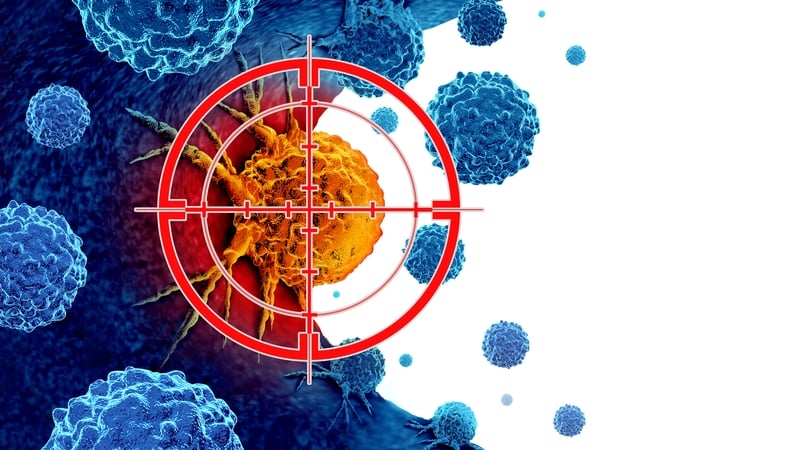
A new study led by Trinity College Dublin (TCD) shows how radiation therapy can be used to expose, and then eliminate, therapy-resistant prostate cancer cells using the body's natural killer cells.
Furthermore, the investigators found this approach also works on other types of cancer cells and may offer fresh hope for people being treated for other forms of therapy-resistant cancer.
The researchers have essentially developed a blueprint for turning cancer cell resistance into an exploitable vulnerability that makes them a softer target.
An international team from TCD and the Moffitt Cancer Center in the US has demonstrated a landmark "evolutionary double-bind" strategy to overcome treatment resistance in prostate cancer.
The idea of exploiting the way cancers evolve to tackle them has often been discussed in oncology conferences, but this study is the first to measure such a method using both lab experiments and detailed mathematical modelling approaches.
Many patients with metastatic cancers receive therapy that is initially highly effective, often resulting in complete remission.
However, cancer cells have a remarkable capacity to evolve resistance to currently available therapies.
As a result, resistant cells eventually proliferate causing the tumour to recur, leading to treatment failure and ultimately the death of the patient.
In other words, increasingly patients are dying because the disease evolves, with cancer cells adapting to and defeating treatments.
Lock on, attack and destroy
Scientists have now established that when cancer cells successfully evolve resistance to DNA damaging treatments, they expose a critical weakness that makes them highly vulnerable to immunotherapy.
This represents what is called an "evolutionary double-bind": the adaptation to one therapy makes the cancer cell more vulnerable to another therapy.
"The strategy is analogous to methods that might be used to control a rodent population in an agricultural field," noted Robert Gatenby, one of the senior members of the research team from the Moffitt Cancer Center.
"You might start by introducing owls," he explained, "but the rodents can adapt by hiding under bushes. Here, the addition of snakes represents an evolution double bind – rodents trying to escape the owls are vulnerable to the snake and, if they avoid the snakes by staying away from bushes, they are easy prey to the owls."
The team began by investigating how cancer cells become resistant to radiation therapy, a well-known phenomenon.
Their results are published in the International Journal of Radiation Oncology, Biology, Physics.
They discovered that these radiation-resistant cells increase proteins called "ligands" that are recognised by natural killer cells.
So the immune system can now lock on, attack and destroy the cancer cells.
The very adaptations that help cancer cells survive radiation simultaneously make them more sensitive to NK cell-mediated killing, creating the "evolutionary double-bind."
In lab experiments using multiple human prostate cancer cell lines, radiation-resistant cells proved up to twice as sensitive to NK cell killing compared with radiation-sensitive cells.
"Importantly, this work challenges a long-held assumption in cancer biology that resistance must come at a fitness cost," said Prof Cliona O'Farrelly, Professor of Comparative Immunology at TCD, and one of the senior authors.
"Our work shows that even when resistant cells grow faster than sensitive ones, a double-bind strategy can still be effective if the second therapy preferentially targets the resistance itself."
"This is very exciting as it also provides a blueprint for how we can intentionally steer tumour evolution, rather than simply trying to react to resistance after it emerges. It moves evolutionary therapy from a conceptual idea to a testable, quantitative treatment design strategy."
