


An extremely rare cycle of paintings depicting a raucous ritual involving the god of wine has been unearthed in the ancient Roman city of Pompeii, the archaeological site has said.
The world-famous site said it had excavated in recent weeks a nearly life-size frieze depicting the procession of Dionysus, the god of wine, painted on three sides of a large banquet room.
Known as a "megalography" from the Greek for "large painting", the frieze depicts a procession, with Dionysus joined by the bacchantes, his female followers.
They are portrayed both as dancers or as hunters, with slaughtered animals on their shoulders.
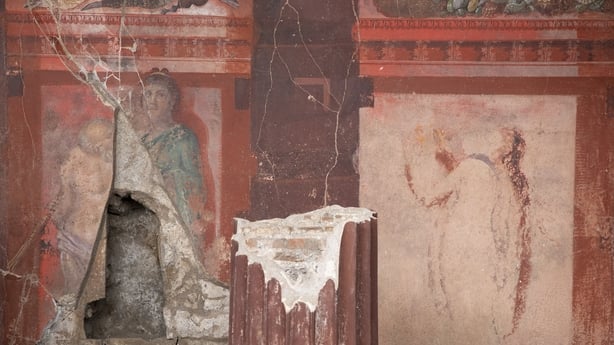
"Young satyrs with pointed ears play the double flute, while another performs a sacrifice of wine in acrobatic style, squirting wine behind him from a drinking horn into a patera (shallow bowl)," Pompeii said in a statement.
The frieze is painted in the second style of Pompeian painting, which is known for its addition of architectural details like pillars.
It dates from about 40 to 30 BC, making it over 100 years old by the time of the eruption of Vesuvius 79 AD that destroyed the city.
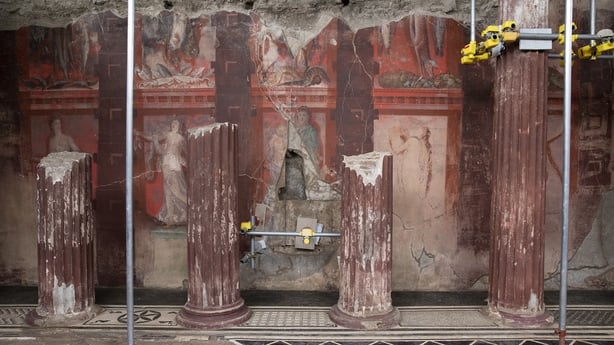
A woman at the centre of the frieze "is about to be initiated into the mysteries of Dionysus, the god who dies and is reborn and who promises the same destiny to his followers", it said.
These initiation rituals, required in antiquity to join such cults, often promised "a new blissful life, both in this world and in the afterlife."
Hunting figures prominently in the rite depicted in the frieze, with another smaller frieze above the principal one depicting animals, alive and dead, a gutted wild boar, various birds, and fish.
"It is an exceptional historical document, said Italian Culture Minister Alessandro Giuli.
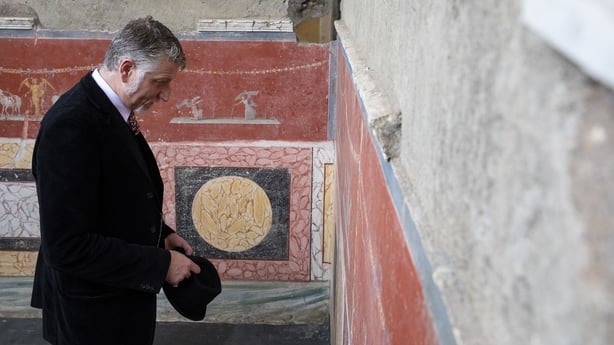
Its discovery makes Pompeii "an extraordinary testimony to an aspect of life in classical Mediterranean life that is largely unknown," he said.
When Vesuvius erupted, the spouting ash and rock helped preserve many of Pompeii's buildings almost in their original state.
Pompeii is now a UNESCO World Heritage Site and the second most-visited tourist site in Italy, after the Colosseum in Rome.
