


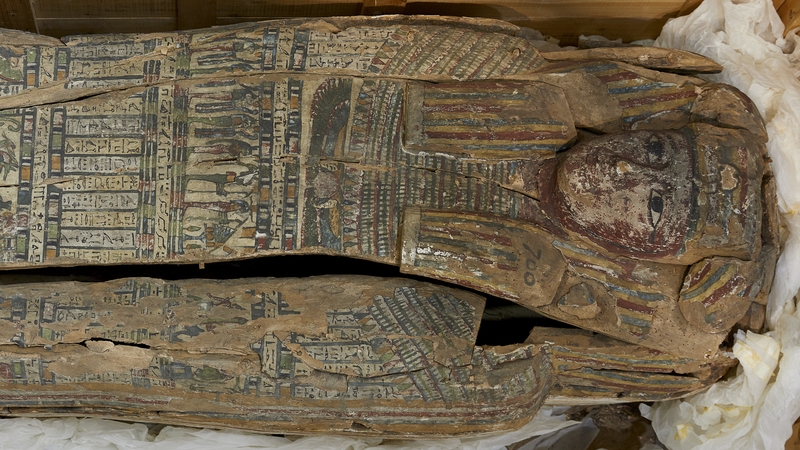
A delicate operation to return an Egyptian mummy and a sarcophagus to Cairo cost University College Cork more than €34,000.
The mummy and its ancient wooden sarcophagus were donated to the college in 1928 though exactly how they came to be in Cork is still a mystery.
A database of costs shows that just over €33,000 was spent on safely packing up the delicate remains for transport to Egypt late last year.
A sum of €7,927 was spent on packing materials and conservation materials including solvent, adhesive, foam and tissues.
That also included the cost of specially designed cushions by a conservation expert and the hire of pallet trucks for careful removal of the precious cargo.
A further €14,000 was spent on a caged pallet and for transport of the sarcophagus from Cork to Dublin last year.
UCC said other bills included €4,615 for the manufacture of a special crate and 29 "really useful boxes" for the operation.
There were other bills of €5,918 for crate deliveries and the hiring of technicians to help move them to Dublin Airport.
The university also incurred costs of €960 for one of their senior staff to accompany the items back to Egypt and a two-night stay there.
An information note said: "Under the agreement between UCC and the Egyptian authorities regarding repatriation of cultural objects, the objects concerned ceased to be the property of the university once they had left [our] premises.
"UCC was therefore not responsible for any costs incurred thereafter, apart from the [staff] flight and accommodation expenses."
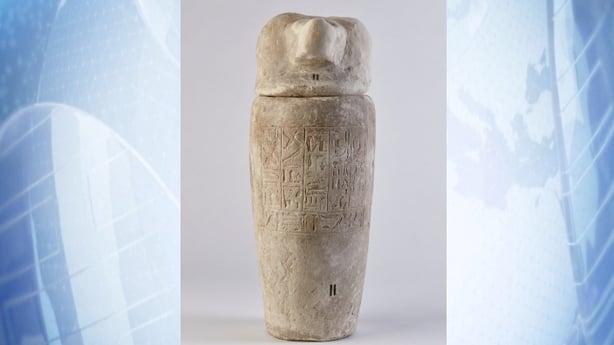
As well as the mummy and sarcophagus, four Canopic jars along with items of cartonnage (coverings) were repatriated.
The sarcophagus is believed to date from around 600 BCE with an inscription indicating it was for a man named Hor.
It had painted decorations on its lid that depicted the procession of the gods and prayers that Hor would have eternal life.
It was excavated in the early 1900s from tombs in the Valley of the Queens and may have been sold through the 'Salle de Vente' saleroom of the Egyptian Museum after.
The mummified remains are not believed to be 'Hor' but are thought to be an adult male of around 50 years of age and roughly 1.65m (5'5") in height.
A statement from UCC at the time said: "Testing done on the wrapping of the remains date it at around 305 BCE to 500 AD, meaning the sarcophagus pre-dates the human remains by several centuries."
The four jars were bought from a British antique dealer between 1911 and 1912 and were the oldest items of the collection with an estimated date of between 945 and 700 BCE.
