


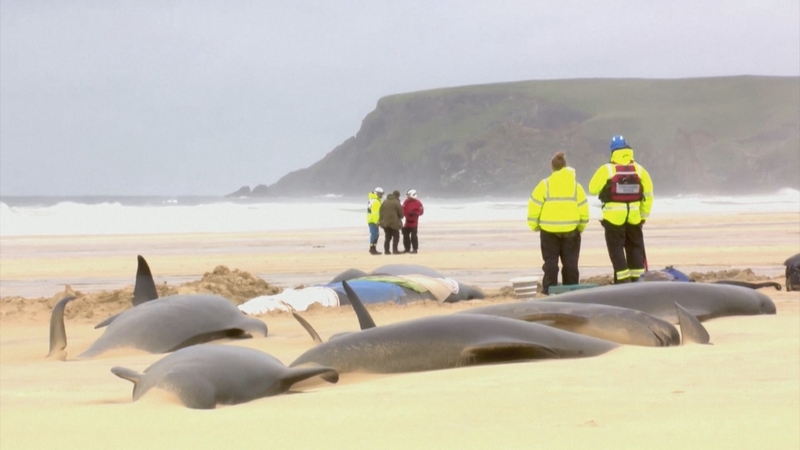
More than 50 pilot whales have died in Scotland after being stranded on a beach on the Isle of Lewis; the largest mass stranding in the country in decades.
Authorities were alerted to the incident on Sunday morning and subsequent attempts to refloat more than a dozen living whales were unsuccessful.
Dr Andrew Brownlow from the Scottish Marine Animal Stranding Scheme (SMASS) told BBC's Good Morning Scotland the 55 whales that were washed ashore at Tràigh Mhòr in North Tolsta on Sunday was one of the biggest mass strandings the organisation had ever dealt with.
Initial reports suggested there were around 55 animals, consisting of both adults and calves. However it was soon discovered that only 15 were still alive.
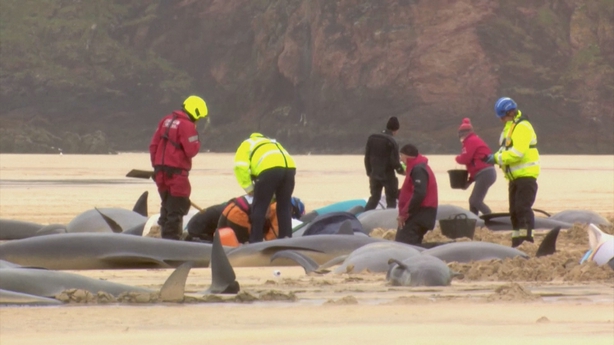
Rescuers later decided to euthanise the remaining stranded whales on welfare grounds. In total 55 whales died, and one is believed to have survived.
Dr Brownlow said: "In terms of the number of casualty animals, this is the biggest one we've had. This is one of the biggest pilot whale mass strandings we've ever dealt with."
Work will be undertaken to determine the cause of the pod's death by SMASS and led by Dr Brownlow.
While the exact cause is currently unclear, Dr Brownlow said SMASS had a "fairly clear idea" the whales could have come onto a "very shallow" beach in quite bad weather.

The charity British Divers Marine Life Rescue (BDMLR) said one female was found with a vaginal prolapse and it suspected that the whole pod was stranded after one whale suffered birthing complications.
"Pilot whales are notorious for their strong social bonds, so often when one whale gets into difficulty and strands, the rest follow," BDMLR said.
Dr Brownlow said there was still a backlog of post-mortem examinations to take place on animals from previous mass strandings and that determining the cause of death will be a "monumental task".
He said: "What we will try and do is triage these animals.
"We will select the animals we think best represent the rest of the pod and make sure we take samples and as much data from those as we can. Then it's simply a race against time, energy, and weather.
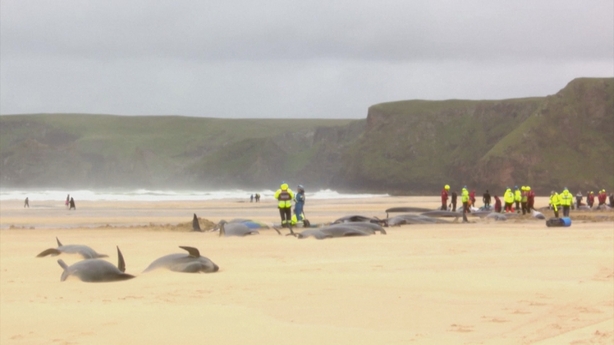
"We will do the most we possibly can to find out what's going on here."
The whales will be taken to a landfill site in Stornoway to be worked on and Dr Brownlow said they would be buried after the post-mortem examinations were complete.
