


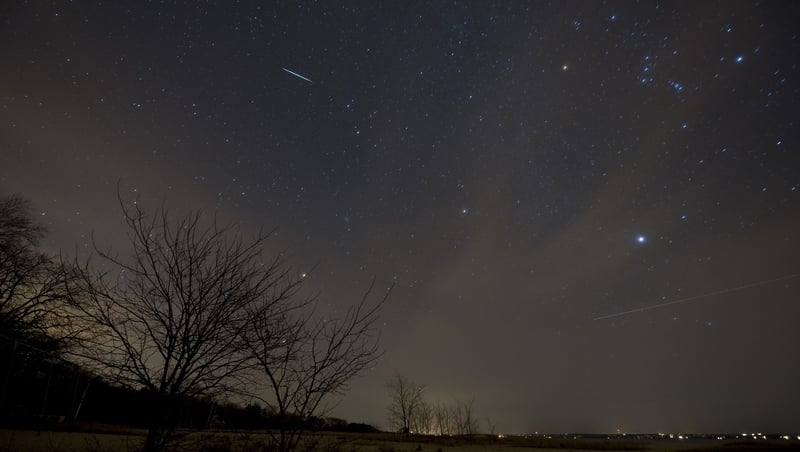
The "best meteor shower of the year" peaks over tonight and Wednesday night, according to Astronomy Ireland.
People all over the Ireland have the opportunity to catch glimpses of "fireballs blazing across the sky" as up to 20 times more shooting stars than normal can be seen.
Astronomy Ireland is asking members of the public to count how many meteors they can see every 15 minutes and send them to its website for publication in its magazine.
The Geminid meteors can appear anywhere in the sky and are are caused by tiny pieces of space debris.
They are bits of dust that fell off a small extinct comet or asteroid called Phaethon that goes around the Sun every one-and-a-half years.
"It has probably been around the Sun thousands of times and has spat out dust particles that have now spread all around its orbit." said founder of Astronomy Ireland David Moore.
The meteors are named due to the fact their paths all trace back to the Gemini constellation.
Mr Moore said the Perseid shower in August has "declined somewhat" leaving the Geminid shower on top.
"It is only because of members of the public monitoring this shower that we know that the Geminids in December is the best of the year" founder David Moore said.
"This is also good news for the public because that August shower cannot be well seen until 11pm but the Geminids begins as soon as it gets dark, around 5pm and runs until dawn." he said.
Astronomy Ireland said the Moon is out of the way until 10pm this year so those in rural areas will get views until then but city dwellers will still see plenty as the Geminids are known for producing bright fireballs.
"You should fill your field of vision with sky. This may involve craning your neck back so you can barely see the horizon at the bottom of your field of vision. A deck chair or sun lounger is ideal for this. Even a blanket on the ground," it said.
Those venturing outside for the meteor shower are advised to wrap up well as temperatures drop.
The Geminid meteor shower lasts for about two weeks between 4 December and 20 December.
The shower peaks around midday on Wednesday so rates will be highest tonight and tomorrow.
The best viewing will be from a dark location after midnight as with all showers, but people are asked to start watching from 6pm to participate in Astronomy Ireland's count.
