


Small rocket builder Rocket Lab is gearing up for a mission in the coming days that would typically only be imaginable in a big-budget action movie: catching a four-storey-tall rocket booster out of the sky with a helicopter.
The California-based company is one of the latest launch firms trying to slash the cost of spaceflight by reusing its rockets after sending satellites to orbit, a trend pioneered by Elon Musk's SpaceX and its fleet of Falcon 9 rockets.
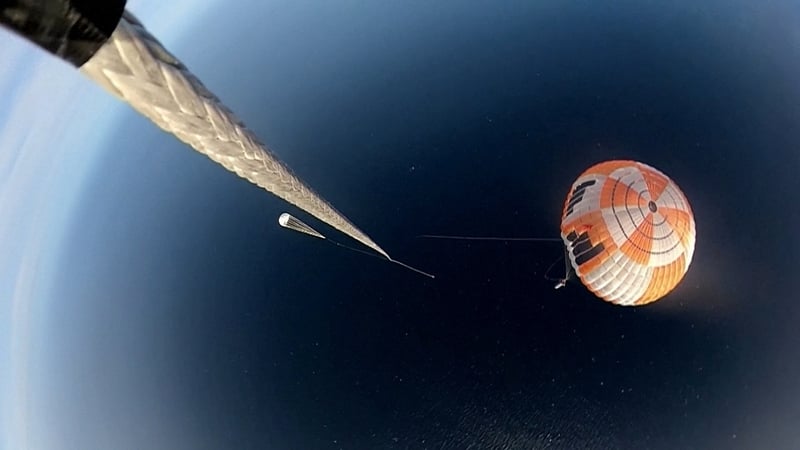
But unlike the Falcon 9, which reignites its engines to return to Earth vertically on a slab of concrete, Rocket Lab's smaller Electron rocket aims to demonstrate a novel approach in which a rescue helicopter with two pilots will attempt to pluck the 39-foot-tall booster stage from mid-air using a combination of ropes, parachutes, heatshields and complex computer algorithms.
Small rocket builder Rocket Lab is gearing up for a mission in the coming days that would typically only be imaginable in a big-budget action movie: catching a four-story-tall rocket booster out of the sky with a helicopter | Read more: https://t.co/rHDVoOAjky pic.twitter.com/0N1ZcFdDYa
— RTÉ News (@rtenews) April 28, 2022
"It's an exciting thing," Rocket Lab chief executive Peter Beck said, adding the rocket recovery test is no more nerve-racking to him than other endeavours in space flight: "If we don’t get it this time, we’ll learn a bunch and we’ll get it the next time, so I’m not super worried from that perspective."
"But I’m pretty confident that if the helicopter pilots can see it, they’ll catch it," he added.
Those pilots have been training for years across some 10 capture tests that involved dummy objects standing in for the first stage booster, which Mr Beck said is the most expensive part of the rocket worthy of recovering, refurbishing in Rocket Lab's New Zealand facilities, and ultimately reusing for another mission.
"If we can use a rocket twice, then we’ve just doubled our production, and that's awesome," he said.
Hinging on good weather conditions, the capture test is planned for tomorrow evening Eastern time, or Saturday morning off the coast of Mahia, New Zealand, the location of Rocket Lab's primary launch site.
Mr Beck said engineers will examine the rocket booster in detail if the recovery attempt goes as planned, which will inform how quickly the Rocket Lab plans to refurbish future boosters before they can refly.
Rocket Lab went public in 2021 in a blank-check merger led by Vector Capital that valued the company at $4.1billion (€3.8million), following similar moves by other younger, publicly traded small launch rivals in an increasingly competitive field that includes Astra Space and Richard Branson's Virgin Orbit.
Rocket Lab has launched roughly two dozen missions to orbit for a mix of government and commercial customers.
The helicopter capture test will take place after the company's Electron rocket sends 34 small satellites to space for a group of companies in a so-called rideshare mission that Rocket Lab named There and Back Again, a pithy reference to the recovery attempt.
After the first stage booster launches to space and releases its satellite-topped second stage on a path toward orbit, it will reorient itself for a blazing descent back toward Earth and reach speeds eight times the speed of sound as it reenters the atmosphere along a narrow path to rendezvous with the helicopter, which is equipped with onboard computers tracking the rocket's location.
The booster stage will deploy a series of parachutes to brake its speed. Pilots will steer the helicopter, dangling a long cable underneath, toward parachuting booster, hook onto it and carry it back to land.
"Every piece we’ve successfully tested individually, now it’s just an orchestra to conduct," Mr Beck said of all the "moving parts" of the test. "We’re feeling good about it, but there’s lots of variables."
