


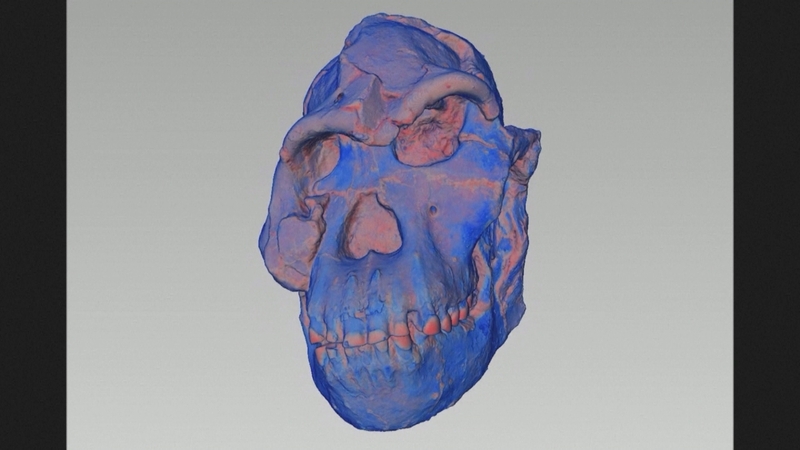
Sophisticated scanning technology is revealing intriguing secrets about Little Foot, the remarkable fossil of an early human forerunner that inhabited South Africa 3.67 million years ago during a critical juncture in our evolutionary history.
Scientists have examined key parts of the nearly complete and well-preserved fossil at Britain's national synchrotron facility, Diamond Light Source.
They gained insight not only into the biology of Little Foot's species but also into the hardships that this individual, an adult female, encountered during her life.
Little Foot's species blended ape-like and human-like traits and is considered a possible direct ancestor of humans.
University of the Witwatersrand paleoanthropologist Ron Clarke, who unearthed the fossil in the 1990s in the Sterkfontein Caves northwest of Johannesburg and is a co-author of the new study, has identified the species as Australopithecus prometheus.
"The importance of it is not only that it is the only complete skull of an Australopithecus from anywhere, but it is the only one with a complete skeleton as well. Furthermore, it is the oldest Australopithecus in southern Africa dating to 3.67 million years ago. So it tells us a lot about our early ancestry," said Clarke.
Little Foot's skull was examined at the Diamond Light Source facility in Oxfordshire, home to Britain's synchrotron, a particle accelerator in which beams travel around a closed-loop path.
Electrons are accelerated to near light speeds until they emit light 10 billion times brighter than the sun, then directed into laboratories in 'beamlines' which allow scientists to study minute specimens using x-ray beams in extreme detail without damaging them.
The scanning focused upon Little Foot's cranial vault - the upper part of her braincase - and her lower jaw, or mandible.
"The bone microstructure looked amazing because we can really see the different tissues; the proportions, the thickness and also the size of the different canals. So all of these make, for me, Little Foot a living person. So it was really moving for us, and so we are really happy to see that we were right in saying that the synchrotron could really help us in analysing Little Foot," said University of Cambridge paleoanthropologist Amélie Beaudet, who led the study published in the journal e-Life.
While Little Foot's precise age has not yet been determined, her teeth provided some clues. The researchers spotted defects in the tooth enamel indicative of two childhood bouts of physiological stress such as disease or malnutrition.
Little Foot, whose moniker reflects the small foot bones that were among the first elements of the skeleton found, stood roughly 4-foot-3-inches (130cm) tall.
The fossil has been compared in importance to the fossil called Lucy that is about 3.2 million years old and less complete.
Both are species of the genus Australopithecus but possessed different biological traits, just as modern humans and Neanderthals are species of the same genus - Homo - but had different characteristics. Lucy is a member of the species Australopithecus afarensis.
Our own species, Homo sapiens, first appeared roughly 300,000 years ago. The synchrotron findings build on previous research on Little Foot.
The species was able to walk fully upright, but also had traits suggesting it also still climbed trees, perhaps sleeping there to avoid large predators.
It had gorilla-like facial features and powerful hands for climbing. The species had legs longer than the arms as do modern humans, making this the most-ancient hominin definitively known to have that trait.
"We're not saying that Little Foot represents a direct ancestor to modern humans, but certainly a relative, certainly a very close relative of our ancestors," said Clarke.
Courtesy: Diamond Light Source
