
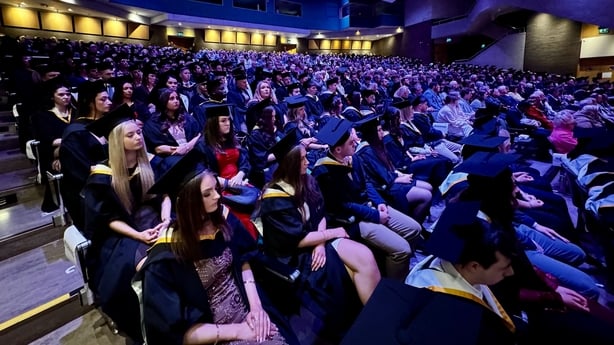
Thirteen Travellers were conferred with postgraduate diplomas and master's degrees at conferring ceremonies at the University of Limerick today.
It is the largest cohort of Travellers/Mincéirí to graduate with level 9 postgraduate qualifications from any Irish university at any one time, making this a significant milestone for the Traveller community in Ireland and University of Limerick.
Of the 13 Travellers to graduate with a Master’s or Graduate Diploma in Sociology, 11 are Traveller women connected with the Limerick Traveller Network.
There is a low level of participation by Travellers in higher education in Ireland, with just 4.7% graduating from third-level education in comparison to 47.7% of the general population. Just 2% of Travellers have obtained degrees.
The UL Mincéir/Traveller Programme was created in 2023 and based on the principle of co-creation, the programme supports are designed and developed based on the needs identified by the Traveller community.
In 2024, a collaboration was established between UL and the Limerick Traveller Network, a community-led network of Traveller representatives from across Limerick.
Fourteen women from eight Traveller sites and two standard housing areas in Limerick have been central to the work of the LTN with education identified early on as a key priority by LTN founders, Olive O’Reilly and Margaret O’Brien, both of whom graduated from UL today along with 10 others from the Limerick Traveller Network.
Margaret O’Brien was conferred with a BA in Psychology while Olive O’Reilly is one of 11 Traveller women connected with the LTN to graduate from UL’s MA in Sociology (Youth, Community and Social Regeneration).

Dr Sindy Joyce, a Human Rights Defender is Course Director of the MA in Sociology at UL and was the first Irish Traveller to graduate with a PhD in Ireland when she was conferred with her doctorate from UL in 2019, the same year that Olive O’Reilly and Margaret O’Brien established the Limerick Traveller Network.
"As a Traveller, an academic and Course Director of UL’s MA in Sociology, I am immensely proud of all my students graduating today," Dr Joyce said.
"This master’s has existed in UL for 15 years and has successfully trained students to work in a wide variety of settings in the youth and community sectors. With a strong international element, the MA attracts students from all over the world, including recent graduates as well as those already working in the NGO sector.
"I am particularly proud to have 13 of the students graduating from this year’s cohort coming from my own community, which shows me how our education system, once harmful to Travellers, can now be a tool of resistance.
"Historically, for Travellers, the Irish education system was about changing our culture and leaving our identity behind but today highlights that our culture is not in conflict with our education system. Traveller voices and knowledge belong in our university spaces, and our epistemologies bring important methods and frameworks to research.
"Each Traveller graduating today makes it a little bit easier for our younger generation to engage with a system that was once so harmful to our community.
"I feel such pride today to celebrate this important milestone for our Traveller students who have shown courage, endurance and determination throughout their time here in UL."
Olive O'Reilly described today as a proud moment for the wider Traveller community in Limerick.
Olive left school at the age of 12 and returned to education in 2006 to complete a Diploma in Women's Studies at UL before embarking on her master’s journey in 2024.
She has devoted many years of her life to advocating and supporting her community on a voluntary capacity and is extremely passionate about human rights.
"Third-level qualifications play a critical role in improving access to employment and career progression for members of the Traveller community.
"Of the 11 women who completed the master’s programme at UL, one was already in employment, and four graduates have since secured employment, highlighting the direct impact of education on achieving employment and independence," Ms O'Reilly said.
"Our achievements today show to Travellers across the country that anything is possible if you believe in yourself and put your mind to it."
We need your consent to load this rte-player contentWe use rte-player to manage extra content that can set cookies on your device and collect data about your activity. Please review their details and accept them to load the content.Manage Preferences
Ellen O’Reilly, who also graduated from UL today with a Master’s in Sociology, left school at 15.
"Passing my master’s as a Traveller woman and a mother-of-four fills my heart with pride.
"There were moments I doubted myself, but I kept going. I did this for my children, for my community, and for every young Traveller who needs to see that their dreams are possible."
Margaret O’Brien, co-founder of the Limerick Traveller Network, who graduated with a BA in Psychology from UL, spoke of the significance of this momentous occasion for the Traveller community in Limerick.
"The Limerick Traveller Network doesn’t just open doors, we walk through them together and leave them wide open behind us.
"Today the LTN celebrates 12 of our members graduating at UL, the home of firsts that awarded the first PhD to a Traveller. Now the first university in Ireland to award 13 Travellers with postgraduate qualifications, 11 of whom are members of the LTN.
"This is not just a milestone for the LTN and UL, but one that raises the bar for Travellers nationwide, with 7 more Travellers from the Limerick Traveller Network now studying at postgraduate level in UL following in the footsteps of our members graduating today."
We need your consent to load this rte-player contentWe use rte-player to manage extra content that can set cookies on your device and collect data about your activity. Please review their details and accept them to load the content.Manage Preferences
The Mincéir/Traveller Programme is led by the UL Access Office, which is committed to supporting the Mincéir/Traveller community through the dedicated role of a Mincéir/Traveller Coordinator.
Edel O’Donnell, UL’s Mincéir/Traveller Coordinator, said: "The determination and achievement of each Traveller graduate, whose success not only marks their own personal milestone but contributes to widening participation and representation within higher education, stands as a powerful example of what is possible when individual lived experience is recognised, respected and valued within academic spaces."