


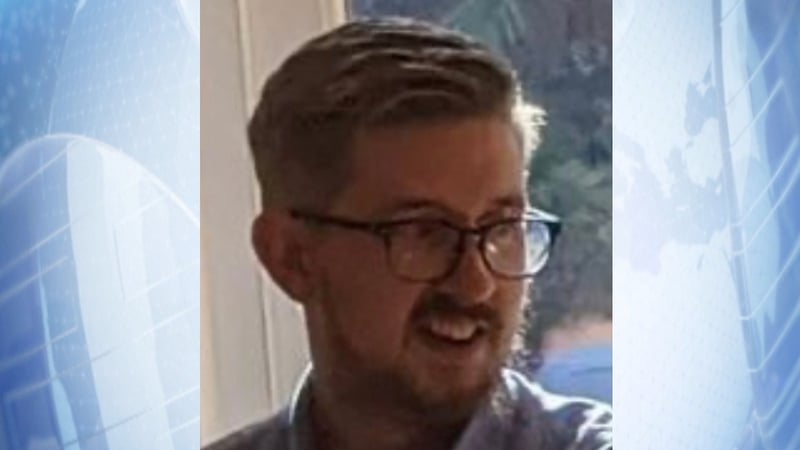
A widow has told an inquest that her husband went to Cork University Hospital with agonising chest pain, spent hours sitting on a chair waiting for treatment and died of a ruptured aorta amid a delayed diagnosis because of a broken CT scanner.
Cork University Hospital (CUH) has apologised "unreservedly and sincerely" for "failings in care" during the admission of father of one Patrick (Pat) Murphy, 34, on 1 September 2021.
The hospital has also apologised for the failings in care by staff onsite to diagnose an aortic dissection.
Mr Murphy had waited nine hours before getting a bed, but as some hospital notes went missing, his family fear that he received very little in the way of appropriate care before his condition became life threatening.
Mr Murphy, who was a chemical engineer, took a taxi from his home in Riverstown, Glanmire, Co Cork as the ambulance service informed his wife Keerti Krishnan Murphy that they were delayed.
Ms Krishnan Murphy had made an emergency call on the evening of 1 September 2021 having been in contact with South Doc about her husband's symptoms.
Ms Krishnan Murphy told Cork Coroner’s Court that her husband became unwell whilst they were watching the Ireland V Portugal World Cup qualifying match at their home.
"I remember him getting animated in our sitting room, nothing I’d hold my breath about. Cristiano Ronaldo was going to score a goal and Pat was telling him off.
"I saw him quietly retreating to our couch, his hands clutching his chest. He walked it off pacing our small front room. He sat back down, then he held his neck.
"He told me that he wasn’t feeling okay and we should call South Doc. It isn’t like Pat to ask for a doctor until something frightened him or was seriously wrong".
Ms Krishnan Murphy said that she called an ambulance and that the doctor at South Doc told her that this was the right decision as it "might be a cardiac related event".
The couple waited for around forty minutes for an ambulance before deciding to book a taxi. When Mr Murphy was in the taxi, the couple received a call that the ambulance could not make it.
Ms Krishnan Murphy said that their 17-month-old son Rohan had been in contact with a young child who had tested positive for Covid-19 at créche, and she needed to test herself for Covid-19 before she could go into the hospital.
She said that her husband kept her updated of what he was happening at the hospital.
"Five to one in the morning Pat was dropped off at the A and E in CUH. I spoke to him slightly later that morning. He told me about the agony he was in.
"To sit on a chair was agony for him and needing to at one point, lay on the ground, to find any bit of relief. Busy nurses walking around him, requesting him to be seated, leaving him laying there when he explained his pain.
"It had been nine hours from his arrival until he was given a bed. I got texts and calls that day with updates — urine tests and a (CT) scan to determine kidney stones.
"The scan, had to be pushed out to the following day, as the one in A and E was broken."
The inquest heard that one of the two CT scanners at the hospital was broken on the night of the incident.
Ms Krishnan Murphy said that on the evening of 2 September, 2021 an urgent CT scene was arranged at CUH which confirmed a Type A dissecting aortic aneurysm, which had ruptured.
She said that the emergency surgery was unsuccessful, and Mr Murphy died the following day.
Following the death of her husband Ms Krishnan Murphy carried out a lot of research into aortic dissection which is a tear in the inner layer of the aorta, resulting in separation of the layers of the aorta.
Ms Krishnan Murphy said that rapid diagnosis and treatment is vital to ensure the survival of the patient.
She said that she was left haunted and scarred by what the hospital informed her at meetings following the death of her husband.
"We were told of nine hours waiting, not having timely access to functioning scans, that could have rerouted the misdiagnosis (of kidney stones) and missing pages of observation.
"The hospital said that they could not guarantee that the same thing would not happen again.
"I have heard through the Aortic Dissection Charitable Trust, that with proper intervention and well documented symptoms, many lives could be saved".
Ms Krishnan Murphy said that her "caring partner" who was a "doting father" could have been saved with timely interventions
"No one should experience the traumatic course of events. My grief is still bitter, wondering how different things might have been."
She told Coroner Philip Comyn that she would never forget what her husband looked like after his emergency operation.
"He was hooked up to monitors, a tube through his mouth. His body seemed swollen.
"A nurse slipped her hand in mine suggesting I call a priest. I was directed by the priest to kiss Pat’s forehead and whisper that I love him, and that Rohan loves him too. Then I heard the monitors flatline for the last time.
"I felt the pain and anguish ripping through my body. I could barely keep my footing. My home was where Pat and my boy were, and now our home will always feel incomplete".
She said that she wants lessons to be learned from the death of her husband.
"I am not convinced the lessons are fully understood or registered.
"I want learnings to come from this. It (aortic dissection) is survivable once detected".
'Truly sorry for what has happened'
In a statement, management at CUH said that a review of the care of Mr Murphy highlighted that a "number of elements" were not delivered as "promptly as they should have been."
The hospital apologised for these "deficiencies".
"We do not underestimate the devastating impact of the passing of Patrick on you and your family and on behalf of Cork University Hospital, we are truly sorry for what has happened.
"We can assure you that lessons have been identified and shared across CUH to ensure that our clinical training processes are strengthened to avoid such a tragic outcome for others in future".
Yvonne Murphy, Mr Murphy’ sister, read out a statement on behalf of her parents Noreen and Willie and her siblings.
She described her brother Pat as an "extraordinary individual" who had a natural charisma which lit up every room.
He met his beloved wife at Lancaster University where he completed a PHD in chemical engineering.
"Pat was the glue which held our family together. His absence has left a void in our hearts which can never be filled".
Ms Murphy said the family were disturbed when they were informed that certain medical records were missing from her brother’s file. She said that they attribute his death to "gaps in the system" at the hospital.
"Under different circumstances Pat could be with us today," she said.
Barrister Doireann O’Mahony, Junior Counsel for the family said that it was "very important for Keerti that learnings are made from this diagnosis".
"Aortic dissection is detectable, treatable and survivable. The Murphy family have been through hell and back. Keerti doesn’t want other families to go through this," she said.
John O’Mahony, Senior Counsel, also representing the family said that when Mr Murphy presented at the hospital he was triaged as category 3, which meant that he should have been seen within an hour.
He said that "despite intense crippling pain, several hours passed" and he was not medically examined.
Dr O’Mahony added that "valuable time" was lost in which the life of Mr Murphy could have been saved.
The inquest heard that Mr Murphy had completed several marathons and was without a history of illness.
Consultant neuroradiologist at CUH Dr Gerald Wyse said that one of the two CT scanners at CUH was not functioning for a period of 21 hours when Mr Murphy was in hospital.
Dr Wyse said that even if Pat had gone for the CT KUB scan in the first instance it would not have shown the aortic dissection.
He said that both of the CT scanners which were in place at CUH in 2021 have been replaced. Dr Wyse said that a third CT scan has also been purchased. He indicated that if they were given six CT scanners they "would take them".
The inquest continues tomorrow.
