


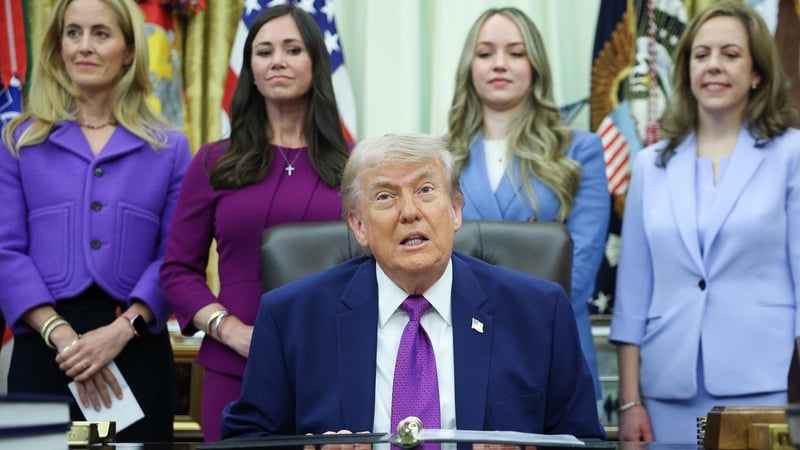
US President Donald Trump has said Iran's peace proposal is "stupid", and described the ceasefire as being on "massive life support".
Days after the US floated an offer in the hopes of re-opening negotiations, Iran yesterday released a response focused on ending the war on all fronts, especially Lebanon, where US ally Israel is fighting Iran-backed Hezbollah militants.
Tehran also included a demand for compensation for war damage and emphasised Iranian sovereignty over the Strait of Hormuz, Iranian state TV said.
It also called on the US to end its naval blockade, guarantee no further attacks, lift sanctions and end a US ban on Iranian oil sales, the semi-official Tasnim news agency said.
Within hours, Mr Trump dismissed Iran's proposal, describing it as "totally unacceptable".
Speaking at the Oval Office this afternoon, Mr Trump said it was a "stupid proposal" and that the ceasefire between the two counties was on "massive life support".
"The ceasefire is on massive life support, where the doctor walks in and says, 'sir, your loved one has approximately a one percent chance of living,'" he told reporters.
"I would call it the weakest right now, after reading that piece of garbage they sent us. I didn't even finish reading it."
He also said he was still aiming for a "complete victory" in the war against Iran.
"We're going to have a complete victory," he said, adding that Iran thinks "I'll get tired of this. I'll get bored, or I'll have some pressure. But there's no pressure".
Iran only demanding its legitimate rights, spokesman says
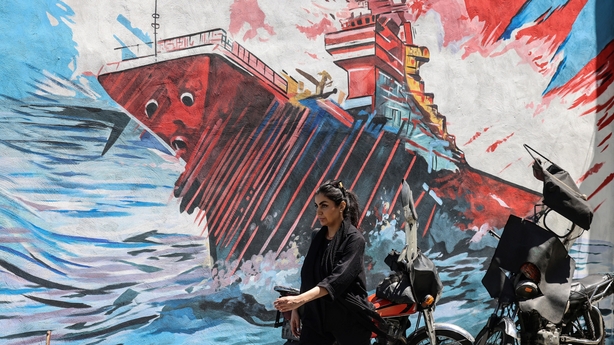
Speaking this morning, Iran's foreign ministry said it had called for an end to the war across the region and the release of frozen assets abroad.
"We did not demand any concessions. The only thing we demanded was Iran's legitimate rights," said ministry spokesman Esmaeil Baqaei in a weekly press briefing.
He said Iran's demands included "an end to the war in the region", ending the US naval blockade, and the "release of assets belonging to the Iranian people, which have for years been unjustly trapped in foreign banks".
Iran's parliament speaker Mohammad Baqer Qalibaf said that Iran's armed forces are ready to respond decisively to any "act of aggression".
Mr Trump has repeatedly threatened to end the ceasefire between the two countries since it took effect on 7 April. But he has also sought to downplay tensions following a series of naval clashes last week.
Brent crude oil futures traded 2.7% higher at around $104 a barrel today, as the deadlock left the Strait of Hormuz largely closed.
Before the war began on 28 February, the narrow waterway carried one-fifth of the world's oil and liquefied natural gas, and has since become a central pressure point in the conflict.
Disruption caused by the near-closure of the strait has forced oil producers to cut exports, and OPEC oil output dropped further in April to the lowest in more than two decades, a Reuters survey showed today.
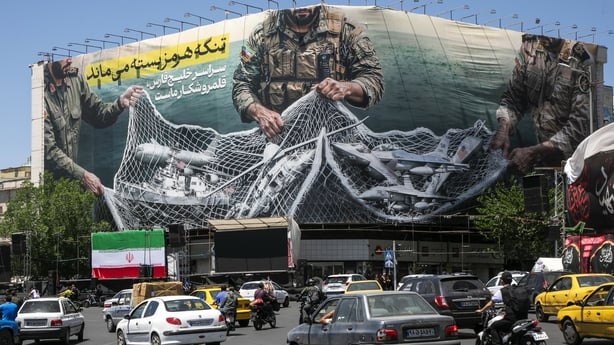
Traffic through the Strait of Hormuz is at a trickle compared with before the war. Shipping data on Kpler and LSEG showed that three tankers laden with crude exited the waterway last week, with trackers switched off to avoid an Iranian attack.
A second Qatari LNG tanker was attempting to transit the strait, the data showed, days after the first such cargo crossed under an arrangement involving Iran and Pakistan.
Sporadic flare-ups around the strait in recent days have tested a ceasefire that has paused all-out warfare since it took effect in early April.
"The oil market continues to trade like a geopolitical headline machine, with prices swinging sharply based on every comment, rejection, or warning coming from Washington and Tehran," said Priyanka Sachdeva, senior market analyst at Phillip Nova.
In the US, surveys show the war is unpopular with voters facing sharply higher gasoline prices less than six months before nationwide elections that will determine whether Mr Trump's Republican Party retains control of Congress.
He said today that he backs reducing the 18-cent federal gasoline tax "till it's appropriate".
Waiving the tax requires Congress, currently controlled by his fellow Republicans, to pass legislation.
Two out of three Americans surveyed - including one in three Republicans and almost all Democrats - think Mr Trump has not clearly explained why the country has gone to war with Iran, according to a Reuters/Ipsos poll completed today.
Washington has also struggled to build international support, with NATO allies refusing to send ships to reopen the waterway without a full peace deal and an internationally mandated mission.
Hakan Fidan, the foreign minister of Turkey, which has been liaising closely with the US, Iran and mediator Pakistan since the start of the war, will hold talks in Qatar tomorrow on the conflict and on ensuring navigational safety in the strait, a Turkish diplomatic source said.
We need your consent to load this rte-player contentWe use rte-player to manage extra content that can set cookies on your device and collect data about your activity. Please review their details and accept them to load the content.Manage Preferences
Trump set to discuss Iran in Beijing
Mr Trump is expected to arrive in Beijing on Wednesday.
With mounting pressure to draw a line under the war and the global energy crisis it has ignited, Iran is among the topics Trump and Chinese President Xi Jinping are set to discuss.
Mr Trump has been leaning on China to use its influence to push Tehran to make a deal with Washington.
Addressing whether combat operations against Iran were over, Mr Trump said in remarks aired yesterday: "They are defeated, but that doesn't mean they're done."
Israeli Prime Minister Benjamin Netanyahu said the war was not over because there was "more work to be done" to remove enriched uranium from Iran, dismantle enrichment sites and address Iran's proxies and ballistic missile capabilities.
The best way to remove the enriched uranium would be through diplomacy, Mr Netanyahu said in an interview that aired Sunday on CBS News' 60 Minutes. But he did not rule out removing it by force.
Iran's President Masoud Pezeshkian said in a social media post that Iran would "never bow down to the enemy" and would" defend national interests with strength".
Despite diplomatic efforts to break a deadlock, the threat to shipping lanes and the economies of the region remained high. Recent days have seen the biggest flare-ups in fighting in and around the strait since a ceasefire began in early April.
The United Arab Emirates said it yesterday intercepted two drones coming from Iran, while Qatar condemned a drone attack that hit a cargo ship coming from Abu Dhabi in its waters.
Kuwait said its air defences had dealt with hostile drones that entered its airspace.
Clashes have also continued in southern Lebanon between Israel and Iran-backed militant group Hezbollah, despite a US-brokered ceasefire announced on 16 April.
An end to hostilities with Iran would not necessarily bring an end to the war in Lebanon, Mr Netanyahu said in the 60 Minutes interview, in which he also said Israeli planners had underestimated Iran's ability to choke off traffic through the Hormuz Strait.
"It took a while for them to understand how big that risk is, which they understand now," he said.
