


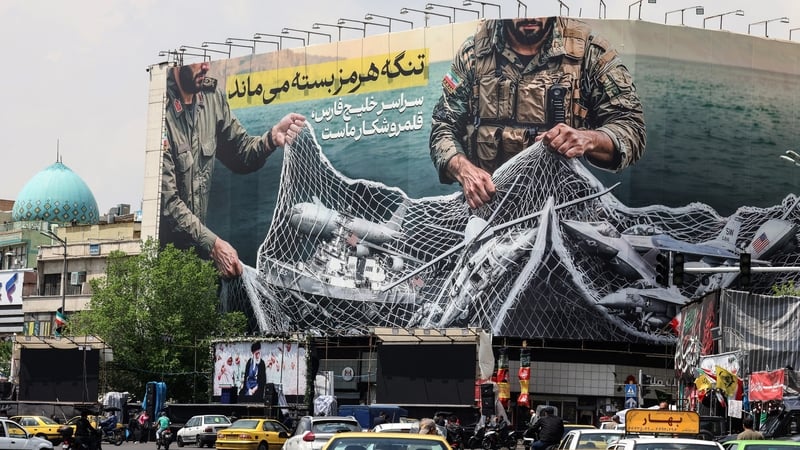
Iran’s Supreme Leader, Ayatollah Mojtaba Khamenei, has said the country will protect its "nuclear and missile capabilities" as a national asset.
The statement was made as US President Donald Trump seeks a wider deal to cement the shaky ceasefire in the war.
Mr Khamenei maintained his defiant tone since taking over following the killing of his father at the start of the conflict.
In a written statement, read by a state television presenter, he said the only place that Americans belonged in the Persian Gulf was "at the bottom of its waters" and that a "new chapter" was being written in the region's history.
Mr Khamenei has not been seen in public since becoming the supreme leader.
We need your consent to load this rte-player contentWe use rte-player to manage extra content that can set cookies on your device and collect data about your activity. Please review their details and accept them to load the content.Manage Preferences
His remarks come as Iran's oil industry is being squeezed by a US Navy blockade halting its tankers from getting to sea.
However, the world economy is also under pressure as Iran maintains its chokehold on the Strait of Hormuz, through which one-fifth of all crude oil is transported.
The shock to supplies and prices is putting pressure on President Trump, who has floated a new plan to reopen the strait.
Under the plan, the United States would continue its Iranian port blockade, while coordinating with allies to impose higher costs on Iran's attempts to subvert the free flow of energy, according to a senior administration official.
Mr Trump is weighing multiple diplomatic and policy options to push Iran to end its chokehold on the waterway, the official said.
With a fragile ceasefire in place, the US and Iran are locked in a stand-off over the strait.
The US blockade is designed to prevent Iran from selling its oil, depriving it of crucial revenue while also potentially creating a situation where Tehran has to shut off production because it has nowhere to store oil.
The strait’s closure is also a problem for Gulf allies of the US, which use the waterway to export their oil and gas.
A recent Iranian proposal would push negotiations on the country’s nuclear programme to a later date.
President Trump said that one of the major reasons he went to war was to deny Iran the ability to develop nuclear weapons.
Tehran has long maintained its programme is peaceful, though it enriched uranium at near-weapons-grade levels of 60%.
Pakistan is continuing to facilitate indirect talks between the US and Iran but said it would also welcome direct communication between the two sides, even by phone.
"If the two parties can engage in real-time conversations, that could ease the sticking points," said Ministry of Foreign Affairs spokesperson Tahir Andrabi at a weekly news briefing.
He declined to share details of any Iranian or US proposals.
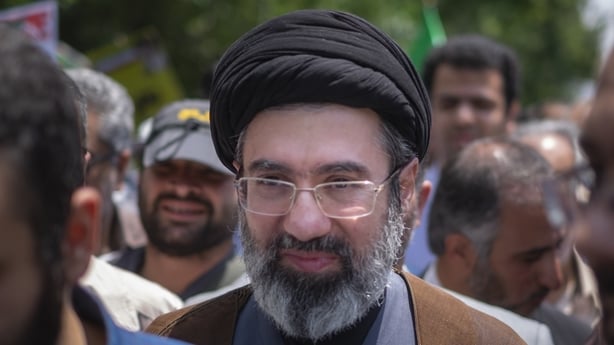
Mr Khamenei’s remarks - issued to mark Persian Gulf Day in Iran - signalled that nuclear issues and Iran’s ballistic missile programme would not be traded away.
"Ninety million proud and honourable Iranians, inside and outside the country, regard all of Iran’s identity-based, spiritual, human, scientific, industrial and technological capacities - from nanotechnology and biotechnology to nuclear and missile capabilities - as national assets, and will protect them just as they protect the country’s waters, land and airspace," Mr Khamenei said.
He referred to the US as the "Great Satan", a long-hurled insult by Iranian leaders towards the US since the 1979 Islamic Revolution.
"Foreigners who come from thousands of kilometres away to act with greed and malice there have no place in it - except at the bottom of its waters," said Mr Khamenei, who was reportedly wounded in the 28 February attack that killed his father, Ayatollah Ali Khamenei, who was 86.
US blockade 'doomed to fail' - Pezeshkian
Meanwhile, Iran's President Masoud Pezeshkian said the US naval blockade was "contrary to international law" and "doomed to fail".
He added, in a statement, that such measures would "not only fail to enhance regional security, but are in fact a source of tension and a disruption to lasting stability in the Persian Gulf".
In his remarks, Mr Khamenei appeared to signal that his country would maintain its control over the Strait of Hormuz, which sits in the territorial waters of Iran and Oman.
It has reportedly been charging some ships $2 million (€1.7m) each to travel through the strait.
Mr Khamenei said that Iran’s control of the strait will make the Gulf more secure, and that Tehran’s "legal rules and new management" of it will benefit all of the region’s nations.
However, the world considers the strait an international waterway, open to all without paying tolls.
Gulf Arab nations, chief among them the United Arab Emirates, have described Iran’s control of the waterway as akin to piracy.
Additional reporting Reuters, AFP
