


US President Donald Trump said he had ordered his envoys not to travel to Pakistan for peace talks with Iranian officials, but also that the move didn't mean resuming the war.
Mr Trump made the announcement in individual phone calls with reporters, and later in a post on social media, shortly after Iran's Foreign Minister Abbas Araghchi departed Islamabad.
Mr Trump's son-in-law Jared Kushner and special envoy Steve Witkoff had been scheduled to leave for Islamabad, Pakistan's capital, for a second round of peace talks with Iran.
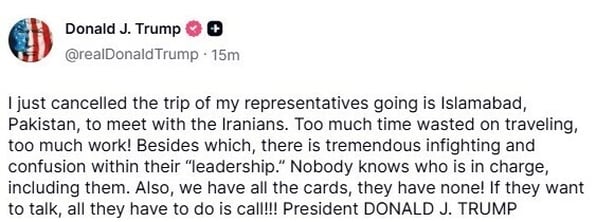
"I just cancelled the trip of my representatives going is (sic) Islamabad, Pakistan, to meet with the Iranians. Too much time wasted on traveling, too much work!" he wrote on his Truth Social media platform.
"Besides which, there is tremendous infighting and confusion within their 'leadership.' Nobody knows who is in charge, including them," he continued.
However, Mr Trump left the door open to further negotiations, saying if the Iranians "want to talk, all they have to do is call!!!"
Asked earlier by Axios whether the cancellation of the envoys' trip meant he would resume the war, Mr Trump said: "No. It doesn't mean that. We haven't thought about it yet."
The United States has extended indefinitely a truce with Iran that took effect on 8 April.
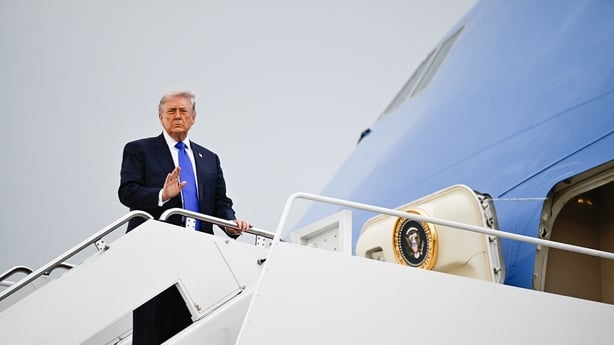
Speaking this afternoon on the tarmac at Palm Beach airport in Florida, Mr Trump said the Iranians "gave us a paper that should have been better, and interestingly, immediately when I cancelled it - within 10 minutes - we got a new paper that was much better."
When asked by a journalist what was in the new document, he said: "We talked about they will not have a nuclear weapon, very simple."
Iran's state television said Tehran's envoys had no immediate plans to hold face-to-face talks with the Americans, and that Pakistan would serve as a bridge to convey Iranian proposals.
Pakistan's Prime Minister Shehbaz Sharif said he spoke by phone with Iranian President Masoud Pezeshkian after US-Iran peace talks in Islamabad were called off and reaffirmed his country's readiness to help resolve the conflict.
"Pakistan remains committed to serve as an honest and sincere facilitator - working tirelessly to advance durable peace and lasting stability in the region," Mr Sharif wrote on X.
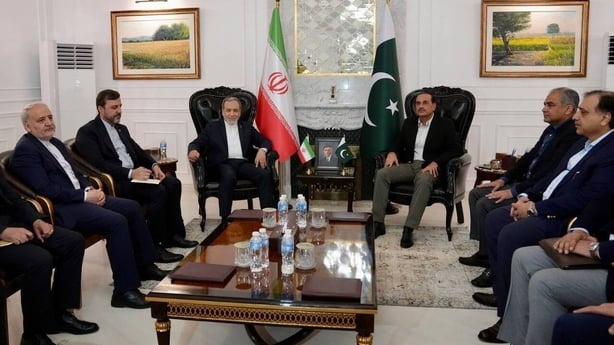
Iranian Foreign Minister Abbas Araghchi will head back to Pakistan after visiting Oman, state media reported, having just left Islamabad earlier in the day.
The IRNA news agency, citing the foreign ministry, reported that Mr Araghchi "is scheduled to visit Pakistan again after completing his trip to Oman and before travelling to Russia".
Part of his delegation had returned to Tehran, it added, "to consult and obtain the necessary instructions on issues related to ending the war, and is scheduled to rejoin Araghchi in Islamabad on Sunday night".
Opening Hormuz 'vital'
Iran's military, meanwhile, remained defiant.
In a statement carried by state media, the military's central command said that if "the invading US military continues blockading, banditry, and piracy in the region, they should be certain that they will face a response from Iran's powerful armed forces".
Since the last round of talks, efforts to bring the two sides back to the table have hit an impasse, with Iran refusing to participate as long as a US naval blockade on its ports remains in place.
Iran has imposed a de facto blockade of its own on the Strait of Hormuz, allowing only a trickle of ships to pass through the vital waterway, throwing global energy markets into turmoil.
Oil prices slid on Friday amid hopes that fresh peace talks would see an end to Tehran's disruption of trade through the strait.
EU says opening Hormuz 'vital'
Since the last round of talks, efforts to bring the two sides back to the table have hit an impasse, with Iran refusing to participate as long as a US naval blockade on its ports remained in place.
Iran has imposed a de facto blockade of its own on the Strait of Hormuz, allowing only a trickle of ships to pass through the vital waterway, throwing global energy markets into turmoil.
Oil prices slid yesterday amid hopes that fresh peace talks would see an end to Iran's disruption of trade through the strait.
European Council President Antonio Costa said that the strait "must immediately reopen without restrictions and without tolling."
"This is vital for the entire world," Mr Costa added.
Major Wall Street indices closed at fresh records yesterday as markets cheered the latest batch of earnings reports and US and Iranian officials headed to Pakistan.
The United States continued meanwhile to build up its forces in the Middle East with the arrival of its third aircraft carrier in the region, the USS George HW Bush.
Turkey may consider role in Hormuz demining after Iran-US deal, minister says
Turkish Foreign Minister Hakan Fidan said that Turkey could consider taking part in demining operations in the Strait of Hormuz following a possible peace agreement between Iran and the United States.
Mr Fidan, speaking to reporters in London yesterday evening, said a technical team was expected to carry out mine-clearing work in the strait after any agreement, adding that Turkey viewed such efforts positively in principle as a humanitarian duty.
However, he cautioned that Turkey would reassess its position ifany future technical coalition of countries became a party to renewed conflict,
Mr Fidan also said he believed issues related to Iran's nuclear programme could be resolved at the next round of talks in Pakistan.
