


US President Donald Trump said the United States could end its military attacks on Iran within two to three weeks and that Tehran did not have to make a deal as a prerequisite for the conflict winding down.
The remarks underscored the shifting and at times contradictory statements from Washington about how the war, now in its fifth week, might end.
"We'll be leaving very soon," Mr Trump told reporters at the White House , saying the exit could take place "within two weeks, maybe two weeks, maybe three."
Asked if successful diplomacy with Iran was a prerequisite to the US winding down what it has dubbed "Operation Epic Fury", Mr Trump said it was not.
"Iran doesn't have to make a deal, no," he said. "No, they don't have to make a deal with me."
The White House later said Mr Trump would address the nation "to provide an important update on Iran" at 2am Irish time tomorrow.
Washington previously threatened to intensify military operations if Tehran did not accept a 15-point US ceasefire framework that had among its core demands that Iran commit not to pursue nuclear weapons, halt all uranium enrichment and fully reopen the Strait of Hormuz
TUNE IN: Tomorrow night at 9PM ET, President Trump will give an Address to the Nation to provide an important update on Iran.
— Karoline Leavitt (@PressSec) March 31, 2026
Earlier, US Defence Secretary Pete Hegseth said Mr Trump was willing to make a deal with Iran to end the war that has killed thousands, spread across the region, disrupted energy supplies and threatened to send the global economy into a tailspin.
Talks were ongoing and gaining strength, Mr Hegseth said, but the US was prepared to continue the war if Iran did not comply.
"We have more and more options, and they have less ... in only one month we set the terms, the upcoming days will be decisive," Mr Hegseth said in Washington.
Iran's Revolutionary Guards hit back with a new threat against US companies in the region starting today.
It listed 18 businesses including Microsoft, Google, Apple, Intel, IBM, Tesla and Boeing that would be targeted from 8pm Tehran time (4.30pm Irish time).
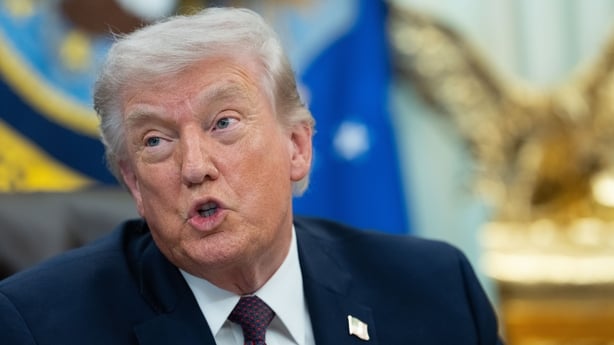
When asked if he was concerned about threats to the companies, Mr Trump said no.
"They don't have much left to threaten," he said of Iran.
Iranian Foreign Minister Abbas Araqchi said he has been receiving direct messages from US special envoy Steve Witkoff but they do not constitute "negotiations", Qatar's Al Jazeera TV cited him as saying.
The messages include threats or exchanged views delivered through "friends," he added.
Mr Trump earlier criticised countries that have not helped the US war effort, such as Britain.
In a social media post, he said that in response to the global fuel shortage, these countries should buy energy from the US or find "some delayed courage, go to the strait and just TAKE IT".
France and Italy have pushed back against some US-Israeli military operations, sources said, highlighting how divisions between NATO allies have been exposed by the war.
War continues to rage
The war has also revived conflict between Israel and theIran-backed Lebanese group Hezbollah.
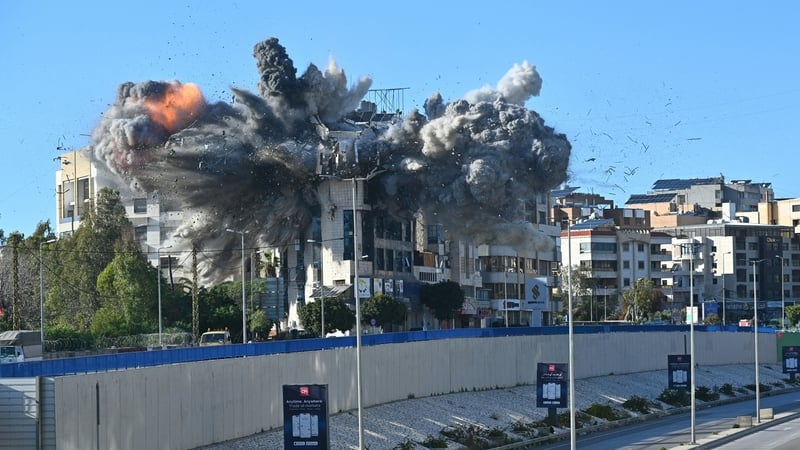
At least seven people were killed and 24 wounded in two Israeli strikes in the Beirut area, the Lebanese health ministry said, in attacks that hit vehicles in Beirut's southern outskirts and in an area just south of the capital.
Israel's military said it carried out two separate strikes targeting a senior Hezbollah commander and another senior member of the Iran-aligned group in the Beirut area.
It did not identify them or say whether they had been killed.
There was no immediate comment from Hezbollah on the strikes.
US General Dan Caine, chairman of the Joint Chiefs of Staff, told reporters in Washington that the US military was continuing to strike key manufacturing and research sites and had taken out over 150 Iranian naval vessels.
With attacks showing no sign of easing, Pakistan is seeking to mediate in the war.
The foreign ministers of China and Pakistan called for an immediate ceasefire, urging peace talks to be held as soon as possible after they met in Beijing.
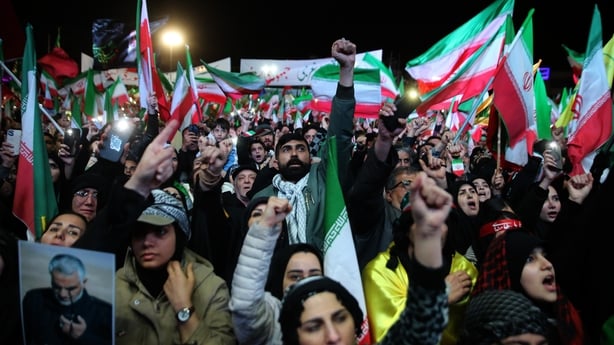
Iran has remained defiant despite heavy US and Israeli attacks for the past month, as neighbors have been pulled into the conflict.
Heavy strikes were reported in the Lebanese capital of Beirut, security sources told journalists.
Israel's military said it had struck a senior Hezbollah commander and an additional senior fighter in two separate attacks there.
Syrian state television reported that explosions heard in Damascus were the result of Israeli air defences intercepting Iranian missiles.
A weather station's radar and building in the Iranian port of Bushehr were put out of service after being hit twice in US-Israeli attacks, a regional official told state media.
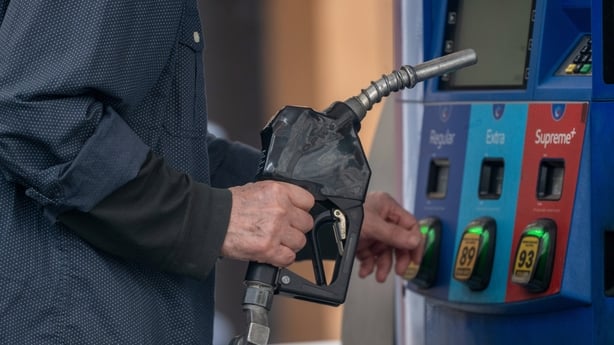
Higher oil and fuel prices have also started to weigh on US household finances and are a political headache for Trump and his Republican Party before the November midterm elections.
The US national average retail price of gasoline crossed $4 a gallon for the first time in over three years earlier this week, data from price-tracking service Gas Buddy showed.
Two-thirds of Americans believe the US should work to end its involvement in the Iran war quickly, even if that means not achieving the goals set out by the Trump administration, a Reuters/Ipsos poll found.
Read more:
How Strait of Hormuz has always been key to Iran's defence strategy
How Iran war is causing massive turbulence for aviation industry
Free public transport and four-day weeks - how nations are responding to fuel crisis
