


US President Donald Trump and UK Prime Minister Keir Starmer spoke about the "importance" of reopening the Strait of Hormuz, currently blocked by Iran, the UK leader's office said.
"The leaders discussed the ongoing situation in the Middle East and the importance of reopening the Strait of Hormuz to end the disruption to global shipping, which is driving up costs worldwide," a Downing Street spokeswoman said in a statement.
Yesterday, Mr Trump urged other countries such as China, France, Japan, South Korea and Britain to send warships to help the United States secure the strait.
Iran's military is effectively blocking the crucial waterway in retaliation for US-Israeli strikes, aiming to damage the world economy and pressure Washington as oil prices soar.
Mr Starmer also "expressed his condolences for the American service personnel who have lost their lives during the conflict", the statement said.
The Trump administration plans to announce as early as this week that multiple countries have agreed to form a coalition that will escort ships through the Strait of Hormuz, the Wall Street Journal reported, citing US officials.
US officials responding to economic uncertainty over high oil prices predicted that the US-Israeli war on Iran would end within weeks and that a drop in energy costs would follow, despite Iran's assertion that it remains "stable and strong" and ready to defend itself.
Mr Trump threatened more strikes on Iran's main oil export hub Kharg Island over the weekend and said he was not ready to reach a deal to end the war which has shut off the vital Strait of Hormuz and shaken up global energy markets.
Mr Trump has said Iran wants to negotiate, but Iranian Foreign Minister Abbas Araghchi disputed that claim.
"We have never asked for a ceasefire, and we have never asked even for negotiations," Mr Araghchi told CBS.
He added: "We are ready to defend ourselves for as long as it takes."
With crude oil prices hovering around $100 a barrel, Trump administration officials insisted that all signs point to a relatively quick end to the conflict.
"This conflict will certainly come to the end in the next few weeks - could be sooner than that...and we'll see are bound in supplies and a pushing down of prices after that," US Energy Secretary Chris Wright told ABC.
Meanwhile, Mr Araghchi sought to project an image of strength.
"It's not a war of survival. We are stable and strong enough. We don't see any reason why we should talk with Americans, because we were talking with them when they decided to attack us, and that was for the second time," Mr Araghchi said.
With the war entering its third week, Mr Trump claimed that US strikes had "totally demolished" much of Kharg Island and warned of more, telling NBC News yesterday, "We may hit it a few more times just for fun."
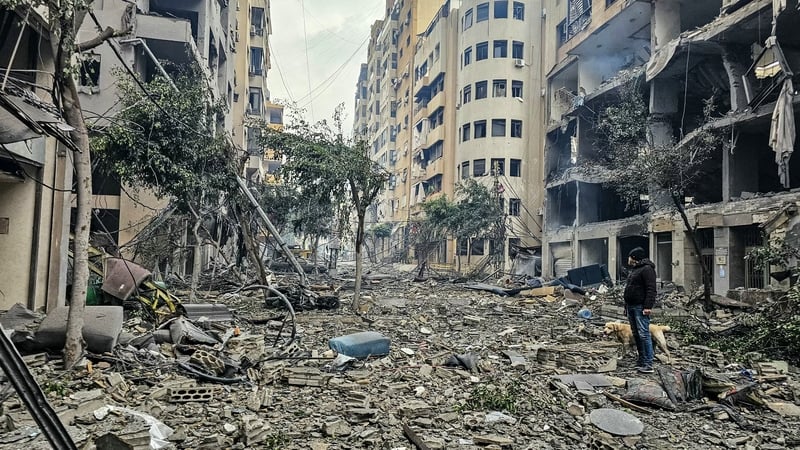
The comments marked a sharp escalation from Mr Trump, who had previously said the US was targeting only military sites on Kharg, and dealt a blow to diplomatic efforts to end a war that has spread across the Middle East and killed more than 2,000 people, most in Iran and Lebanon.
The World Health Organization said that it had released $2 million in emergency funds to countries in the region, which has experienced large-scale population movements with more than 100,000 people in Iran relocating and up to 700,000 in Lebanon internally displaced.
Washington has brushed aside attempts by Middle Eastern allies to open talks, three sources told Reuters, and Iran's Revolutionary Guards said they had fired more missiles at Israel and three US bases in the region.
But Israel and Lebanon are expected to hold talks in coming days aimed at securing a ceasefire that would see Iran-backed Hezbollah disarmed, two Israeli officials said.
Lebanon was sucked into the war when Hezbollah opened fire at Israel, saying it was to avenge the killing of Iran's supreme leader, and Israel has responded with a fierce offensive.
Why has Kharg Island become focus of Middle East war?
War, energy crisis looks set to persist
With global air transport heavily disrupted and no clear end insight, Iran's ability to choke off traffic through the Strait of Hormuz, the conduit for a fifth of global oil and liquefied natural gas, has emerged as a decisive threat to the global economy.
Although some Iranian vessels have continued to pass, the passage has been effectively closed for most of the world'ss hipping since the United States and Israel attacked Iran on 28 February at the start of an intensive bombing campaign that has hit thousands of targets across the country.
The International Energy Agency said oil from its emergency reserves will begin flowing to global markets soon, with member countries pledging to make available 411.9 million barrels.
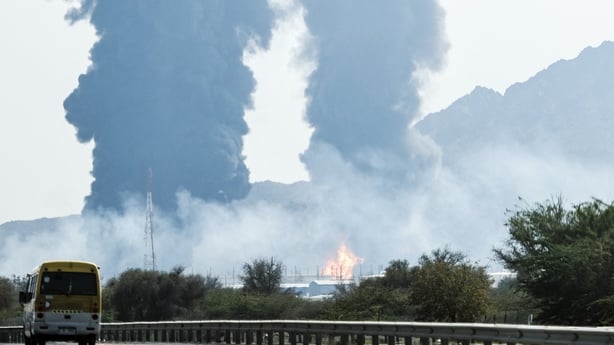
Underlining the impact the war has had on energy infrastructure in the region, the global ship-refuelling hub of Fujairah in the United Arab Emirates was closed after barrages on Saturday but resumed oil-loading operations, a Fujairah-based industry source said.
Mr Araqchi denied Iran was targeting civilian or residential areas in the Middle East and said it was ready to form a committee with its neighbours to investigate the responsibility for such strikes.
But as the standoff continued, Iran's Revolutionary Guards said it had fired more missile and drone barrages at targets in Israel and at US military bases in the region, where Saudi Arabia said it had intercepted 10 attacks.
Iran has not yet used its newest missiles, IRGC spokesperson Ali Mohammad Naini said in comments carried by state media.
"Isn't Trump saying that he has destroyed the Iranian navy? If he dares, let him send his ships to the Persian Gulf region," Mr Naini added.
Israel said its jets hit more targets in western Iran, including headquarters of the Revolutionary Guards and Basij militia forces in the city of Hamadan.
Israel's Foreign Minister Gideon Saar rejected claims that Israel had told the United States it was running low on interceptors.
