


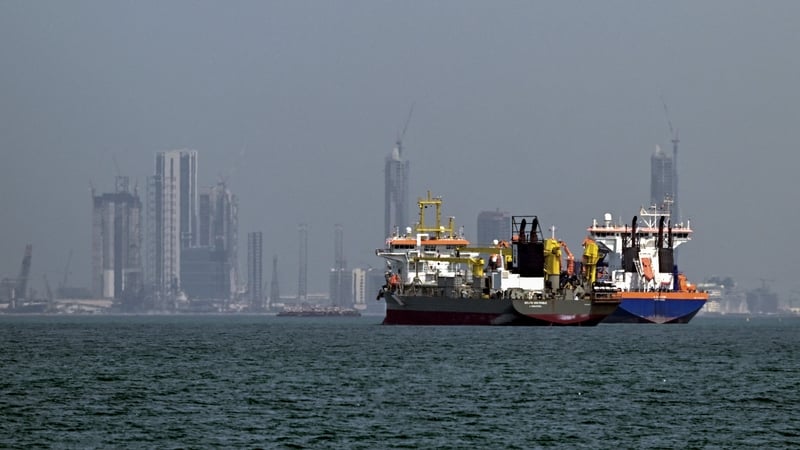
US President Donald Trump has called on nations to send warships to keep the Strait of Hormuz open for shipping as Iranian forces continue their retaliation campaign amid US and Israeli attacks on Iran.
About a fifth of global oil and liquefied natural gas normally passes through the strait, a narrow passage of water between Iran and Oman.
Iran's ability to stop shipping through the channel could give it enormous leverage over the US and its allies.
"The Countries of the World that receive Oil through the Hormuz Strait must take care of that passage, and we will help - A LOT!
"The US will also coordinate with those Countries so that everything goes quickly, smoothly, and well," Mr Trump wrote in a post on his Truth Social platform.
In an earlier post, Mr Trump claimed that "Many Countries, especially those who are affected by Iran's attempted closure of the Hormuz Strait, will be sending War Ships, in conjunction with the United States of America, to keep the Strait open and safe".

He added that he hoped China, France, Japan, South Korea, the UK and others would send ships to the area.
"In the meantime, the United States will be bombing the hell out of the shoreline, and continually shooting Iranian Boats and Ships out of the water," he wrote.
The White House did not respond to a request for comment on whether any countries had agreed to send ships.
Oil prices have surged by 40% as Iran has choked off the vital Strait of Hormuz and attacked Gulf energy facilities.
US forces struck Kharg Island yesterday, from which nearly all of Iran's oil is exported, with Mr Trump saying they had "obliterated every MILITARY target", though sparing its energy facilities.
Iran had threatened that US-linked oil and energy firms would be "turned into a pile of ashes" if they were hit, with Foreign Minister Abbas Araghchi later repeating the warning and accusing the US of firing rockets at Kharg from its bases in the UAE.
He then called on Iran's neighbours to expel American forces, saying the US security umbrella was "inviting rather than deterring trouble".
Watch: Smoke rises near energy installation in Fujairah, UAE
Western nations have bolstered their military presence in the eastern Mediterranean during the US-Israeli war on Iran, focusing on the security of Cyprus after an Iranian-made drone hit a British military base on the island on 2 March.
The UK is also exploring additional options for deployments to the Gulf after Iran stepped up attacks on vessels, defence minister John Healey said on Thursday.
The UK government is talking to allies and partners about "a range of options to ensure the security of shipping in the region", a Ministry of Defence spokesperson said.
The French navy is deploying about a dozen naval vessels, including its aircraft carrier strike group, to the Mediterranean, Red Sea and potentially the Strait of Hormuz as part of defensive support to allies threatened by the conflict.
France has been consulting with European, Asian and Gulf Arab states over the past week with a view to putting together a plan for warships eventually to escort tankers through the strait, French officials said.
Mr Trump said that the US was willing to escort ships through the Strait of Hormuz to protect them from Iranian attack, as his administration searches for ways to ease high oil prices fuelled by the US-Israeli war on Iran.
'Diplomatic avenues' available to stop war in Lebanon - Guterres
UN chief Antonio Guterres said on a visit to Beirut that diplomatic channels remained open to end the war between Israel and Hezbollah and urged the international community to support Lebanon.
Lebanon was dragged into conflict last week when Hezbollah attacked Israel in response to the killing of Iranian supreme leader Ayatollah Ali Khamenei in US-Israeli strikes.
Hezbollah's leader Naim Qassem has said the group was ready for a long confrontation with Israel.
Israel continued its attacks on Lebanon as Hezbollah claimed strikes against northern Israel.

Lebanese health officials said Israeli attacks on the country since 2 March had killed 826 people, including 106 children.
US news site Axios reported that Israel was planning a major ground invasion of Lebanon "aiming to seize the entire area south of the Litani River", citing US and Israeli officials.
The area, covering hundreds of square kilometres, is already subject to Israeli evacuation warnings.
Mr Guterres, however, insisted "there is no military solution, only diplomacy" and dialogue.
Read more: Why has Kharg Island become focus of Middle East war?
The UN chief arrived in Beirut yesterday for what he called a solidarity visit.
He launched a $325 million (€281m) humanitarian appeal to support Lebanon as it responds to the displacement of hundreds of thousands of people amid sweeping Israeli army evacuation orders.
Mr Guterres urged the international community to "step up your engagement, empower the Lebanese state" and support the army, which has committed to disarming Hezbollah.
Turkey expressed deep concern over Israel's ongoing strikes on Lebanon over concerns it would commit "a new genocide" under the guise of fighting Hezbollah.
"We are frankly concerned (Israeli Prime Minister Benjamin) Netanyahu is moving toward a new genocide under the pretext of fighting Hezbollah," Turkish Foreign Minister Hakan Fidan said, urging the international community to "take immediate action".
Paramedics
The health ministry said 31 paramedics had been killed this month, after the bodies of additional health workers were found following an overnight Israeli attack that authorities said hit a healthcare centre in Burj Qalawiya in the country's south, killing doctors, paramedics and nurses.
Mehieddine al-Teryaki, one of the individuals surveying the destruction, said his uncle and three family members were killed.
"What they did is a massacre," he said.
The Islamic Health Committee said the centre was one of its facilities, pledging such attacks would not deter it from "performing our humanitarian duty".
Watch: Fire burns after strike reported at US embassy in Iraq
The Israeli military claimed Hezbollah uses the centres ambulances militarily, and its spokesman Avichay Adraee said that Israel would act "in accordance with international law against any military activity" by any Hezbollah use of medical facilities or ambulances.
Lebanon's health ministry accused Israel of repeatedly "targeting ambulance crews while they were performing rescue duties".
The Israeli army claimed that it had struck Hezbollah operatives yesterday "who were bringing rockets into a weapons depot" in Majedel, near Burj Qalawiya.
It also claimed it had struck "approximately 110 Hezbollah command centres" since Israel and the US started their war on Iran.
An Israeli attack hit an apartment building in a northern Beirut suburb that had been targeted a day earlier.
An AFP correspondent in the Nabaa-Burj Hammoud area saw rescue workers at the scene and damage including a hole in a building.
The health ministry said the strike killed one person in Burj Hammoud, a densely populated, area known for its large Armenian-Lebanese community.
'No safety'
Levon Ghazalian, 42, who lives in the building next door, said "it's the first time this happens" in the area, which was spared in the previous conflict between Israel and Hezbollah in 2024.
"All the neighbours are afraid," he told AFP.
Hanadi Hachem, 50, who was in her pyjamas, said "there's no safety anymore... you never know where a strike will come from".
She said she and some family members were sleeping in their car out of fear.
In the suburbs of the southern city of Sidon, state media reported an Israeli attack targeted an apartment in the densely populated Haret Saida area, while also reporting Israeli attacks in other parts of the country's south.
Kandice Ardiel, spokesperson for the United Nations Interim Force in Lebanon, told AFP that one of the peacekeepers' positions near Mais al-Jabal was hit a day earlier, "likely by heavy machine gun fire", with one peacekeeper lightly wounded, and said the force had launched an investigation.
French President Emmanuel Macron said the Lebanese government was ready to engage in "direct talks" with Israel and offered to host negotiations in Paris, warning that "everything must be done to prevent Lebanon from descending into chaos".
Read more:
Follow live updates
How will the Iran war affect the cost of your supermarket shop?
