


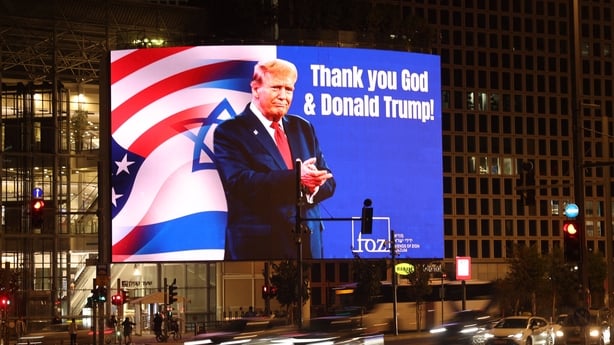
Israeli Prime Minister Benjamin Netanyahu has said the joint US-Israeli campaign is "crushing" Iran and its Lebanese ally Hezbollah and called for Iranians to rise up and overthrow the Islamic Republic.
Mr Netanyahu spoke soon after new Iranian supreme leader Mojtaba Khamenei's first statement, in which he vowed to avenge the Iranians killed in the war so far.
"We are crushing Iran and Hezbollah," he said in a televised media briefing.
In wide-ranging comments on the war, Mr Netanyahu said he was seeking to use the conflict to oust the clerical leadership in Iran.
"I have added a third objective, which is to create, for the Iranian people, the conditions to bring down this regime," Mr Netanyahu said.
We need your consent to load this rte-player contentWe use rte-player to manage extra content that can set cookies on your device and collect data about your activity. Please review their details and accept them to load the content.Manage Preferences
The other two goals remained preventing Iran from developing nuclear weapons and destroying its ballistic missile capabilities, he said.
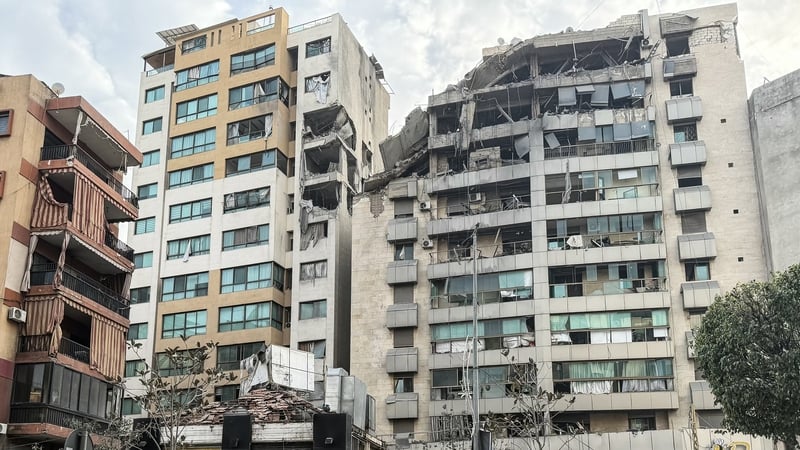
Mr Netanyahu used his remarks to demand that Beirut rein in Lebanese militant group Hezbollah, which has joined Iran in launching missile strikes on Israel.
"I told the Lebanese government a few days ago, you are playing with fire if you continue allowing Hezbollah to operate, in violation of your commitment to disarm it," he said.
"The time has come for you to do so. Now, if you do not do so, it is clear that we will do so," he continued.
Hezbollah said it carried out a number of attacks against Israel, including on an air defence system near the town of Caesarea, home to Mr Netanyahu's private residence.
Israel has threatened to target Lebanese government infrastructure if the attacks by Hezbollah persist.
Mr Netanyahu had a personal message for Iran's new leader, saying: "We eliminated the old tyrant, and the new tyrant, the puppet of the Revolutionary Guards, can't show his face in public."
Mojtaba Khamenei had earlier issued a first statement in his name that was read out by a TV presenter.
He also said Iran will fight on and keep the Strait of Hormuz shut as leverage against the US and Israel.
No images have been released of him since an Israeli strike at the start of the war that killed much of his family, including his father and wife.
His statement called on Iran's neighbours to shut US bases on their territory and warned that Iran would continue to target them.
"I assure everyone that we will not neglect avenging the blood of your martyrs," said the hardline cleric, who is close to Iran's top military force.
"The popular demand is to continue our effective defence and make the enemy regret it. The lever of blocking the Strait of Hormuz must continue to be used," Mr Khamenei added.
Iranian state television offered no explanation for why the message was read out rather than delivered in person.
Iranian officials have said Mr Khamenei was lightly wounded in the initial 28 February airstrikes, but the extent of his injuries is unclear.
The prospect of one of the most severe disruptions ever to global energy supplies enduring sent oil prices up about 9% to $100 a barrel, after falling earlier in the week on hopes of a swift end to the conflict.
US stocks fell, with the S&P 500 notching its biggest three-day percentage drop in a month.
Two tankers were ablaze in an Iraqi port after being hit by suspected Iranian explosive-laden boats, a clear sign of defiance toward US President Donald Trump, who said yesterday the United States had already won the war.
Images verified by Reuters as filmed from the Iraqi port of Basra showed ships engulfed in massive orange fireballs that lit up the night sky. At least one crew member was killed.
Hours earlier, three other ships were struck in the Gulf.
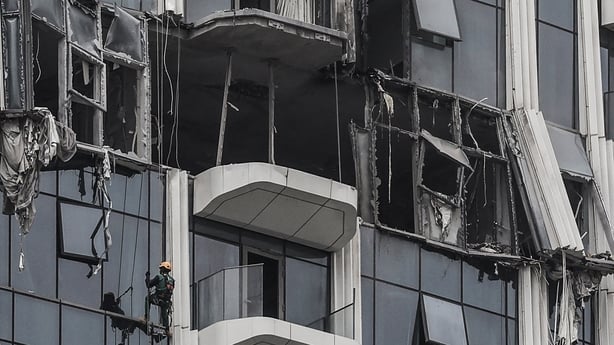
Iran's Revolutionary Guards claimed responsibility for at least one attack, on a Thai bulk carrier that was set ablaze.
Another container vessel reported being struck by an unknown projectile near the United Arab Emirates.
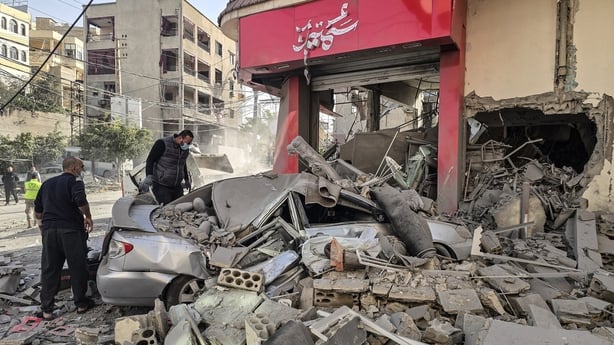
On another front in the unpredictable war, Israeli airstrikes hit a building in central Beirut, sending thick smoke above the Lebanese capital.
Israel also ordered residents out of another swathe of southern Lebanon, intensifying its offensive against the Iran-backed Hezbollah group after it fired its biggest volley of rockets into Israel since the start of the war.
So far, the war has killed more than 2,000 people, including almost 700 in Lebanon.
Undermining US and Israeli claims to have knocked out much of Iran's stock of long-range weapons, more drones were reported flying into Kuwait, Iraq, the UAE, Bahrain and Oman.
Iran has said it will not let oil back through the strait until US and Israeli attacks cease, but Trump played down the higher prices.
"The United States is the largest Oil Producer in the World, by far, so when oil prices go up, we make a lot of money," President Trump wrote on social media.
US Treasury Secretary Scott Bessent told Sky News in an interview that the US Navy, perhaps with an international coalition, would escort vessels through the Strait of Hormuz when it is militarily possible.
Watch: Trump says US looking 'strongly at the straits'
The US is a net oil exporter but also the world's biggest oil consumer. Economists say sustained high prices would drive broad inflation.
Iran's UN Ambassador said Iran is not going to close the Strait of Hormuz, but added that it was Iran's right to preserve the security of the key shipping route.
"We are not going to close the Strait of Hormuz," Mr Iravani said. "But it is our inherent right to preserve the peace and security in this waterway," he added.
In a prepared statement he read to reporters before responding to questions, Mr Iravani said that "Iran fully respects and remains committed to the principle of freedom of navigation under the law of the sea".
Separately, Mr Trump said the Iranian men's national soccer team was welcome to participate in the 2026 World Cup, which the US is co-hosting, but added that it was not appropriate that they be there "for their own life and safety".
Inside Iran, residents said security forces were increasing their presence to demonstrate continued control.
"Security forces are everywhere, more than before. People are afraid to come out, but supermarkets are open," teacher Majan, 35, said by phone from Tehran.
Israel said it had struck checkpoints in Tehran of the Basij, the Revolutionary Guard's voluntary militia.
Israel and the United States have called on Iranians to rise up and topple their clerical rulers.
Many Iranians want change and some openly celebrated the elder supreme leader's death on 28 February, the war's first day, after his forces had killed thousands of anti‑government protesters in January.
But there has been no sign of organised dissent while the country is under attack.
Iran's message is that its strategy now is to impose a prolonged economic shock to force Mr Trump to back off.
A spokesperson for Iran's military command said the world should prepare for oil prices of $200 a barrel.
US Energy Secretary Chris Wright said on Thursday he did not expect that to happen, but did not totally rule it out.
"I would say unlikely, but we are focused on the military operation and solving a problem," Mr Wright told CNN.
Oil prices rose despite the announcement that developed countries would release 400 million barrels of oil from strategic reserves, nearly half from the United States.
Read more:
Follow live updates on the Iran war
Latest Middle East stories
