


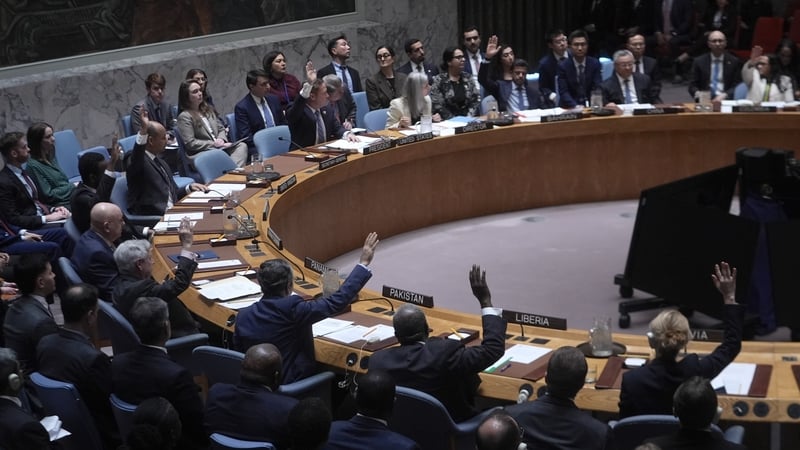
The UN Security Council has called for Iran to halt its attacks on Gulf states, in a resolution that did not mention US or Israeli strikes on Iran, prompting Iran's ambassador to decry a "blatant misuse" of the international body.
The resolution, passed by 13 votes with two abstentions, "demands the immediate cessation of all attacks by the Islamic Republic of Iran against Bahrain, Kuwait, Oman, Qatar, Saudi Arabia, the United Arab Emirates, and Jordan".
It also "condemns any actions or threats by the Islamic Republic of Iran aimed at closing, obstructing, or otherwise interfering with international navigation through the Strait of Hormuz".
Iran has repeatedly struck Gulf states in retaliation for US-Israeli attacks that killed Iranian supreme leader Ayatollah Ali Khamenei and continue to pummel Iranian sites.

The Islamic Republic has also fired on commercial ships passing through the Strait of Hormuz, a crucial sea passage for the global fuel trade, in a bid to inflict pain on the global economy.
Jamal Fares Alrowaiei, the UN ambassador of Bahrain, which introduced the resolution sponsored by 135 countries, said its passing reflected the Gulf's key role in the global economy.
"This is why ensuring the security of this region is not merely a regional matter, it is a common international responsibility that is closely linked to the stability of the global economy and energy security," Mr Alrowaiei told the Security Council.
Veto-holders China and Russia both abstained from the Security Council vote, angered that the resolution did not acknowledge US-Israeli hostility towards Iran.
Iranian ambassador Amir Saeid Iravani said adoption of the text represented a "blatant misuse of the Security Council mandate in pursuit of the political agendas" of the United States and Israel.
"Let me make it clear, this resolution is a manifest injustice against my country, the main victim of a clear act of aggression," he said.
The United States, which backed the text, said its adoption reflected a broad condemnation of Iranian strikes.
"Iran's strategy of sowing chaos, of trying to hold their neighbours hostage, trying to shake the resolve of the region, has clearly backfired, as shown by this vote today," said US Ambassador Mike Waltz.
Meanwhile, officials from President Donald Trump's administration have estimated during a congressional briefing this week that the first six days of the war on Iran had cost the United States at least $11.3 billion, a source familiar with the matter said.
That figure, from a closed-door briefing for senators yesterday, did not include the entire cost of the war, but was provided to politicians as they have clamoured for more information about the conflict.
Several congressional aides have said they expect the White House to soon submit a request to Congress for additional funding for the war.
Some officials have said the request could be for $50 billion, while others have said that estimate seems low.
The administration has not provided a public assessment of the cost of the conflict or a clear idea of its expected duration.
President Trump said during a trip to Kentucky that "we won" the war but that the United States will stay in the fight to finish the job.
We need your consent to load this rte-player contentWe use rte-player to manage extra content that can set cookies on your device and collect data about your activity. Please review their details and accept them to load the content.Manage Preferences
The $11.3 billion figure was first reported by the New York Times.
The campaign against Iran began on 28 February with US and Israeli airstrikes and has so far killed around 2,000 people, mostly Iranians and Lebanese, as the conflict has spread into Lebanon and thrown global energy markets and transport into chaos.
Administration officials have also told politicians that $5.6 billion of munitions were used during the first two days of strikes.
Members of Congress, who may soon have to approve additional funding for the war, have expressed concern that the conflict will deplete US military stocks at a time when the defence industry was already struggling to keep up with demand.
Mr Trump met executives from seven defence contractors last week as the Pentagon worked to replenish supplies.
Democratic politicians have demanded public testimony under oath from administration officials about the Republican president's plans for the war, including how long it might last and what his plans are for Iran once the fighting has stopped.
Iran said the world should be prepared for oil to hit $200 a barrel as its forces attacked merchant ships in the blockaded Gulf.
Iran also fired at Israel and targets across the Middle East, demonstrating it can still fight back despite what the Pentagon has described as the most intense US-Israeli strikes yet.
Oil prices that shot up earlier this week have eased and stock markets have rebounded, with investors betting for now that President Trump will find a quick way to end the war he began alongside Israel nearly two weeks ago.
Worst energy supply disruption since 1970s
But so far there has been no let-up on the ground, or any sign that ships can safely sail through the Strait of Hormuz, where a fifth of the world's oil has been blockaded behind a narrow channel along the Iranian coast in the worst disruption to energy supplies since the oil shocks of the 1970s.
The International Energy Agency, made up of major oil-consuming nations, recommended releasing 400 million barrels from global strategic reserves to stabilise prices, the biggest such intervention in history, which was swiftly endorsed by Washington. But the rate at which countries can release it would account for just a fraction of the supply through the Hormuz Strait.
"Get ready for oil to be $200 a barrel, because the oil price depends on regional security, which you have destabilised," Ebrahim Zolfaqari, spokesperson for Iran's military command, said in comments addressed to the United States.
Oil prices, which shot up briefly to nearly $120 a barrel on Monday, have since settled around $90, suggesting investors are betting on a swift end to the war and reopening of the strait.
Iran makes clear it intends to prolong economic shock
Iranian officials have made clear they intended to impose a prolonged economic shock as the war carries on.
After offices of a bank in Tehran were hit overnight, Mr Zolfaqari also said Iran would respond with attacks on banks that do business with the United States or Israel. People across the Middle East should stay 1,000 metres from banks, he added.
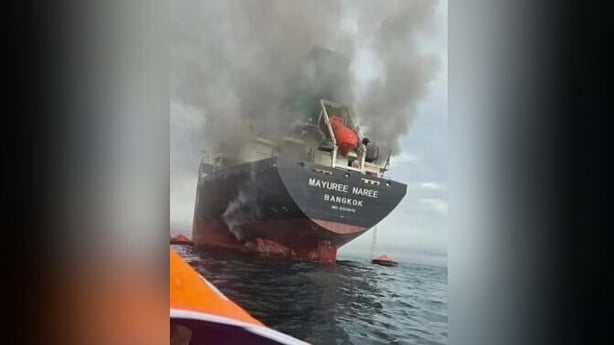
Iran's Revolutionary Guards said their forces had fired on two ships in the Gulf that had disobeyed their orders. One, a Thai-flagged bulk carrier, was set ablaze, forcing the evacuation of crew, with three people reported missing and believed trapped in the engine room.
Reuters could not verify the second incident described by the Guards involving what they described as a Liberian-flagged ship. But two other ships, a Japanese-flagged container ship and a Marshall Islands-flagged bulk carrier, were reported to have sustained damage from projectiles.
The strikes raised the number of merchant ships that have been hit since the war began to 14.
A senior Israeli official told Reuters Israeli leaders now privately accepted that Iran's ruling system could survive the war. Two other Israeli officials said there was no sign Washington was close to ending the campaign.
