


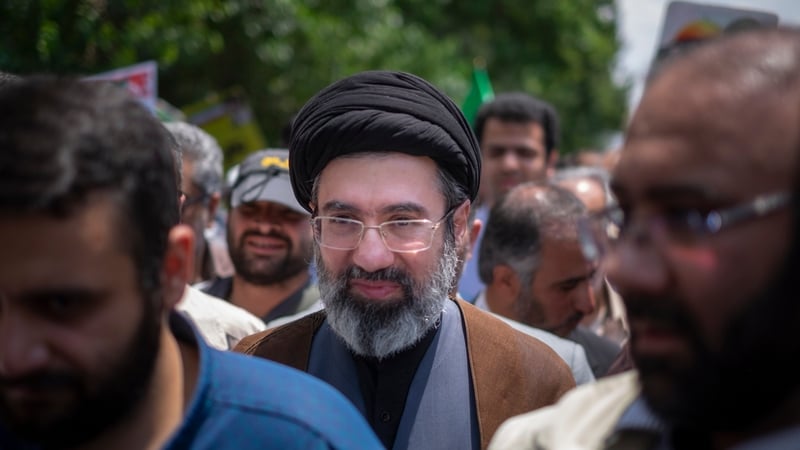
Iran's Assembly of Experts has announced Mojtaba Khamenei as the new supreme leader.
Mr Khamenei, a mid-ranking cleric with close ties to the powerful Revolutionary Guards, had long been viewed by elements of Iran's ruling establishment as a potential successor to his father Ayatollah Ali Khamenei, who was killed after the United States and Israel launched strikes on Iran.
Although Iran's ruling ideology frowns on the principle of hereditary succession, he has a powerful following within the Guards and his dead father's still-influential office.
We need your consent to load this rte-player contentWe use rte-player to manage extra content that can set cookies on your device and collect data about your activity. Please review their details and accept them to load the content.Manage Preferences
Mr Khamenei amassed power under his father as a senior figure close to the security forces. He has opposed reformers seeking to engage with the west as it tries to curb Iran's nuclear programme.
His close ties with the elite Revolutionary Guard Corps give him added leverage across Iran's political and security apparatus and he built up influence behind the scenes as his father's "gatekeeper".
The supreme leader has the final say on matters of state, including foreign policy and Iran's nuclear programme.
Mr Khamenei could face opposition from Iranians who have shown they are ready to stage mass protests to press their demands for greater freedoms despite bloody crackdowns by the authorities.
He was born in 1969 in the holy Shia city of Mashhad and grew up as his father was helping lead the opposition to the Shah. As a young man, he served in the Iran-Iraq war.
He studied under religious conservatives in the seminaries of Qom, Iran's centre of Shia theological learning, and has the clerical rank of Hujjat al-Islam.
He has never held a formal position in the Islamic Republic's government and has appeared at loyalist rallies but has rarely spoken in public.
His role has long been a source of controversy in Iran, with critics rejecting any hint of dynastic politics in a country that overthrew a US-backed monarch in 1979.
US military says seventh service member dies in conflict
The announcement comes as the US military reported a seventh American died from wounds sustained during Iran's initial counter-attack a week ago, a day after US President Donald Trump presided over the return to the US of the remains of the six others who died.
As Mr Trump pressed for an "unconditional surrender" from Iran, Mohammad Bagher Qalibaf, Iran's parliament's speaker, said Tehran was not seeking a ceasefire to the war and would punish aggressors.
Israel has continued to target senior Iranian figures, including Abolqasem Babaian, the recently appointed head of the military office of the supreme leader, saying he was killed in a strike yesterday.
Black smoke hangs over Tehran
As fighting escalated on day nine of the US-Israeli campaign against Iran, thick black smoke hung over Tehran, residents said, after strikes on oil storage facilities had lit up the night sky with plumes of orange flame.
Iran's foreign ministry spokesperson Esmaeil Baghaei said the large-scale attack marked a "dangerous new phase" of the conflict and amounted to a war crime.
"By targeting fuel depots, the aggressors are releasing hazardous materials and toxic substances into the air," he wrote on X.
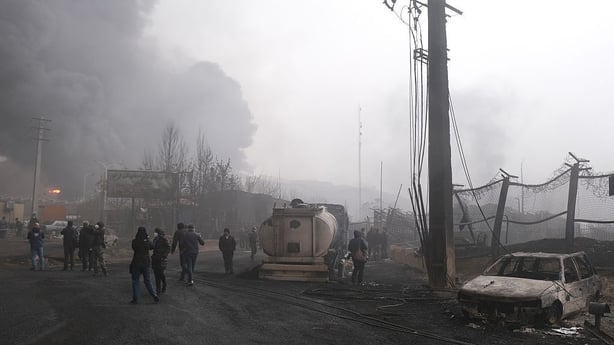
Israeli military spokesman Lieutenant Colonel Nadav Shoshani told reporters the depots were used to fuel Iran's war effort, including producing or storing propellant for ballistic missiles.
"They are a legal military target," he said.
Israeli Prime Minister Benjamin Netanyahu said his government would press on with the assault and strike Iran's rulers "without mercy".
"We have an organised plan with many surprises to destabilise the regime and enable change," he said in a video statement.
US special envoy Steve Witkoff and Mr Trump's son-in-law Jared Kushner will visit Israel on Tuesday, according to Axios, citing a senior US official.
Mr Trump told reporters on Air Force One that he was not seeking negotiations to end the conflict, which has driven up global energy prices, disrupted business and snarled air travel.
"At some point, I don't think there will be anybody left maybe to say, 'We surrender'," he said.
Iranian drones target Gulf states
Saudi Arabia, Kuwait, the United Arab Emirates and Bahrain reported Iranian drone attacks yesterday and early today, including a huge fire that engulfed a government office block in Kuwait.
Kuwait's interior ministry said two officers were killed, while the UAE said four migrant workers had died in Iranian attacks there so far.
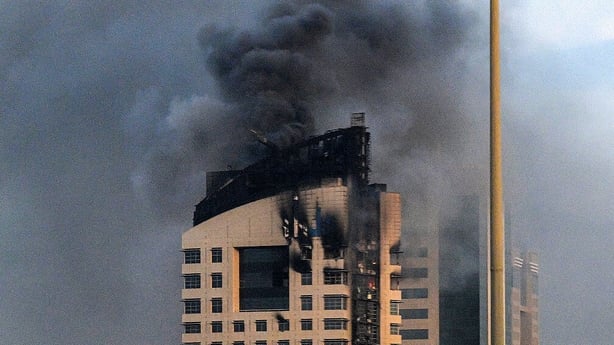
The UAE said air defence teams had knocked out 16 ballistic missiles and 113 drones fired towards the Gulf state. One missile fell in the sea and four drones hit the country's territories.
Bahrain said that an Iranian drone attack had caused "material damage" to a desalination plant, though water supplies were not disrupted. It was the first time an Arab country has said Iran targeted a desalination facility during the conflict.
Yesterday, Iran accused the United States of striking a desalination plant on Qeshm Island, disrupting water supplies to 30 villages and calling it "a dangerous move with grave consequences".
In Saudi Arabia, two people were killed and 12 injured after a projectile hit a residential area in Al-Kharj city, the Civil Defence agency said.
Riyadh has told Tehran that continued Iranian attacks on the kingdom and its energy sector could push Riyadh to retaliate, people familiar with the matter said.
Lebanon has also been pulled into the conflict after the Iran-backed militant group Hezbollah launched rockets and drones into Israel last week, with nearly 400 people killed by Israel over the past week, the health ministry said.
Israel killed at least four people when it struck a hotel in central Beirut today, saying it had targeted Iranian commanders operating in the city - the first such strike on the heart of the Lebanese capital - amid heavy bombardment of the southern suburbs and the country's south and east.
Mr Trump has justified the biggest US military operation in the Middle East since the 2003 invasion of Iraq by saying Tehran posed an imminent threat to the United States, without providing evidence.
He has also said Iran was too close to being able to build a nuclear weapon.
The US and Israel have discussed sending special forces into Iran to secure its stockpile of highly enriched uranium at a later stage of the war, Axios reported, citing sources.
Asked yesterday about sending ground troops to secure nuclear sites, Mr Trump said it was something they would only do if the Iranians were "so decimated that they wouldn't be able to fight at the ground level".
The US-Israeli attacks have killed at least 1,332 Iranian civilians and wounded thousands, according to Iran's UN ambassador.
