
It is a week tomorrow since the US and Israel launched their war on Iran, and the regime of the now dead Ayatollah Ali Khamenei and the Republican Guard.
We've heard a great deal since then from Western politicians and Middle East analysts about the global impacts of the war.
But how do Iranians living under bombardment feel about the war, the possible fall of the ruling Islamic regime, the significant loss of Iranian lives, and the disruption to everyday life?
A number of people living inside the Islamic Republic have spoken about their experience of the war, under condition on anonymity, for fear of reprisal.
A woman in Tehran described the scene in her neighbourhood upon hearing of the killing of Ayatollah Ali Khamenei: "I cannot describe how we felt at that moment. We were all just shouting at how happy we are.
"We all went through the windows and we were all shouting 'thank God' for giving us such an experience. I was really happy that I'm alive to see this moment, to see this day. There was a woman, she was old, but we could actually hear her voice, and she said 'thank God, he finally heard the voices of all the mothers, all the sad mothers of this land' and I was crying with her voice."
Regime supporters took to the streets
Plenty of regime supporters also took to the streets in the aftermath of the killing, says another woman from Tehran, who fled the capital with her family in the days following the conflict.
"I want to say that the level of repression is so intense that even right now, the regime's supporters are holding carnival-like celebrations every night, making loud noise and disturbing people.
We need your consent to load this rte-player contentWe use rte-player to manage extra content that can set cookies on your device and collect data about your activity. Please review their details and accept them to load the content.Manage Preferences
"I don’t understand how someone whose leader has died is holding carnivals, I really don’t understand it. They are repressing people very intensely in a structured way. And when I see things like this, I get scared."
The conflict has raged for six days, with intense bombardment from the US and Israel.
Another man, who again did not want to be named, described the conditions for people caught in the crossfire in the capital, Tehran.
"We see, mostly they are targeting military areas, IRGC bases, security zones, headquarters, and Basij bases.
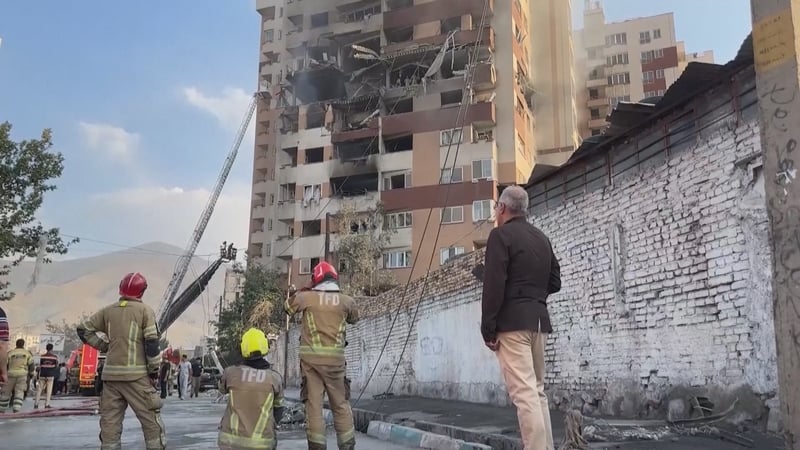
"Now, the houses around them, due to the blast waves, sometimes their windows and doors, or even walls, have collapsed. People are warned not to pass near them, and they take these warnings seriously.
"Tehran’s situation is still closed down, and I think less than 2%, like these shops we see open, often have no customers, no one coming in to buy anything. Most cities, including Tehran, look empty and quiet."
Regime leaders 'using hospitals for shelter'
Despite the ongoing threat of missile strikes, though, another woman, says it is the regime officials that are putting ordinary Iranians in the most danger.
"Israel told us to evacuate some regions that are related to military services. And we see that even after one day, after bombing or airstrikes, that Israel attacked some region that is really important to the military forces.
"Unfortunately, they (the Iranian regime) use people to protect their own forces.
"For example, I have some friends that are doctors and nurses. I'm really worried about them when they have to go to that hospital, because they (the regime) hide the people that they want to keep safe, all the important generals and military commanders, in hospitals."