


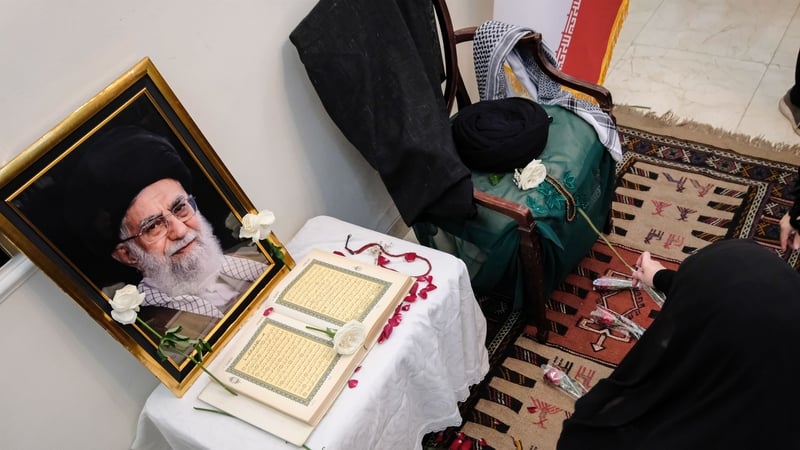
US President Donald Trump has said that he wants the United States to play a role in choosing Iran's next supreme leader.
He said that it was early in the process of selecting a replacement for Ayatollah Ali Khamenei, but his son Mojtaba was an unlikely choice.
"We want to be involved in the process of choosing the person who is going to lead Iran into the future," President Trump said.
"We don't have to go back every five years and do this again and again."
Mr Trump also encouraged Kurdish opposition groups in Iran to go on the offensive.
"I think it's wonderful that they want to do that, I'd be all for it," he said.
Asked if the US would provide or had offered air cover, he responded: "I can't tell you that," but added that the objective for the Kurds would be "to win".
"If they're going to do that, that's good," President Trump added.
Iranian Kurdish militias have consulted with the US in recent days about whether, and how, to attack Iran's security forces in the western part of the country, according to sources with knowledge of the matter.
The coalition of groups - based on the Iran-Iraq border in the semi-autonomous region of Iraqi Kurdistan - has been training to mount such an attack in hopes of weakening the country's military, as the US and Israel continue to target Iran with bombs and missiles.
Mr Trump also signalled confidence that the major shipping route near Iran, the Strait of Hormuz, will remain open.
Closing the Strait of Hormuz, a narrow channel between Iran and Oman through which one-fifth of the world's crude oil and liquefied natural gas passes, has been one of Iran's main objectives.
Shipping through the crucial artery has ground to a near halt after Iranian attacks on six vessels.
"They have no navy, you know the navy is now at the bottom of the sea," President Trump said. "I'm watching Hormuz very closely."
Israel orders residents to leave southern Beirut
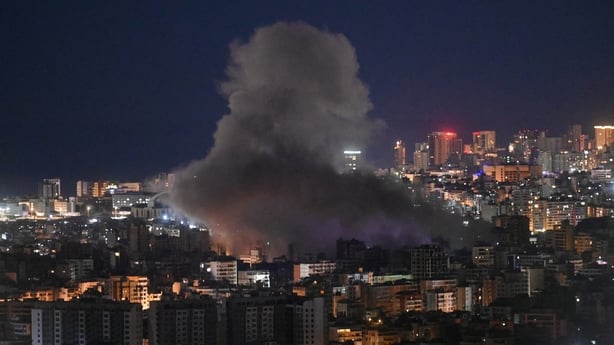
The Israeli military has warned hundreds of thousands of residents in the southern suburbs of Lebanon's capital, Beirut, to leave immediately.
Yesterday, Israel told people in the south Lebanon to move north of the Litani River.
The death toll from Israeli strikes on Lebanon has risen to 102, according to the health ministry in Beirut, since the country was drawn into the war earlier this week.
The ministry added that 638 people have also been wounded since Monday.
It said the tolls were likely to increase as hospitals receive more victims.
Iran accused the US and Israel of deliberately targeting civilian areas since the war began on Saturday.
"Our people are being brutally slaughtered as the aggressors deliberately target civilian areas and any location they believe will inflict the maximum possible suffering and loss of life," foreign ministry spokesman Esmaeil Baqaei said in a social media post.
Iranian security chief Ali Larijani condemned President Trump after an attack on a school in southern Iran on Saturday in which more than 160 people died.
Mr Larijani said that the killing of innocent girls in Minab, "at the hands of Israeli-American criminals", shows the theory of peace through strength has been "stained with blood".
In a social media post, he addressed President Trump directly, asking: "Was this the anthem you composed for freedom in Iran?"
Earlier, Iran's Revolutionary Guards said that they had hit a US tanker in the northern part of the Gulf.
The guards said in the statement, carried by state media that, in time of war, passage through the Strait of Hormuz would be under the control of Iran.
The Iranian foreign minister said earlier that the US will "bitterly regret the precedent it has set" following its sinking of an Iranian warship yesterday.
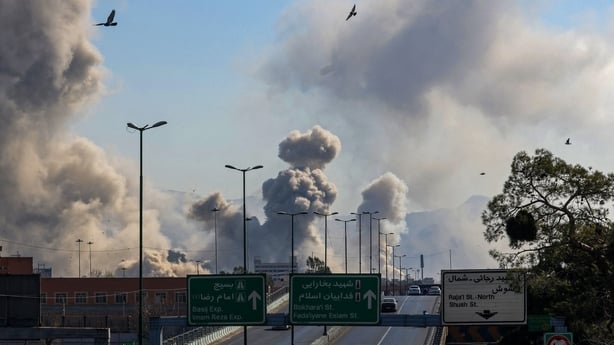
Azerbaijan has warned that it is preparing an unspecified response after Iranian drones flew across its border and injured four people in Nakhchivan.
"These attacks will not remain unanswered," the Azerbaijani Defence Ministry said in a statement.
Azerbaijan said that one drone fell on the terminal building of Nakhchivan International Airport, around 10km from the border with Iran, and another drone landed close to a school building in a nearby village.
Nakhchivan is a landlocked exclave of Azerbaijan, bordering Armenia, Iran and Turkey.
Watch: Drone strike at Nakhchivan International Airport in Azerbaijan
As the conflict continues, countries in the Middle East have told European officials they are concerned about the risk of civil war in Iran, said EU High Representative for Foreign Affairs Kaja Kallas.
"When we talk to the countries in the region, they are also worried about civil wars inside Iran because of the regime's leadership and what is going on there," she said, as EU foreign ministers met representatives of the Gulf Cooperation Council.
"Wars really end in diplomacy and there has to be room for diplomacy here to really get out of this cycle of escalation," Ms Kallas said.
