


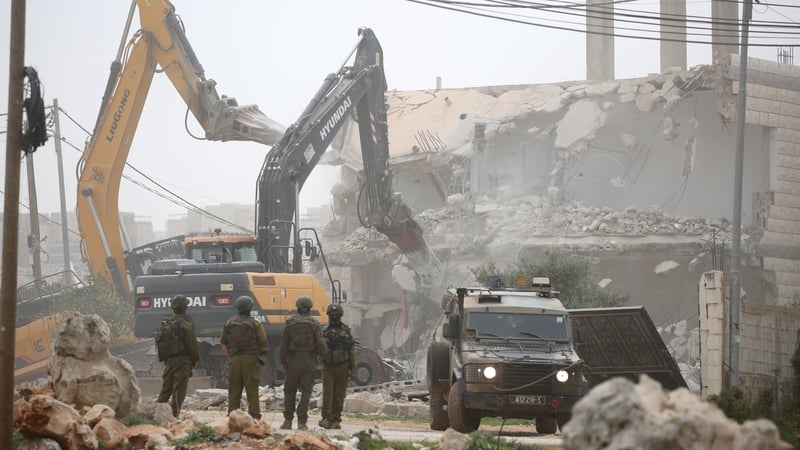
A top UN official warned today that steps by Israel to tighten control of areas of the West Bank administered by the Palestinian Authority amount to "gradual de facto annexation."
Since last week, Israel has approved a series of initiatives backed by far-right ministers to consolidate control over the West Bank where the Palestinians exercise limited autonomy under past deals.
"We are witnessing the gradual de facto annexation of the West Bank, as unilateral Israeli steps steadily transform the landscape," UN Under-Secretary-General Rosemary DiCarlo told a meeting of the Security Council on the Palestinian question.
"If implemented, these measures will constitute a dangerous expansion of Israeli civil authority in the occupied West Bank, including in sensitive areas like Hebron.
"The moves could lead to settlement expansion by removing bureaucratic barriers and easing land purchases and building permits."
The recently approved steps are set to increase Israel's control in parts of the West Bank where the Palestinian Authority currently exercises power.
'Prevent destabilization'
Under the Oslo Accords, the West Bank was divided into areas A, B and C - under Palestinian, mixed and Israeli governance respectively.
The West Bank would form the largest part of any future Palestinian state, but many on Israel's religious right view it as Israeli land.
The Oslo Accords, in place since the 1990s, were signed with the stated aim of paving the way for an independent Palestinian state.
The UN missions for 85 member states issued a joint statement yesterday condemning Israel's encroaching control of the West Bank.
"We strongly condemn unilateral Israeli decisions and measures aimed at expanding Israel's unlawful presence in the West Bank," the statement said.
Israeli Foreign Minister Gideon Sa'ar said ahead of DiCarlo's remarks that "amazingly so many countries say the Jewish presence in our ancient homeland violates international law.
"No other nation in any other place in the world has a stronger right than our historical and documented right to the land of the Bible."
Britain's Foreign Secretary Yvette Cooper, who chaired the meeting, said: "we must prevent the destabilization of the West Bank and preserve the viability of a Palestinian state."
"We have seen the Palestinian economy face strangulation, including the Israeli government withholding some of the Palestinian Authority's own tax revenues."
Today's meeting was reportedly brought forward as US President Donald Trump prepares to convene a meeting of his 'Board of Peace' in Washington.
The board, of which Trump is the chairman, was initially designed to oversee the Gaza truce and the territory's reconstruction after the war between Hamas and Israel.
But its purpose has since morphed into resolving myriad international conflicts, triggering suspicions the US president wants to create a rival to the United Nations.
"The board is not talking. It's doing," US ambassador to the UN Mike Waltz said, accusing "the chattering classes" of criticizing the structure of the board.
The UN will be unrepresented at the meeting of the board.
Israel says it will limit number of Palestinian worshippers at Al-Aqsa
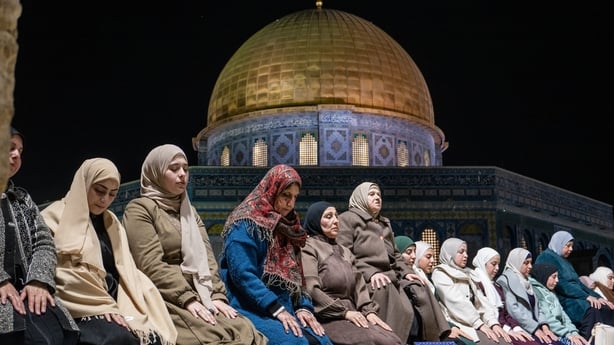
Meanwhile, Israel announced that it will cap the number of Palestinian worshippers from the occupied West Bank attending weekly Friday prayers at the Al-Aqsa Mosque in east Jerusalem at 10,000 during the holy month of Ramadan, which began today.
Israeli authorities also imposed age restrictions on West Bank Palestinians, permitting entry only to men aged 55 and older, women aged 50 and older, and children up to age 12.
"10,000 Palestinian worshippers will be permitted to enter the Temple Mount for Friday prayers throughout the month of Ramadan, subject to obtaining a dedicated daily permit in advance," COGAT, the Israeli defence ministry agency in charge of civilian matters in the Palestinian territories, said in a statement.
"Entry for men will be permitted from age 55, for women from age 50, and for children up to age 12 when accompanied by a first-degree relative."
COGAT told AFP that the restrictions apply only to Palestinians travelling from the West Bank, which Israel has occupied since the 1967 Arab-Israeli war.
"It is emphasised that all permits are conditional upon prior security approval by the relevant security authorities," COGAT said.
"In addition, residents travelling to prayers at the Temple Mount will be required to undergo digital documentation at the crossings upon their return to the areas of Judea and Samaria at the conclusion of the prayer day," it added, using the Biblical term for the West Bank.
During Ramadan, hundreds of thousands of Palestinians traditionally attend prayers at Al‑Aqsa, Islam's third‑holiest site, located in east Jerusalem, which Israel captured in 1967 and later annexed in a move that is not internationally recognised.
Since Israel's war in Gaza broke out in October 2023, the attendance of worshippers has declined due to security concerns and Israeli restrictions.
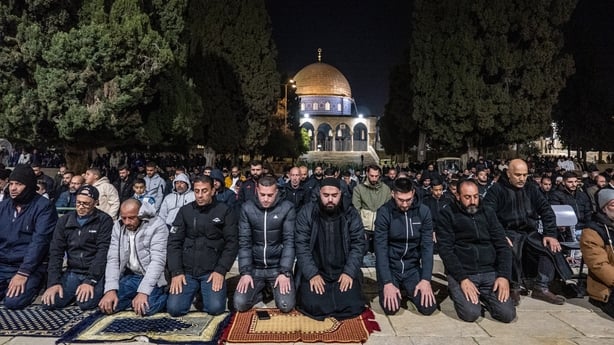
The Palestinian Jerusalem Governorate said this week that Israeli authorities had prevented the Islamic Waqf - the Jordanian‑run body that administers the site - from carrying out routine preparations ahead of Ramadan, including installing shade structures and setting up temporary medical clinics.
A senior imam of the Al-Aqsa Mosque, Sheikh Muhammad al-Abbasi, told AFP that he, too, had been barred from entering the compound.
"I have been barred from the mosque for a week, and the order can be renewed," he said.
Sheikh Abbasi said he was not informed of the reason for the ban, which came into effect on Monday.
Under long‑standing arrangements, Jews may visit the Al‑Aqsa compound - which they revere as the site of the first and second Jewish temples - but they are not permitted to pray there.
Israel claims it is committed to upholding this status quo, though Palestinians fear it is being eroded.
In recent years, a growing number of Jewish ultranationalists have challenged the prayer ban, including far‑right politician Itamar Ben Gvir, who prayed at the site while serving as national security minister in 2024 and 2025.
IDF soldier killed in Gaza in 'friendly fire' incident
Earlier today, Israeli Prime Minister Benjamin Netanyahu said that a soldier killed in Gaza died in a "friendly fire" incident.
Earlier, the Israeli military had claimed that Staff Sergeant Ofri Yafe, 21, was killed in combat in southern Gaza.
However, in a message of condolence to Mr Yafe's family, Mr Netanyahu said he "fell in a painful friendly fire incident" in the Palestinian territory, according to a statement issued by the prime minister's office.
The death brings to five the number of Israeli soldiers killed in Gaza since a ceasefire took effect on 10 October.
