


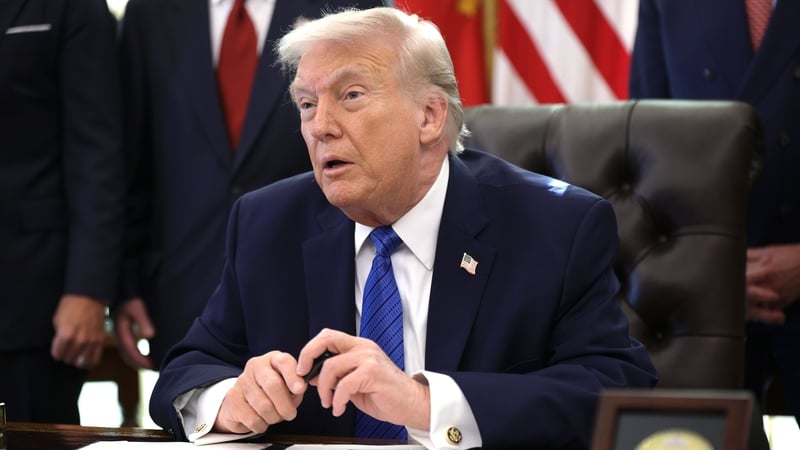
US President Donald Trump has said he believed Iran wanted to make a deal to avoid military action, adding that he had set Tehran an undisclosed deadline to respond as US ships steam towards the region.
"I can say this, they do want to make a deal," Mr Trump told reporters in the Oval Office. Asked if he had given a deadline, Mr Trump said "yeah I have" but said that "only they know for sure" what it was.
Earlier today, the United States announced new sanctions against Iran's interior minister and other officials increasing pressure on the Iranian government.
Announcing the sanctions the US Treasury Department said Iranian Interior Minister Eskandar Momeni "oversees the murderous Law Enforcement Forces of the Islamic Republic of Iran (LEF), a key entity responsible for the deaths of thousands of peaceful protesters".
Those sanctioned also included several high-ranking officers of the Islamic Revolutionary Guard Corps, as well as Iranian investor Babak Morteza Zanjani, who stands accused of having "embezzled billions in funds from the Iranian people".
In a first, Treasury also announced sanctions against digital currency exchanges linked to Mr Zanjani "that have processed large volumes of funds associated with IRGC-linked counterparties."
Yesterday, the European Union designated the Revolutionary Guards as a "terrorist organisation," adopting visa bans and asset freezes on a number of Iranian state entities and officials.
Meanwhile, Iran's top diplomat Abbas Araghchi said that Iran is ready to resume nuclear talks with the United States "on an equal footing".
Speaking at a joint press conference in Istanbul with his Turkish counterpart, Mr Araghchi said: "If the negotiations are fair and on an equal footing, the Islamic Republic of Iran is ready to participate."
He added the standard disclaimer that Tehran has "never sought to obtain nuclear weapons".
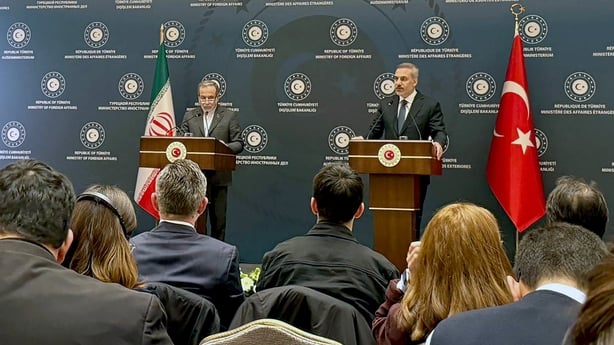
Turkish Foreign Minister Hakan Fidan said he spoke with US special envoy Steve Witkoff yesterday and that he will continue speaking to US officials on Iran.
Speaking at the joint press conference, Mr Fidan said he hoped a solution could be found to avoid conflict and the isolation of Iran.
We need your consent to load this rte-player contentWe use rte-player to manage extra content that can set cookies on your device and collect data about your activity. Please review their details and accept them to load the content.Manage Preferences
Speaking yesterday, Mr Trump said: "We have a lot of very big, very powerful ships sailing to Iran right now and it would be great if we didn't have to use them."
However speaking this afternoon, Mr Araghchi said Tehran had no plans in place to meet with US officials about resuming talks, insisting preparatory work was the first priority.
"No meeting plan has been set between us and the Americans. We are ready for fair and just negotiations, but preparations are needed, both in terms of the form and subject of the discussions and the venue," he said, indicating he had discussed the matter with Mr Fidan in Istanbul.
US officials say Mr Trump is reviewing his options but has not decided whether to strike Iran.
US-Iranian tensions have soared in recent weeks after a crackdown on protests across Iran by its clerical authorities.
The US president has repeatedly threatened to intervene if Iran continued to kill protesters, but the countrywide demonstrations over economic privations and political repression have since abated.
Mr Trump has said the United States would act if Iran resumed its nuclear programme after air strikes last June by Israeli and US forces on key nuclear installations.
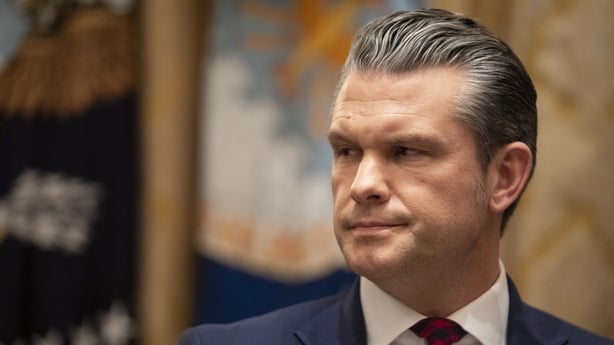
With a large US military force gathered in the region, Mr Hegseth was asked earlier by Mr Trump at a cabinet meeting to comment on the situation in Iran.
"They should not pursue nuclear capabilities. We will be prepared to deliver whatever this president expects of the War Department," he said, referring to the Trump administration's unofficial renaming of the Defense Department.
Speaking to Al-Jazeera television on Wednesday, Mr Fidan said he had suggested Washington tackle outstanding issues with Iran "one-by-one", starting with the nuclear file rather than trying to address everything at once.
His remarks reflected Tehran's own stance on talks, said Director of the Ankara-based Centre for Iranian Studies Serhan Afacan.
"If Trump invites the Iranians to reach a deal on the nuclear file, they are going to say yes. But if you put all of the issues in the same basket, that will be impossible," he said.
"For now, the ballistic missile programme remains a red line, as it sits at the core of Iran's defence architecture," he added.
Mr Afacan said: "Compromise is not impossible, but it would only come after long rounds of negotiations and if Tehran's security concerns - especially vis-a-vis the US and Israel - are substantially addressed.
"It all depends on what President Trump is going to say: if he says 'I'm not going to attack Iran' we should expect to see negotiations in a matter of weeks."
The move put the guards in a category similar to that of Islamic State and al Qaeda, marking a symbolic shift in Europe's approach to Iran's leadership.
Iran's foreign minister criticised the EU ministers' decision.
Europe is "making another major strategic mistake," he wrote on X, adding that "the EU's current posture is deeply damaging to its own interests".
