


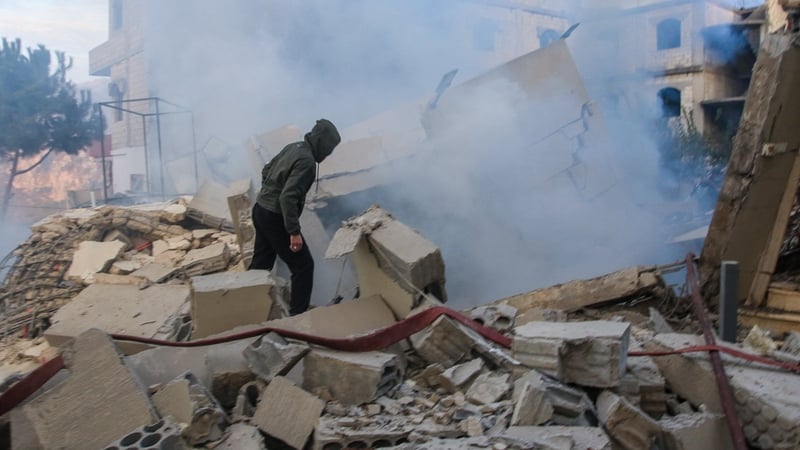
Israeli raids have hit south Lebanon as its military said it was striking Hezbollah weapons storage facilities, a day after Lebanese and Israeli civilian representatives held their first direct talks in decades.
Despite a ceasefire in November of last year that was supposed to end more than 12 months of hostilities between Israel and the Iran-backed militant group, Israel has kept up strikes on Lebanon and has also maintained troops in five south Lebanon areas it deems strategic.
The visit from Sunday to Tuesday of Pope Leo XIV had provided Lebanon with a window of reprieve from Israeli air strikes, which had intensified in recent weeks, and the pontiff urged an end to hostilities during his visit.
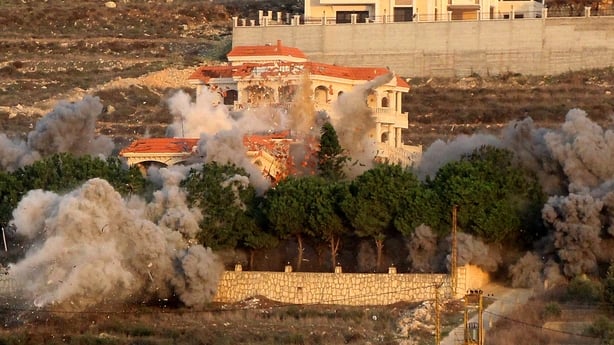
Today however, the Israeli army said it "began conducting strikes on Hezbollah terror targets in southern Lebanon," after warning it would strike buildings in south Lebanon's Mahrouna and Jbaa.
It subsequently issued warnings that it would strike further Hezbollah "military infrastructure" in Majadal and Baraasheet, also in the south.
Lebanon's official National News Agency said "Israeli warplanes launched a strike on the town of Mahrouna" while other raids targeted buildings in Jbaa, Majadal and Baraasheet.
An AFP photographer saw smoke rising from the site of the strike in the town of Jbaa.
"It's a completely civilian area. We're used to Israeli threats from time to time," a local official told journalists.
"As for the damage, there's not a window within 300 metres that didn't break. Everyone is living in shock," he added.
Meanwhile, the Israeli military said it struck "weapons storage facilities belonging to Hezbollah" located in the "heart of the civilian population".
"This is yet another example of Hezbollah's cynical use of Lebanese civilians as human shields, and continued operations from within civilian areas," it said.
Lebanon's government has committed to disarming Hezbollah but the group has rejected the idea and many in the country fear a return to expanded Israeli military operations.
'Not yet at peace talks'
Lebanese and Israeli civilian representatives held surprise talks yesterday under the auspices of the ceasefire monitoring mechanism at the UN peacekeeping force's headquarters in Lebanon's Naqura near the border with Israel.
Representatives of the ceasefire monitoring committee - the United States, France, Lebanon, Israel and the UN force - regularly convene in Naqura.
Lebanon and Israel have technically been at war since 1948, and Lebanese Prime Minister Nawaf Salam cautioned the new diplomatic contact did not amount to broader peace discussions.
The United States has been piling pressure on Lebanon to rapidly disarm Hezbollah, and has pushed for direct talks between the two neighbours.
Israeli Prime Minister Benjamin Netanyahu's office said the atmosphere at the talks was "positive", and that there had been agreement "to develop ideas to promote potential economic cooperation between Israel and Lebanon".
Israel also made it clear it was "essential" that Lebanese militant group Hezbollah disarm regardless of any progress in economic cooperation, the premier's office added.
Salam said the new discussions were strictly limited to fully implementing last year's truce.
"We are not yet at peace talks," he told journalists yesterday.
He said the talks only sought "the cessation of hostilities", the "release of Lebanese hostages" and "the complete Israeli withdrawal" from Lebanon.
A spokesperson for the French foreign ministry meanwhile said France "welcomes the holding of these discussions" that allow "all parties to come to the table".
"We are fully committed to ensuring that this mechanism remains the framework to promote de-escalation and enable a lasting return to stability in the region," he said.
Until now, Israel and Lebanon, which have no formal diplomatic relations, have insisted on limiting participation in the ceasefire mechanism to military officers.
The US embassy in Beirut said US envoy Morgan Ortagus also attended.
Ortagus was in Jerusalem a day earlier and met with Israeli Prime Minister Benjamin Netanyahu and Israeli Foreign Minister Gideon Saar.
Anti-Hamas Gazan clansman reported killed
The head of an armed Palestinian faction that opposes Hamas in Gaza has been killed, Israeli media has reported, in what would be a blow to Israeli efforts to support Gazan clans against the Islamist movement.
Yasser Abu Shabab, a Bedouin tribal leader based in Israeli-held Rafah in southern Gaza, has led the most prominent of several small anti-Hamas groups that emerged in Gaza during the war that began more than two years ago.
His death would be a boost to Hamas, which has branded him a collaborator and ordered its fighters to kill or capture him.
There was no immediate word about Abu Shabab's status on the Facebook page of his group, the Popular Forces.
Mr Netanyahu acknowledged in June that Israel had armed anti-Hamas clans, though Israel has announced few other details of the policy since then.
