


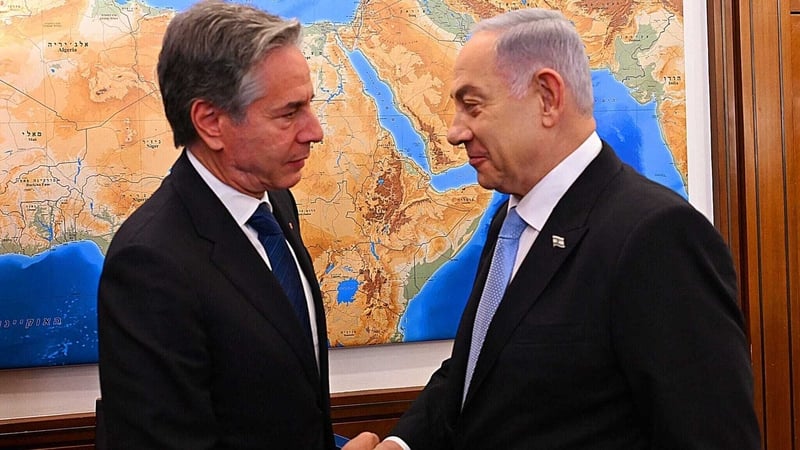
Secretary of State Antony Blinken has urged Hamas to accept a US bridging proposal for a Gaza ceasefire and hostage release deal after what he said was a "very constructive" meeting with Israeli Prime Minister Benjamin Netanyahu.
He had earlier said the latest push for a deal was probably the best and possibly last opportunity, urging both sides towards agreement.
Talks in Qatar last week paused without a breakthrough, but the negotiations are expected to resume this week based on the US proposal to bridge the gaps between Israel and Hamas.
However, with the Palestinian Islamist group announcing a resumption of suicide bombing inside Israel after many years, and medics saying Israeli military strikes killed at least 30 Palestinians across Gaza, there are few signs of conciliation on the ground.
"In a very constructive meeting with Prime Minister Netanyahu today, he confirmed to me that Israel accepts the bridging proposal - that he supports it," Mr Blinken told reporters in Tel Aviv.
"It's now incumbent on Hamas to do the same, and then the parties, with the help of the mediators - the United States, Egypt and Qatar - have to come together and complete the process of reaching clear understandings about how they'll implement the commitments that they've made under this agreement."
Despite US expressions of optimism and Mr Netanyahu's office describing the meeting as positive, both Israel and Hamas have signalled that any deal will be difficult.
Hamas accused Mr Netanyahu of "thwarting the mediators' efforts" and Turkey said Hamas envoys had told it that US officials were "painting an overly optimistic picture".
Months of on-off talks have circled the same issues, with Israel saying the war can only end with the destruction of Hamas as a military and political force and Hamas saying it will only accept a permanent, and not a temporary, ceasefire.
There are disagreements over Israel's continued military presence inside Gaza, particularly along the border with Egypt, over the free movement of Palestinians inside the territory, and over the identity and number of prisoners to be freed in a swap.
There is an urgency to reach a ceasefire deal amid fears that war could engulf the region. Iran has vowed to retaliate against Israel after the assassination of Hamas leader Ismail Haniyeh in Tehran on 31 July.
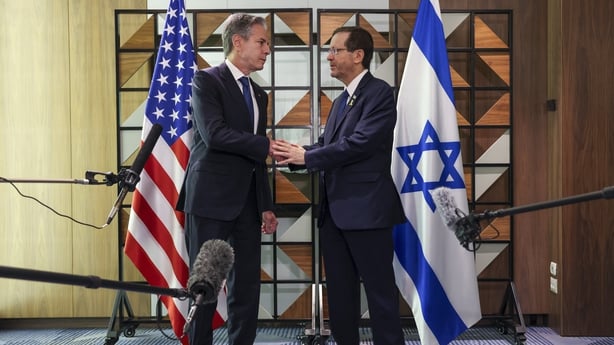
Mr Blinken appealed that "no one takes any steps that could derail this process, and so we're working to make sure that there is no escalation, that there are no provocations".
Diplomats hope that a Gaza deal could help avert a wider conflagration, and a US official speaking on customary condition of anonymity said that this is "a particularly critical time".
Ahead of the talks in Qatar last week, Hamas had called on mediators to implement a framework outlined in late May by President Biden, rather than holding more negotiations.
After a new proposal was drawn up at those talks, Hamas now accuses Mr Netanyahu of obstruction.
According to Hamas, the latest proposal "responds to Netanyahu's conditions, especially his rejection of a permanent ceasefire and a comprehensive withdrawal from the Gaza Strip, and his insistence on continuing to occupy the Netzarim junction, the Rafah crossing and the Philadelphi corridor".
The latter two places are seen by Israel as important for preventing the flow of any weapons into Gaza, while the Netzarim junction sits at a strategic point between northern and southern Gaza.
Mr Netanyahu was "fully responsible for thwarting the efforts of the mediators, obstructing an agreement, and (bears) full responsibility for the lives" of hostages in Gaza, the Islamist movement said in a statement.
We need your consent to load this rte-player contentWe use rte-player to manage extra content that can set cookies on your device and collect data about your activity. Please review their details and accept them to load the content.Manage Preferences
While the pro-Western Jordan, hostage supporters protesting in Israel, and Hamas itself have called for pressure on Mr Netanyahu in order for an agreement to be reached, far-right members crucial to the prime minister's governing coalition oppose any truce.
Yesterday Mr Netanyahu reiterated that Hamas must be pressured.
"Hamas, up to this moment, remains obstinate. It did not even send a representative to the talks in Doha. Therefore, the pressure should be directed at Hamas and (their leader Yahya) Sinwar, not at the Israeli government," Mr Netanyahu said at a cabinet meeting.
The plan announced by Mr Biden at the end of May would freeze fighting for an initial six weeks as Israeli hostages are exchanged for Palestinian prisoners in Israeli jails and humanitarian aid enters besieged Gaza.
As efforts towards a long-sought truce continued, so has the violence in Gaza, and in the Israeli-occupied West Bank and in Lebanon, where Israeli forces and Hamas's Iran-backed ally Hezbollah have traded near-daily fire throughout the war.
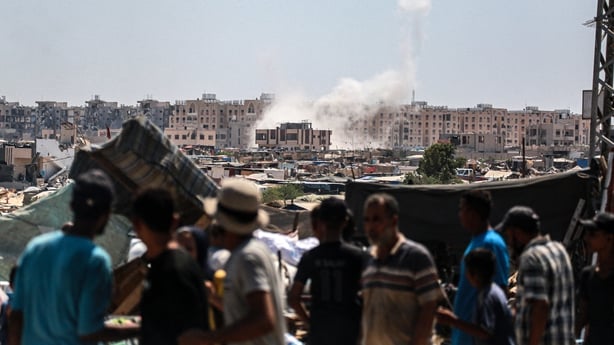
Civil defence rescuers in Hamas-run Gaza reported a total of 11 people killed in Israeli bombardment of Deir el-Balah and in air strikes on Jabalia refugee camp.
The latest killings have pushed to 40,099 the death toll from Gaza's health ministry, which does not give details of civilian and militant deaths.
Hamas's 7 October attack on Israel claimed the lives of around 1,200 people, mostly civilians, and unleashed Israel's devastating response.
Out of 251 hostages seized during the attack, 111 are still held in Gaza, including 39 the military have said are dead. More than 100 were freed during a one-week truce in November.
