


Israeli Prime Minister Benjamin Netanyahu has vowed to press ahead with a long-promised assault on the southern Gaza city of Rafah, whatever the response by Hamas to the latest proposals for a halt to the fighting and a return of Israeli hostages.
Expectations that a ceasefire agreement could be in sight have grown in recent days following a renewed push led by Egypt to revive stalled negotiations between Israel and Hamas, Gaza's ruling militant group.
However, Mr Netanyahu said that with or without a deal, Israel intended to pursue the operation to destroy the remaining Hamas combat formations in Rafah, where more than one million Palestinians displaced from their homes are seeking shelter.
"The idea that we will halt the war before achieving all of its goals is out of the question," he said in a statement.
"We will enter Rafah and we will eliminate the Hamas battalions there - with or without a deal, in order to achieve total victory."
The United Nations Humanitarian Affairs and Emergency Relief Coordinator warned that "a ground operation" in the city "is on the immediate horizon".
Martin Griffiths said: "The world has been appealing to the Israeli authorities for weeks to spare Rafah ... the simplest truth is that a ground operation in Rafah will be nothing short of a tragedy beyond words."
He added that Israeli improvements to aid access in Gaza "cannot be used to prepare for or justify a full-blown military assault on Rafah".
UN Secretary-General Antonio Guterres appealed for states with influence over Israel "to do everything in their power" to prevent an assault on the city.
An Israeli government spokesperson said Hamas was getting the message when it came to the country's stance on a ceasefire, but the militant group had no incentive to release hostages unless it understood that it had a lot to lose.
"The vast majority of people in Israel want us to finish the job and that's exactly what we'll do," Avi Hyman told RTÉ's Drivetime.
He said that Israel takes the utmost precautions in warfare, was fully compliant with international humanitarian law and was doing its utmost to get aid into Gaza.
Mr Hyman added that when the dust settles "the real numbers of dead will come out as the numbers coming from Hamas authorities could not be trusted".
"We have to destroy Hamas for the sake of Israel and for the sake of the free world," he added.
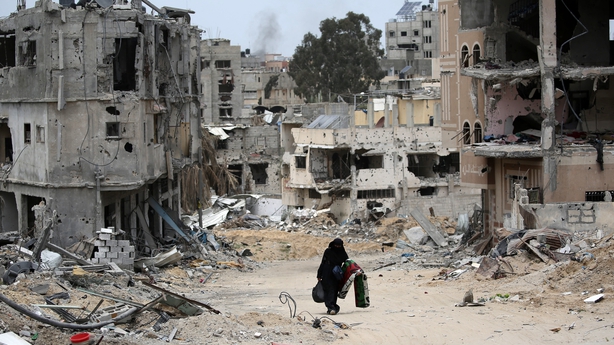
Gaza - which is densely populated - has already been largely devastated by the Israeli campaign and international pressure for an agreement to stop the war has been building as the conflict nears the end of its seventh month.
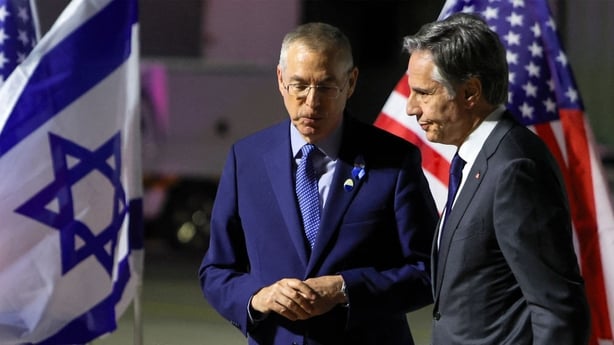
US Secretary of State Antony Blinken has arrived in Tel Aviv following a visit to Riyadh to help advance a normalisation deal between Saudi Arabia and Israel.
The US State Department said it had still not seen a credible plan for an Israeli operation in Rafah.
Visiting French Foreign Minister Stephane Sejourne also weighed in, telling Mr Netanyahu that going ahead with the Rafah operation would be a "bad idea" that would not resolve anything.
Earlier, a source close to Mr Netanyahu said Israel has been waiting for Hamas to respond to the latest ceasefire proposals tabled by Egypt, one of several foreign mediators, before sending a team to Cairo to continue talks.
But there has been little sign of agreement on a Hamas demand that any deal must ensure a withdrawal of troops and a permanent end to the Israeli operation in Gaza - the most fundamental difference between the two sides.
"We can't tell our people the occupation will stay or the fight will resume after Israel regains its prisoners," said a Palestinian official from a group allied with Hamas. "Our people want this aggression to end".
For Mr Netanyahu, any move is likely to be affected by divisions in his coalition cabinet between ministers pressing to bring home at least some of the 133 Israeli hostages left in Gaza, and hardliners insisting on the long-promised assault on remaining Hamas battalions in Rafah.
Israeli officials have said the operation could be deferred if Hamas accepts the deal on offer - which includes no definitive ceasefire but the return of 33 vulnerable hostages - women, children and those in frail health - in exchange for a much larger number of Palestinian prisoners and a limited pause in the fighting.
"As far as Israel is concerned, this is the last chance to hold off a Rafah sweep. The IDF [Israel Defense Forces] has already started mobilising troops for that operation," said a second Israeli official, speaking on condition of anonymity because of the sensitive nature of the talks.
The Israeli military said two divisions which left Gaza last week were refitting and repairing equipment and holding training and operational assessment exercises in preparation for continued operations in the enclave.
However, there were some questions about whether the repeated declarations of an impending operation were intended mainly as a negotiating tactic to put pressure on Hamas.
A US official, speaking on condition of anonymity, said Mr Netanyahu's repeated vows to launch an Israeli offensive into Rafah were "definitely meant to apply pressure at this point".
"It is uncertain if he (Netanyahu) is committed in the longer term" to storming Rafah, the official said.
Mr Netanyahu's position has been complicated by talk that the International Criminal Court (ICC) may be preparing arrest warrants for himself and other senior Israeli leaders on charges related to the conduct of the war.
He said that any ICC arrest warrants would be a scandal on an "historic scale" but would not affect Israel's determination to achieve its war aims.
The ICC has said nothing to confirm the speculation, which prompted Israeli Foreign Minister Israel Katz to warn Israeli embassies abroad to bolster their security.
But it underlined fears in Israel of growing isolation over the fighting in Gaza, which has caused mounting international alarm at the scale of destruction, the risk of famine and the prospect of a slide into a wider regional conflict.
Most of Gaza's 2.3 million people have been displaced by the war.
Israel's military campaign has killed at least 34,535 Palestinians, including 47 in the past 24 hours, acccording to Gaza's health ministry.
Israel's air and ground war in the enclave began after Hamas-led gunmen crossed the border on 7 October and rampaged through nearby communities, killing 1,200 Israelis and foreigners and taking 253 into captivity, according to Israeli figures.
