
RTÉ's North East Correspondent Laura Hogan travels to Navan, Co Meath, and Dundalk, Co Louth, and speaks to commuters who make the journey to Dublin using public transport.
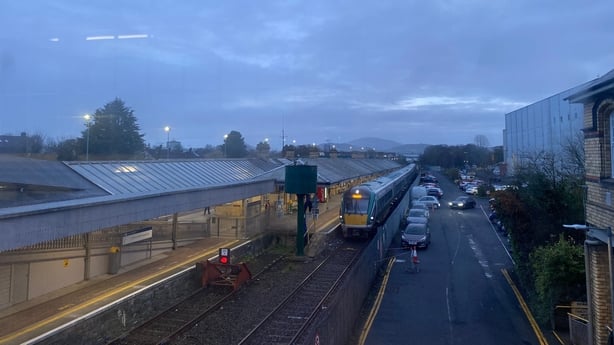
Morning had not quite broken at Dundalk's Clarke Station when we arrive to capture the early morning commute.
The porch light was still on and bird song was audible under the hum of a waiting train bound for Dublin.
But we were by no means the first ones there, with the upper carpark already full just after 6am.
The larger lower car park would not be far behind it, as people from Dundalk and its surrounding areas arrive for the next leg of their journeys.
Louth may be the 'Wee County', but it is home to the country's two largest towns - Dundalk and Drogheda.
The last census in 2022 showed that 7,418 workers in Louth were travelling more than one hour to work, accounting for 14% of commuter journeys in the county.
More than 3,000 workers were commuting into Dublin from Drogheda alone, placing the town among the top ten with the largest number of people travelling to Dublin city and suburbs for work.
Four years on, those numbers are likely to have grown even further as more and more people come to live here.
Many new housing developments are popping up in parts of Dundalk and Drogheda, making it an attractive place to live and all in commuting distance from the capital.
The commuter experience
On normal weekdays, around 2,500 train journeys start or end in Dundalk, while around 4,000 journeys start or end from Drogheda.
The busiest services on the route are the 7.36am train from Drogheda to Pearse Station, and the 5.59pm Grand Canal Dock to Dundalk service.
The commuters we spoke to are making the journey two, three or four days a week, with some remote work mixed in.
Their journeys are taking between one-and-a-half and two hours door-to-door, each way.
The frequency of services is something that has improved in recent years, with the Enterprise service from Belfast to Dublin now running every hour, serving Dublin Connolly, Drogheda, Dundalk, Newry, Portadown and Belfast Grand Central.
Other Iarnród Éireann commuter services operate with more stops along the way to Dublin.
Extra trains have led to higher demand, but another issue has arisen too - the availability of car parking.
There are 200 car parking spaces in Dundalk.
Iarnród Éireann said that the expansion of the Enterprise Service has led to "significant growth in demand and there is pressure on car park capacity as a result".
Read more commuter stories:
Can Cork's transport plans keep pace with city's growth?
How long is a commute in Dublin's rush hour traffic?
Bike, car and bus - which gets to centre of capital first
Seán Reilly does the journey two to three days a week.
"Two hours, door to door. I'm lucky I live in Dundalk. It's a bit of a drag, but I'm used to it. I've been doing it for a long time," he said.
"It has improved a lot, the number of services over the years. Parking is getting very busy. If you were getting a train in an hour, you mightn't get a parking space."
Trish Lambe, who commutes to Dublin four days a week, described the parking situation as being at "crisis point".
"It's great, apart from the parking. They've taken away a lot of parking. Parking is crazy. It's great they've put on new trains, there's one an hour. But parking has become crisis level," she said.
Late last year, there was a clamp down on parking along a service road connecting the station to the Ardee Road, to ensure access for emergency services and bus transfers.
Darragh Kirwan arrived to catch the 7.08am service.
"It's all great. This is the first day there's no car parking spaces in the last 18 months, so not great. They're running out every day, it's getting busier and busier," he said.
Iarnród Éireann said it is finalising a full review with the National Transport Authority of parking capacity around the network, which will determine priorities for investment.
It said that "improved cycle parking and other public transport links are also crucial to improving access for customers".
Fred Sheedy has moved back to Dundalk after 20 years in Dublin and said that he is really enjoying his commute.
"Having the train is brilliant. I'll get an hour of work done when I get on and be set up for the day by the time I'm in the office. The train is brilliant.
"It can be busy at certain times. I'm here at 7am, I try to get an earlier train to avoid the rush because it can get quite busy."
Tom Murphy moved to Dundalk from Dublin and commutes twice a week. He said that he is thankful for his situation.
"I moved out here because Dublin is so expensive, housing wise," he said.
"Weirdly, I was previously living in Skerries and timewise, it takes me as much time to come to work from here as it did from Skerries on the Enterprise service."
Elisha Shannon is also new to the area having moved up from Dublin. She is now commuting to college in Belfast.
She said that the journey is quite smooth and there are generally no issues, except for time.
Door to door, she said, takes a long time and a two-hour class in college takes seven hours out of her day.
Another commuter, Maria from Dundalk, said that she prefers taking the train to driving.
"Battling the traffic would be even worse. Sometimes it's a bit stressful to see if I can get a seat on the train," she said.
David Campbell has been doing the commute for years and said passenger numbers have "increased dramatically".
"I used the train before Covid. From before Covid to now, the number of people taking the trains is huge.
"The journey is pretty good, the trains are good. Parking is a bit of an issue, there are not enough spaces. Space can be a bit of an issue going from Dublin to Belfast," he said.
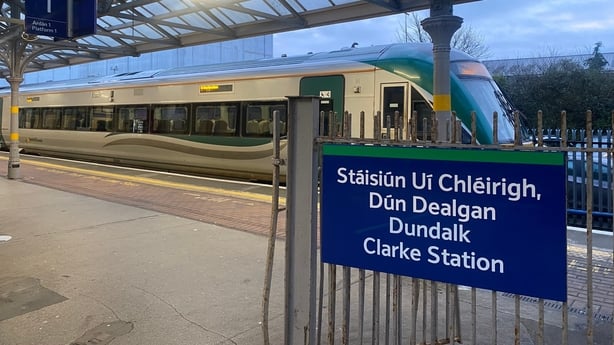
It is just after 8am when we board the Enterprise train, which looks to be almost full as it pulls into Dundalk.
Some passengers are standing between carriages and by the time it arrives in Drogheda's MacBride station, the platform is full of waiting commuters.
Some will be lucky to find seats, others will stand for the rest of the journey.
Parking in Drogheda is very busy and can be an issue.
Here, there are 300 spaces over two sites. The main station has the bulk of the spaces and there are 50 extra spaces at a site on the Marsh Road, which are now operational after not being available for a time due to ongoing works.
Louth County Council said that while parking is a matter for Iarnród Éireann, the parking issues at both stations was highlighted and discussed at a recent senior level meeting between council and Iarnród Éireann officials.
The council's executive also wrote to Iarnród Éireann to put forward suggestions around parking in Dundalk from elected members.
Extra train station
There have also been repeated calls for a second train station to be built on the north side of Drogheda, where most of the housing development is happening.
Last September, in response to a parliamentary question, the Minister for Transport said that he was "unaware of a business case for a new station on the north side of Drogheda, though this issue can be kept under review as the population changes".
Darragh O'Brien said that "an additional station would require funding and have to secure relevant approvals required under the infrastructure guidelines" and that Iarnród Eireann would engage with any parties proposing a new station.
Iarnród Eireann said that while there are no specific plans funded at present, in principle it believes housing should be developed around high capacity public transport corridors and that appropriately located stations can support this.
It said that it would engage with Louth County Council on any development plans.
The council said that it "recognises the benefits" a train station in north Drogheda would bring, "in terms of improving access to rail services and promoting sustainable transport for an expanding population in this part of the town" and that the proposed second station was among the matters discussed at a recent senior-level meeting with the rail operator.
Back to the office
The Cathaoirleach of Louth County Council is also a commuter, travelling to Dublin by train twice a week.
Seán Kelly said that there has been a "huge increase" in the populations of both urban and rural areas of Louth over the last number of years and that is now impacting on commuting.
"The issues we have with the train, sometimes is with capacity coming from Belfast," he said.
"Sometimes the train is actually a shorter train than usual and that has a knock-on effect, particularly in Dundalk and Drogheda, coming from Belfast it's already full by the time it gets to Dundalk."
But he says that the "big issue is parking".
"We need to do as much as we can to support commuters as possible, and if that's just making more parking available so its a less stressful time to get into the station and get parked then we should be doing that as soon as possible."
He has also found that more people are returning to work in the office in Dublin.
"Remote working, although it's a great concept, is starting to ease off.
"A lot of people are returning to the office on a more frequent basis. Constituents are moving to three or four days back in the office, that's additional traffic by car and by public transport."
Cllr Kelly also said that commuting from the area by bus or car is also causing problems for constituents.
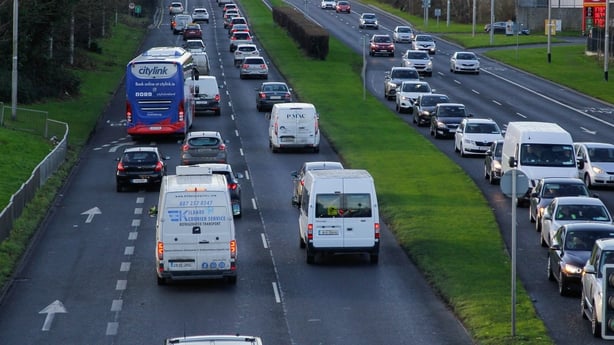
"That too is becoming an issue because of how busy the M1 Motorway is," he said.
"It's just a backlog. Once you hit exit 5 or 6 on the M1 after 7am, you're just stuck in traffic. And God forbid there's a car accident in either direction, that leads to further delays.
"It's a sign of success as an economy that we're all heading to work, but public transport needs to be improved," he said.
Commuting from Navan
While all commutes have their issues, the option of travelling by train is a luxury that many people in other parts of Dublin's wider commuter belt simply do not have.
One of those places is Navan, Co Meath.
Navan's train station closed to passengers in 1958, so commuters here are reliant on buses and cars to drive long distances.
Overall, the county's population grew by 13% between 2016 and 2022, and like Louth, it's likely to have increased further since then.

According to the last census, the county had the highest proportion of commuters travelling for over an hour to work and like Drogheda, it is also among the top ten towns with the largest number of people travelling into Dublin for work.
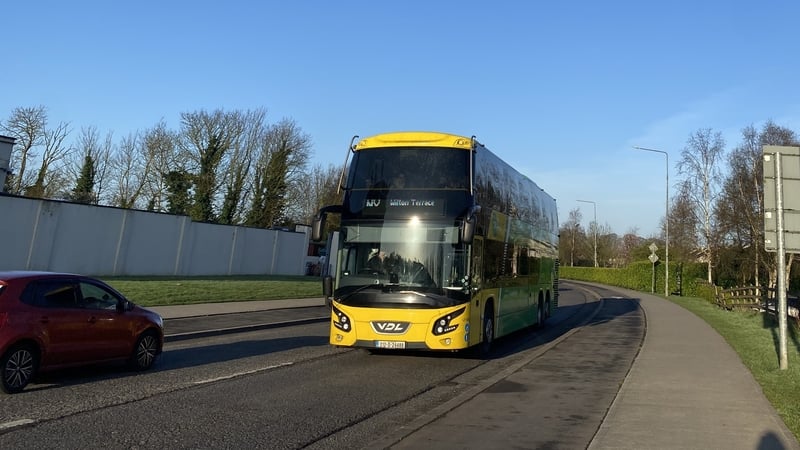
There are three main bus services from Navan to Dublin, which are operated by Bus Éireann - the NX, 109 and 109a routes.
The National Transport Authority has said that passenger numbers across all three routes have increased by 21% since 2023, while numbers using the NX are up 28%.
'I sometimes feel like I live on the bus'
As the sun came up over Navan, we caught some of the early risers before they got on board the NX from the Navan Park and Ride and Johnstown stops.
Kinga Piotrowska travels to Dublin three or four times a week, but the journey time varies.
"It depends on the day. It can be an hour, one-and-a-half hours, two hours. You never really know. I end up getting the earlier bus if I can," she said.
"I'm up at 6am, back home at 7pm, in a good case where there's no delays on the M50."
Ms Piotrowska said she takes the direct bus because it does not go through Johnstown, a route she said that can add up to 30 minutes onto the journey.
"I feel sometimes like I live on the bus and I'm very jealous of my friends who have a train."
Adewale Adeagbo described the commute as "hectic".
"It should be straightforward because it's not that far," she said.
"I commute from here to Westmoreland Street. It takes an average of two hours, sometimes two hours 30 minutes to get there. This is a journey that should take less than an hour."
Precious Adewale, a student at Trinity College Dublin, is also waiting on the NX.
"For a 9am lecture, I wake up at 6am and get the 650 bus. And still sometimes I get there late. Punctuality is a problem."
Another commuter, Ano Laerke Ryan, said that the service is unreliable.
"The bus will be here in a minute. Well, I don't know! I might not get a seat. I could be left stranded here.
"You see every day on social media the buses are cancelled or delayed. I have a meeting at 10.30am and I'm here at 8am to make sure I make that meeting today."
'Performance issues' on Navan bus services
The NX Route operates approximately every 20 minutes and Bus Éireann said that additional vehicles are deployed during weekday peak periods to support demand.
The 109 route goes every hour and every 20 minutes during morning and evening peaks.
The 109a is an hourly, 24-hour service and all three routes are operated using high capacity, double-deck coaches.
The operator said that its services can be impacted by general traffic congestion, particularly on key commuter corridors into Dublin, which can affect journey times and service regularity.
It said it is working with the National Transport Authority to monitor performance and demand levels, and to deploy additional capacity "where feasible".
The NTA said it is "aware of performance issues on the routes, including punctuality and reliability issues due to increased congestions nearer Dublin, as well as capacity at peak times".
It said "significant investment" was made on the routes in 2024 to address performance issues and it is "actively working" with Bus Éireann to "identify further changes in the shorter term, the implementation of which will be subject to operational readiness and the availability of funding".
A detailed review of the NX route is now being carried out, with an objective of increasing peak period capacity and delivering "a more efficient and effective time table in the face of rising congestion and passenger demand".
Changes may include additional timetabled departures, including earlier morning services, timetable changes and potential routing changes in the city centre.
This review is expected to be completed next month, when a consultation on proposed changes will also take place.
Emer Toibín is Aontú's local councillor in the Navan Municipal District, and has been campaigning on the issues of improved bus and rail services.
"There is just an incredible amount of issues. And these issues centre around bus cancellations, lack of capacity, not enough buses at peak hours. Just unreliability", she said.
"The vast majority of commuters from Navan go by car to Dublin, because they don't feel like the public service is reliable. It makes sense, if the Government provides a reliable public service, people will use it.
"Meath is quite close to Dublin, but despite close proximity, it has the longest journey times," Ms Tóibín said.
"Meath's population is one of the fastest growing in the country. It makes sense that capacity matches with demand. And that isn't happening."
She recently met with the NTA and Bus Éireann to discuss the issue, and has called for more buses and a service that starts at 5am. She also said that some revised routes would be helpful.
"Buses that start on the north side, it would be great if some of those went straight onto the motorway, instead of stopping at five or six other bus stops before getting onto the main road to Dublin.
"That adds another 25 minutes and prevents people from getting to work on time," she said.
Cllr Toibín has also been among the prominent local voices in the campaign to bring the rail service back to Navan.
Navan rail line
In response to a parliamentary question about the Navan rail line just last month, the Minister for Transport said that the Government was committed to the Navan rail project and it was anticipated that a planning application (a railway order) would be lodged with An Coimisiún Pleanála in 2028.
The new line would extend by 40km from the existing terminus at the M3 Parkway near Dunboyne as far as Navan town.
Iarnród Éireann said it will publish the Emerging Preferred Route for a public consultation next month.
It is expected that the preferred route will be confirmed by the end of the year, before the project moves to the design phase and business case approval process.
"Subject to approval, this would allow construction to begin in 2030, in line with timescales envisaged in the NTA's Greater Dublin Area Transport Strategy."
The line would have a maximum capacity of a train every 15 minutes in each direction, which is estimated to be around 4,500 passengers per hour each way.
While it seems that plans for the Navan Rail line are on track, commuters from the expanding town will be hoping the bus service is improved sooner, rather than later, because the possibility of a new train service from the town is still some years away.