Remains uncovered at a monastic site in Co Offaly following Storm Éowyn last year have been carbon dated to the early Christian period.
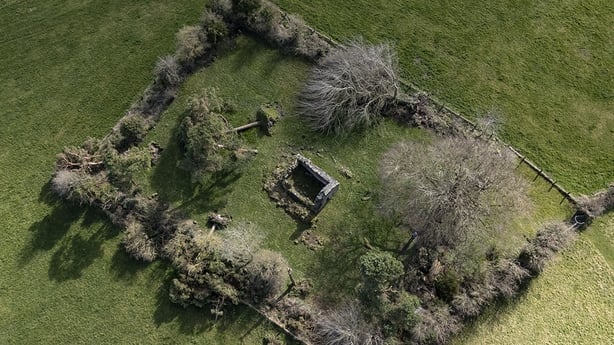
On 24 January last year, Storm Éowyn arrived with powerful winds that tore through the Lemanaghan monastic site, near Ballycumber.
Four mature trees within the enclosure surrounding the early Christian oratory of St Mella were knocked to the ground, exposing human remains.
Radiocarbon dating has now confirmed that the remains were at least 1,000 years old - with some burials placed within decades of the death of St Manchán, who is founder of the Lemanaghan monastery.
The discovery has stunned the local community, not least because the storm that exposed the burials struck on St Manchán's feast day, a day that is still marked every year.
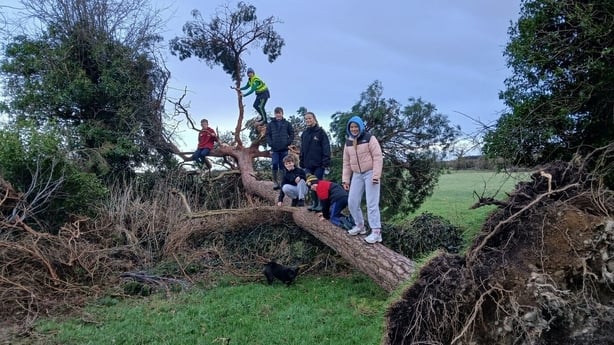
It was during this annual day of pilgrimage last year, after the storm had passed, that local Aoife Phelan, accompanied by her sons, nieces and nephews, first noticed the uprooted trees.
"So, the day after the storm last year was St Manchán's feast day, it was a really cold evening, but every year on St Manchán’s day, we pilgrim to the Holy Well," explains Ms Phelan.
"Knowing the site well, the opportunity to excavate human remains from tree root plates at Mella's Cell was undoubtedly a career highlight"
"The kids ran on ahead to St Mella's Cell and I followed them down. When we came down initially, it was devastating," she said.
"All the trees had fallen, and this was an area renowned for its peaceful sense of tranquility with the trees.
"Of course, it just brought joy to the children, because they started climbing on them," she added.
"We took some pictures of them climbing them and it was only looking back on the photographs later, that they saw that there could be something there," Ms Phelan said.
The following day, local resident Séamus Corcoran recognised that the exposed skull at the site was likely human remains.
The community made contact with officials which led to the full archaeological investigation facilitated by the Heritage Office in Offaly County Council, the National Monuments Service and the National Museum.
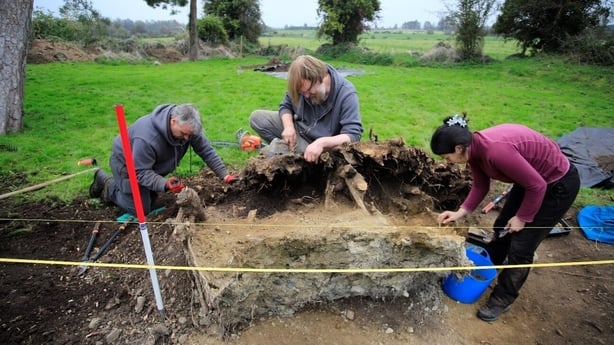
A team of archaeologists from Irish Heritage Schools led by Dr Denis Shine later excavated the site.
Until then, the enclosure around St Mella’s Cell was never known to be a burial ground.
"We have been lucky to work with the lovely community of Lemanaghan on several occasions on both a voluntary and professional basis," said Dr Shine.
"We have also been bringing third level student groups here for a number of years.
"Knowing the site well, the opportunity to excavate human remains from tree root plates at Mella’s Cell was undoubtedly a career highlight," he said.
"Lots of options were carefully explored with the National Museum and National Monuments Service, before we decided that excavation was the only viable option," he added.
Dr Shine said the excavation, while small in scale, was challenging.
"It was incredibly challenging due to complex and unusual excavation circumstances created by Storm Éowyn, which resulted in extremely precariously held together burials that were severely disturbed by roots.
"However, we were lucky to have a very experienced team, who deserve our thanks, as do the Council and National Monuments Service for funding," he said.
Investigations continue into findings at the site.
The exact number of different skeletons is still under investigation as the remains were interwoven, possibly layered on top of each other.
However, it is certain that multiple individuals were found buried according to Christian tradition, aligned east to west, within what is now understood to be an intimate and sacred part of the early monastic complex.
Scientific analysis shows that one burial dates to between 662 and 817 AD, while another dates to between 707 and 939 AD, meaning the individuals were possibly laid to rest within decades of St Manchán himself.
"Four disturbed articulated inhumations were identified," said project osteoarchaeologist Dr Annamaria Diana.
"Further human remains were observed in the northeastern tree root plate, but thankfully these could subsequently be preserved in situ," she said.
"All skeletal remains from the site are currently being analysed to assess biological profiles and possible pathological conditions as well as to establish the minimum number of individuals represented.
"Based on preliminary observations carried out so far, the assemblage clearly includes more than the four articulated burials and contains individuals of different ages, with identified juvenile teeth confirming the presence of children in the burial ground," she added.
"The discovery feels like a message from our ancestors"
The findings, locals say, have transformed understanding of the site, revealing that Lemanaghan was not just a place of prayer and pilgrimage but also a place of burial at the heart of monastic life.
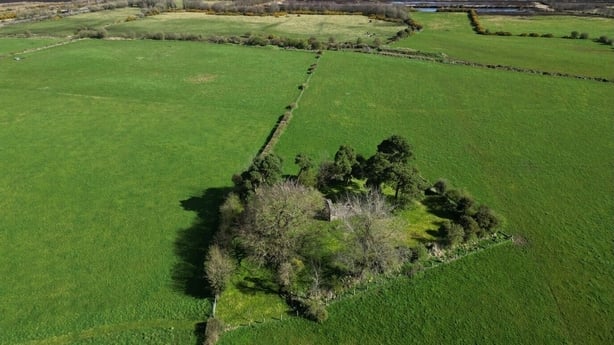
Lemanaghan is already recognised as one of Ireland's most significant archaeological landscapes, encompassing an early monastery, a unique surviving oratory, a medieval togher, medieval shrine, holy wells, cross slabs and internationally important relics.
The surrounding boglands have yielded discoveries spanning thousands of years, including prehistoric wooden trackways and platforms, Bronze and Iron Age artefacts, medieval tools and objects of daily life preserved in the peat.
Residents say all of this reinforces the long-held local belief that Lemanaghan was once a hive of movement, devotion, burial, industry and pilgrimage at the heart of the midlands.
"The Lemanaghan Conservation Plan was commissioned by the Heritage Council in 2001 and since then there has been extensive conservation work led by Margaret Quinlan conservation architect, and geophysical surveys," said Amanda Pedlow, Offaly Heritage Office.
"The importance of this monastic site is very central to the community who take extraordinary care of it.
"However 20 years later new evidence has come to light which changes the interpretation of history again," she said.
"Even though this site has had a lot of attention, it's clear there is more to be found," she added.
We need your consent to load this rte-player contentWe use rte-player to manage extra content that can set cookies on your device and collect data about your activity. Please review their details and accept them to load the content.Manage Preferences
Local residents believe the discovery was not just an accident of nature, but a moment when the past demanded to be seen and protected.
"The discovery feels like a message from our ancestors," said Ms Phelan.
"It is a moment when a sacred landscape has spoken again, revealing that Lemanaghan still yields the secrets of a deeply rooted past.
"They have quite literally lifted their heads from the earth after 1,300 years, and to do so on St Manchán's feast day is astonishing," she added.