Wildlife conservationists and enthusiasts are appealing to the public for their help in protecting a colony of rare sea-birds that has been discovered on the Co Wexford coastline.
A settlement of nesting Little Terns was found last week towards the south of Curracloe Beach by conservation ranger Dominic Berridge, of the National Parks and Wildlife Service, but will face a tough battle just to survive.
"They hatch after about three weeks of incubation, so we have a few birds here which have maybe a week of incubation behind them, so we're hoping that some at least will survive," he said.
He pointed out that, on the beach, there are many dangers posed to the Little Terns.
"Between grey crows, rooks, foxes, even mink, if they're resting on the mainland, if you like, they are very vulnerable to ground predators and other predators," Mr Berridge said.
The birds were found nesting in an area of Curracloe known as The Raven, which is popular with local walkers, despite being relatively inaccessible compared to other parts of this long beach.
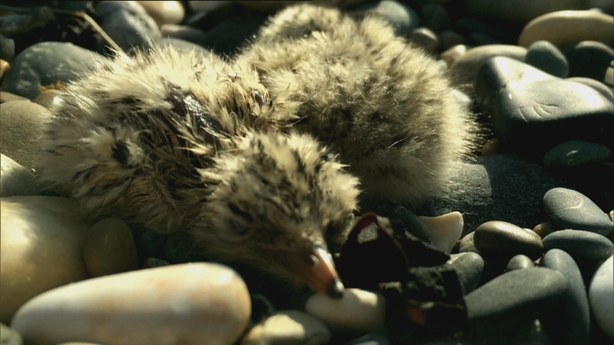
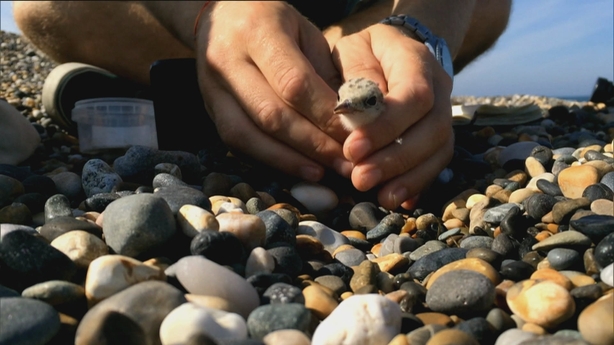
"I was just doing a regular look-around last Wednesday and I could hear this squeaking noise that they make up in the air, this little chipping, so I checked with the telescope and at that stage I could count 31 birds, sitting comfortably, suggesting they were either making nests or just trying out the place," Mr Berridge said.
"There's no proof that all of them have laid eggs, some of them may have just been prospecting and they may come back and lay eggs, but today I can see seven Little Terns sitting on their nests."
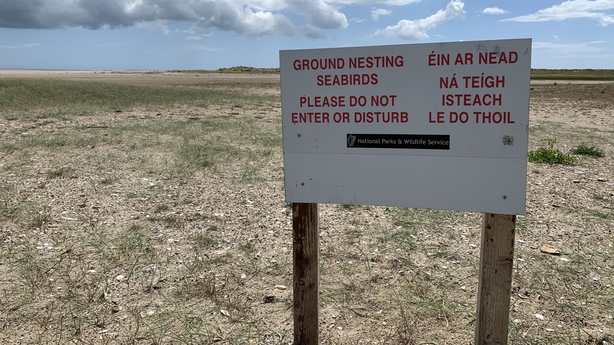
Signs have now been erected by the Department of Housing, Local Government and Heritage's NPWS urging the public to stay away from the nesting area to give the birds a chance to hatch their eggs and, hopefully, rear their chicks.
Dogs should also be kept on leads and under control at all times while in this area.
A number of conservation colonies of Little Terns have been run for some years by Birdwatch Ireland at Portrane in Co Dublin, Baltray in Co Louth and Kilcoole, Co Wicklow, to help maintain the population of this bird.
Little Terns spend the Irish winter and colder months in Africa and nest on our shores at this time of year, with the incubation period for their eggs about three weeks.
More often than not, they make their nests on sandy banks offshore, which helps them to avoid onshore predators such as foxes, mink and dogs, but this batch in Wexford may have had nests over-washed by waves in Wexford Harbour, prompting them to try a new site.
However, they face many issues if many of their young are to survive this hatching season.
"We have to just keep our fingers crossed," Mr Berridge said.
The discovery of the colony has prompted much interest among local bird enthusiasts who are glad of the rare opportunity to see and photograph the Little Terns at such proximity.

Killian Mullarney, local ornothologist and artist, said the find is a "special" one for the area.
He added: "In recent years, at least, Little Terns nesting in Wexford tend to be on the sandbanks out in Wexford Harbour, so they're distant.
"It's a very attractive site, a very nice place to get good views through a telescope without disturbing them, and you can only hope that they have some measure of success because they have a very hard time, Little Terns. It seems that all the odds are stacked against them."
He hoped that at least some "make it through the summer and there's some juveniles in a few weeks".