


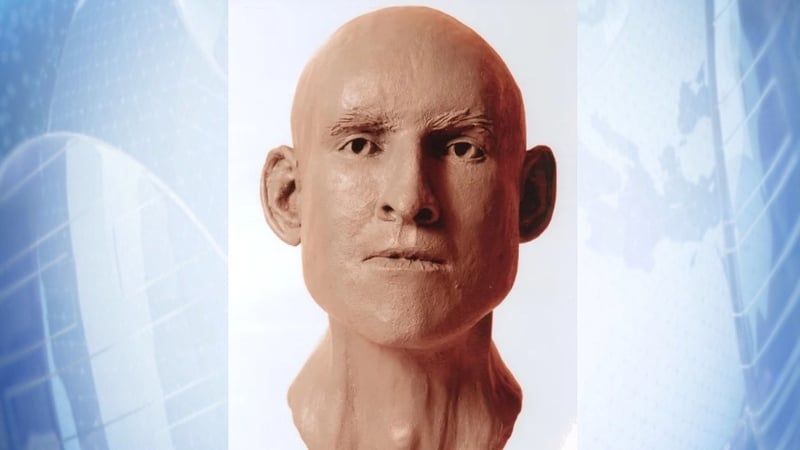
A human skull found in the Irish Sea more than a decade ago has been lost by the State.
Crime author and journalist Barry Cummins said the last time the skull was "accounted for" was in "2007 or 2008".
It was found by the crew of a fishing vessel off Lambay Island on 6 February 2006.
Despite exhaustive inquiries, and a garda appeal, the remains were never identified.
Speaking on RTÉ's Today with David McCullagh, Mr Cummins said the Garda Water Unit searched the area, but the rest of his body was not found.
He said it was likely a "very tragic case" of someone who somehow entered the water.
The man became known as 'Lambay Man' due to the absence of a name.
Mr Cummins explained that the skull was found in two pieces - the cranium and the mandible.
"The fact that these two parts were brought up in the same section of water, and the subsequent forensic analysis, that would indicate that the skull most likely had become removed from the rest of the man's body by decomposition on the seabed not too long before the skull was recovered."
A forensic analysis of the skull indicated that the man’s body had been in the water for weeks, months or maybe years, but not decades.
"This is a man who was alive at the turn of the century. He most likely died in 2004 or 2005," Mr Cummins said.
Detectives sent four of his teeth to an expert in Canada who obtained a DNA sample.
The skull was sent to the University of Dundee in Scotland, where it was analysed by Caroline Wilkinson, an expert in forensic facial reconstruction.
Dr Wilkinson reconstructed how the man might have appeared.
"The clay model - constructed in 2007 - it’s still very valid today," Mr Cummins said.
We need your consent to load this rte-player contentWe use rte-player to manage extra content that can set cookies on your device and collect data about your activity. Please review their details and accept them to load the content.Manage Preferences
Images of the model were used in garda appeals about the case. The last of these was in 2021, on the 15th anniversary of the discovery.
Mr Cummins said: "But what wasn’t said at the time of that appeal was the skull couldn’t be found. That information has only been confirmed very recently."
The skull was in the custody of the Dublin coroner, but were not returned from Scotland to Dublin.
"What gardaí have told me now, in a statement, is the skull was returned from the UK by a third party and returned to a garda station not connected to the investigation," Mr Cummins said.
The investigating station is Balbriggan in Dublin, but based on his research, the skull was sent to a station in the southeast of the country.
"Something happened there - most likely around 2007 or 2008 - that’s the last time that the skull is accounted for," Mr Cummins said.
"It was only sometime later, when a garda went looking to retrieve the skull, that it was discovered that it couldn’t be found. It’s missing."
Gardaí told him that they searched "high and low" for the skull, but could not locate it.
Mr Cummins said the loss has caused upset.
"The indignity of what has happened to this man, whoever he is, but also because of all those efforts that were done at the time back in the early years to try and identify the man.
"Huge efforts all designed to try and restore his identity, his dignity, restore his name, and now his skull has been mislaid."
The Department of Justice publishes a list of unidentified human remains each year.
Mr Cummins said: "I noticed when I looked at the list that Lambay Man - as I call him - was not on that list."
He contacted senior coroner for Dublin, Dr Myra Cullinane, who inherited the case.
"She told me that the skull was not physically in Dublin," Mr Cummins said, and referred him to gardaí.
"This man ... he's one of 50 cases of unidentified bodies currently listed on the official Government website."
This is not the first time it has happened, Mr Cummins said, as a woman’s skull was lost in 1996.
