


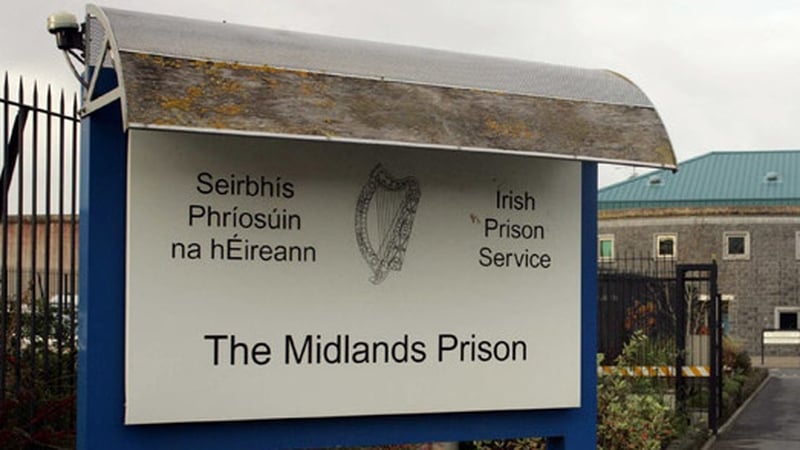
A report into the death of a man at Midlands Prison after staff were unable to find the key to his cell was "extremely distressing to read", the Irish Penal Reform Trust (IPRT) has said.
The Office of the Inspector of Prisons found that a nurse was "obliged to watch helplessly through a cell door" as the 59-year-old man lost consciousness and died after he had an allergic reaction to an antibiotic five years ago.
The report found it took almost a quarter of an hour to open his cell and administer aid after prison staff could not locate the key.
The report said that the circumstances of the man's death were "unconscionable" and recommended system-wide measures are taken to ensure such a scenario does not arise again.
The Irish Prison Service said it has updated its procedures around keys at Midlands Prison, and that measures in other prisons would be considered during broader security reviews where deemed necessary.
IPRT Legal and Public Affairs Manager Niamh McCormack said the report was "extremely distressing to read" and detailed how the man did not have the ability to speak because his throat had swollen, forcing him to hold up a note to say he had had an allergic reaction to the antibiotic.
Speaking on RTÉ's Morning Ireland, she said it was important to acknowledge that a family had been waiting for five years for answers about what happened to their loved one.
She said this was a "trend that we're seeing now" regarding death in custody reports, and also reports in general on prisons.
"They sit on the minister's desk for years and the answers are sitting there within that report and there's delays," she said.
"Our understanding is that with redactions, it can take up time, and there were redactions in this report. The decision was made to redact details from a post mortem examination of the man who passed away."
Ms McCormack said "serious questions" need to be asked around where the key to the man's cell was kept, and access to keys in general.
She explained that the wing where the deceased prisoner was on had a separate key room. This was not manned, she said, because that post had been removed, according to a restructuring process within the prison and was noted as being a cost saving measure.
"It's not unforeseeable that there would be an incident where an emergency would happen and you would need to access a prisoner, so what risk assessment was done? There were 300 prisoners that day who were left without having emergency access," she said.
"The keys were lost but even if they had arrived to the key room there was no one there to let them in, so there are serious questions that need to be asked around how this happened ... we understand that there has been an update in Midlands Prison but how did the decision get made in the first place? Was there any risk assessment done?"
The report said that during 2024, there were 31 deaths which fell within the scope to be investigated. This was the largest number of deaths to be investigated in any year since the Inspectorate began looking at deaths in January 2012.
There were 20 deaths in 2023 that fell within that scope.
Ms McCormack said this increase was "really concerning" and the issue of overcrowding in prisons must be acknowledged.
"That does have an effect on the safety of prisoners and prison staff," she added.
"But ultimately - and it's been noted by the Committee on the Prevention of Torture and by the Irish Penal Reform Trust several times - the State has an obligation to take proactive measures to protect the lives of people in its care.
"The prisoners are on the other side of a locked door and they don't hold the key to that door. When there's a dynamic where somebody holds the key and somebody doesn't hold the key, there has to be proactive measures that are taken. It isn't good enough to say that there's overcrowding, that deaths in custody are unforeseeable or unpreventable, because many of them we say are."
Ms McCormack said it is unusual that there would be a scramble to find a cell key and this particular case would not be a common occurrence.
However, she said there are incidents where repeat recommendations are made by the Inspector of Prisons when these reports are drawn up.
"For example, overdoses in prisons. It's been repeatedly recommended that the systems are put in place and updated to ensure that these overdoses don't keep happening, and there are a lot of overdose related deaths happening in prison that would account for a lot of these increases."
