



Rent prices rose as the Government's new rent reforms came into force on 1 March, according to advertised prices from property website Daft.ie.
Figures show rents increased nationwide by 4.4% from December to March this year, the largest quarterly increase recorded by property website Daft.ie since 2002.
Market rents are now more than one third above their pre-Covid levels and almost 80% higher than 10 years ago, while the availability of rental accommodation has increased compared with three months ago and a year ago, the report found.
Report author Professor Ronan Lyons said the increase in rental accommodation should be "interpreted with care".
"The delay between announcing, in June 2025, and introducing, in March 2026, the new rent control rules appears to have prompted some landlords to delay listing properties until the new regime came into force," he said.
The Government announced a number of rental reforms last year which came into effect from 1 March.
The Government has said the changes will provide greater security for renters and boost supply while the opposition has said it will dramatically increase rent costs by thousands a year and lead to increased homelessness through evictions.
Any tenancies beginning from 1 March are of a minimum duration of six years.
At the end of that term, landlords can raise rents beyond the cap to match the market rate.
In the middle of a tenancy, rent can be increased by a maximum of 2% annually.
Large landlords, defined as having four or more tenancies, will be banned from carrying out no-fault evictions for tenancies beginning from March.
A small landlord can end tenancies through a "no-fault eviction" in limited circumstances, such as economic hardship or to move a family member in but, if they do that, they cannot reset the rent until the six-year window ends.
According to the Daft.ie report, the average market rent is €2,100 for a two-bedroom apartment as of early 2026.
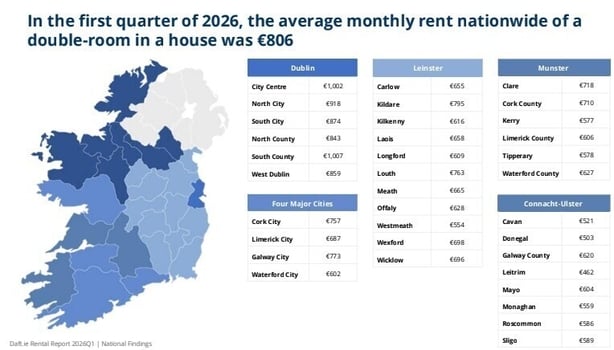
The Daft.ie report shows that market rents in the first quarter of 2026 were 18% higher year-on-year in Galway city, 13% higher in Cork, up 10% in Limerick and 8% in Waterford.
In Dublin, market rents were 6.9% higher in March than a year before.
There were just under 2,500 homes available to rent nationwide on 1 May, which is an increase compared with the same date a year ago (2,300 homes nationwide) and three months ago (1,800).
Daft.ie said availability remains "well below pre-pandemic norms", when there were around 4,000 homes to rent at any one time.
Since January, rent listings have increased with more than 10,600 homes put on the market in February, March and April, up 13% year-on-year.
But the recent increase in listings is only about half the size of the earlier decline.
Professor Lyons said the rent changes appear to have led to "a step-change" in rent prices.
He said: "The first data following the introduction of new rent controls show a sharp increase in rents, alongside a more modest and potentially temporary increase in rental availability.
"The ability to reset rents between tenancies appears to have led to a step-change in rents, with the largest quarterly increase in rents on record.
"At the same time, the increase in listings in early 2026 suggests that some landlords delayed putting properties on the market until the new rules came into force.
"However, the rebound in listings is smaller than the earlier fall, and availability remains far below what would be considered normal.
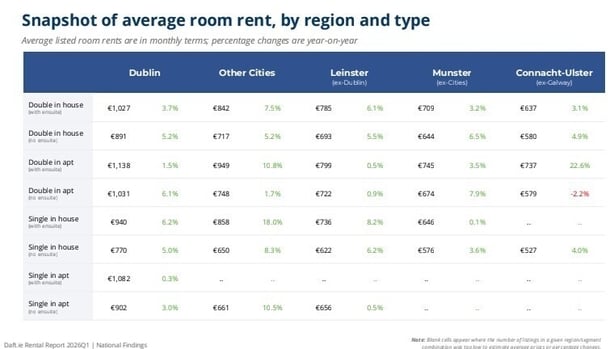
"Trends in room rentals are consistent with this, with the number of rooms available to rent down sharply over the past year, down by more than one fifth nationally and by almost one third in Dublin.
"This indicates that the recent increase in full-property listings is more likely to reflect timing effects, rather than a sustained increase in underlying rental supply.
"The goal of changing the rules, to increase the supply of rental homes and thereby improve affordability for tenants, depends on whether new rental housing is built.
"As the construction of new homes takes years, rather than months, it will be some time before the ultimate impact of the rules can be assessed."
