The 1926 Census returns are being released online in a landmark initiative that gives the public an insight into the lives of people living in Ireland 100 years ago.
Taken on 18 April 1926, the census was the first conducted after the establishment of the Irish Free State.
Director of the National Archives of Ireland Orlaith McBride said: "The 1926 Census marks an incredible moment in Irish history.
"We had just had a decade of revolution, upheaval and conflict.
"History records, the big moments, the big events in people's lives but actually the census returns tell the stories and the colour of people's lives across Ireland."
The 1926 Census recorded a population of 2,971,992, which was a drop of 5.3% from the previous 32 county 1911 Census.
Archivist Chloe Stapleton said she feels more people are interested in Irish history: 'We're having a bit of a cultural revival, and I feel like because these records are so personal and so close to home and family history, it makes them a lot more important."
A genealogist at EPIC's Irish Family History Centre has said there is a great deal to be learned from the census.
Speaking to RTÉ's Morning Ireland, Fiona Fitzsimons said interest was so high the last time that the National Archive server kept crashing.
She said the information will be released in waves.
"I think it's going to be searchable immediately by the forename and the full name and by place, but other information, like occupation and some of the other questions that are asked about marriage, orphanhood, religion and language, are going to be released at a later date.
"So, in a way they're rolling out how the information reaches us and how we can access it," she said.
Ms Fitzsimons added that in her role at the Irish Family History Centre, she sees people every day researching their background.
One of the most scandalous things to learn was that your ancestors were Protestant, she said.
"Once that inter-marriage happens and children are brought up, it's often not talked about again by the family...this is probably the most common scandal that we find, and it always knocks people for six because they think 'how could that have happened so recently, three or four generations, and I don't know about it?'"
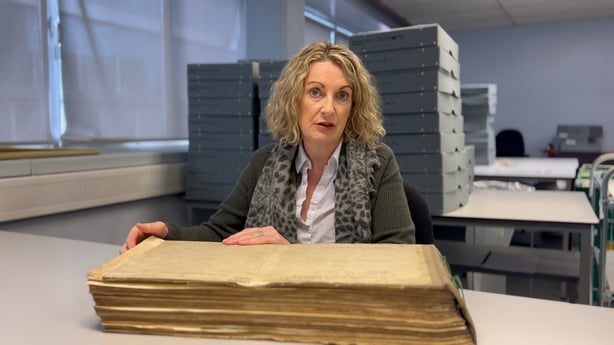
While census forms remain confidential for 100 years, the National Archives has undertaken the monumental task of digitising over 700,000 return sheets to make them available online.
From 12am tomorrow, they will be accessible to genealogists, historians, and the public in Ireland and around the world on the National Archives website.
'Huge amount of work' to digitise documents
Minster for Culture and Media Patrick O'Donovan said that the 1926 Census was the first of its kind under the new "fledgling State".
Speaking on RTÉ's News at One, he said that a "huge body of work" was undertaken by the National Archives to "painstakingly" digitalise thousands of documents.
The minister said that unlike other censuses that have been released up to now, some "survivors" who appear in the 1926 Census will be present at Dublin Castle on publication day tomorrow.
He said that the 1926 Census "shows a huge amount of change," including a population size that has "gone under three million people".
The minister said that the census will also show that the type of industry and commerce in the country at the time contrasts starkly with the economy and commerce nowadays.
"In many ways it's a look socially, economically, politically as well, because it's only two or three years after the formal end of the Civil War that we have an accurate counting and an accurate data set of what Ireland looked like in those very early days of this fledgling state," he said.
Watch our video to find out more about the 1926 Census.