


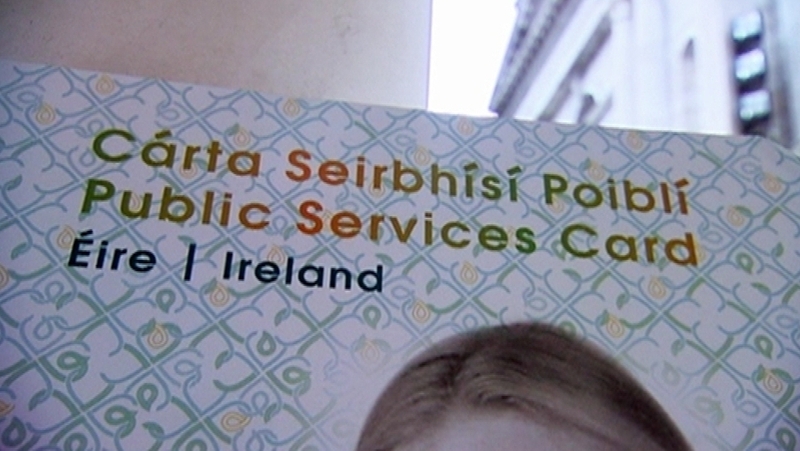
Civil liberties groups have raised "serious concerns" about Government plans to make Public Services Cards an acceptable form of age verification.
The Irish Council for Civil Liberties (ICCL) and Digital Rights Ireland (DRI) say extending the card's use as a generalised form of national identification serves to "compound the legal issues with the card rather than resolving them".
Minister for Social Protection Dara Calleary secured Cabinet sign-off for priority drafting of a Bill which would allow a Public Services Card holder to use it as a form of identity when engaging with a body that is not specified under existing legislation - such as banks, credit unions, or utility companies.
The Government said: "Currently, should a non-specified body accept the Public Services Card as a form of identity verification, they would be guilty of an offence.
"This amendment will allow a cardholder to use - of their own volition - their Public Services Card as a form of identity in, for instance, their local credit union, the bank, or with a utility provider."
It would see a cardholder choosing to include their date of birth on their card so they can use it as a means of age verification.
'A de facto national identity card'
However, the ICCL said this comes after the Data Protection Commission (DPC) found the Department of Employment and Social Protection unlawfully processed the facial biometric data of up to 70% of the population over a 15-year period.
Digital Rights Ireland chairman Dr TJ McIntyre said the card was introduced for social welfare purposes but was now being turned into "a de facto national identity card".
He said: "There has been no public debate about introducing a national identity card and no proper legislative framework."
Olga Cronin, senior policy officer at Enforce, ICCL, said: "Despite the warnings, the Government is allowing the PSC to be turned into an unlegislated, badly planned national identity card system without considering the data protection implications.
"It is at risk of normalising unregulated mass surveillance and undermining public trust at a very sensitive time."
Meanwhile, the Government has been exploring the possible implementation of an age verification requirement for social media.
Tánaiste Simon Harris said a "digital wallet" would be the next step in such a move, and a public consultation process on the policy is under way.
The proposed digital wallet app will be a place to securely access versions of documents such as a birth certificate or driving licence for quick access, verification, and EU compatibility.
