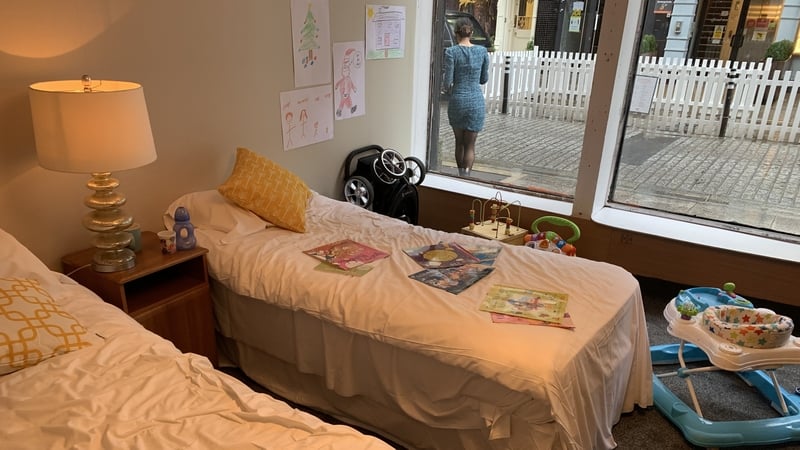

Newly homeless families face unlawful decision-making by local authorities as pressure on emergency accommodation intensifies, according to the Mercy Law Resource Centre (MLRC).
The organisation, which provides free legal advice and representation to people who are homeless or at risk of homelessness, says local authorities are developing and applying their own "unlawful eligibility criteria" for homeless supports.
MLRC tracked legal challenges faced by a sample of 37 homeless families that presented to its service.
A report published this morning shows that children with disabilities are unable to access emergency accommodation.
It also highlights difficulties faced by mothers and children facing homelessness following an escape from domestic violence.
In one case, a woman and two children fled reported domestic abuse and entered a refuge in a new county.
When the family's stay in short-term refuge accommodation came to an end, the mother sought homeless support from the local authority in her new location.
MLRC states that she was "refused support by the local authority, which stated, wrongfully, that as your last known address is [in a different county …], you will need to contact them for homeless supports".
Legal intervention from MLRC resolved the situation; however, it has stressed the need for the provision of training to local authorities on administrative law, constitutional law and human rights principles which govern the exercise of public body discretion.
The report says family units are being separated and placed across multiple homeless accommodations.
The experience of one family involved the male partner living in a homeless hostel while his female partner and children were living in a separate family hub.
Mercy Law has recommended the introduction of amendments to the Housing Act 1988 to require local authority staff to have regard to the best interests of the child and the need to respect family life.
According to the report, families are often provided with "inadequate 'vouchers' to self-source emergency accommodation".
A homeless family of two adults and six children were provided with a voucher from their local authority to the value of €130 per night, to cover their accommodation.
On the day that the voucher was provided, the family were unable to identify anywhere that was willing to accept the vouchers and became deeply concerned about the prospect of rough sleeping.
MLRC intervened on the family’s behalf, and the local authority eventually booked a placement for the family.
The charity has called for an end to the practice of providing vouchers to families to self-source homeless support. It says local authorities should instead directly book homeless accommodation placements for families.
Another homeless family with an autistic child felt forced to remain in hidden homelessness, moving between family members' severely overcrowded properties.
The family reported that a one-room emergency accommodation placement for the entire family would have been more unsuitable for the needs of an autistic child because it would remove the family from overnight support being offered by extended family.
The training of local authority staff is required, according to MLRC Managing Solicitor Paul Dornan, so that they can "more easily understand the legal obligations that apply when making decisions on homeless supports."
He said legislative change should also be introduced "to better guide local authorities in dealing with homeless families, particularly vulnerable cohorts such as victims of domestic violence and persons with disabilities.
"Families who become newly homeless against the backdrop of relentless pressure on emergency accommodation are increasingly vulnerable to poor or unlawful decision-making on the part of local authority staff."