There is cocaine use in "every village and every town in Ireland", according to Cuan Mhuire addiction treatment services.
Meanwhile, one in five male inter-county players surveyed by the Gaelic Players Association say they know a teammate struggling with drug misuse.
Cian McCormack has been looking at the issue.
A recent survey of more than 3,600 inter-county players found that 20% of men and 4% of women knew team-mates struggling with drug misuse.
For Westmeath footballer Luke Loughlin, though, drug use is not the norm in Gaelic games and those figures reflect a wider reality in society.
"If I just think of the cohort of under 20s on our panel … I wouldn't think it'd be the norm for them to be out doing drugs … it definitely wouldn't be something accepted," says Luke.
Speaking to RTÉ's Morning Ireland, Luke says there is a responsibility that comes with representing your county.
"The last thing you want is young people looking up to you thinking this is okay because it's definitely not," he adds.
But Luke understands the other side too. Addiction and drug use are part of his own story.
"I’m in recovery from addiction to alcohol, cocaine and gambling," he says.
From birth, he had no relationship with his biological father, which led to deeper feelings of a void in his teenage years. That was filled by cocaine, alcohol and gambling addiction.
Alcohol came first, at age 14, and by 16, he had moved on to cocaine.
On the pitch, Luke was central to Westmeath football but off it, personal instability impacted his game.
"I’ve been dropped nine times," he says. "When I was about 18 to 25, I was dropped nine different times off the [Westmeath] panel."
Managers kept giving him chances. But the underlying issues remained.
"I'd done a lot of damage … to my family and my community. I'd hurt a lot of people."
"You can't really help someone until they want to help themselves"
His family knew he had a problem and when he admitted his addiction, his mother intervened and helped him to get treatment through the Gaelic Players Association (GPA).
"You can’t really help someone until they want to help themselves," he says.
There was a turning point. A conversation during addiction treatment after his three-year-old cousin had died. At that time, he was also off the road for drink driving.
"I went to treatment because there was nowhere else to go," he says.
The counsellor said her son had been killed in a drink-driving incident and asked him: "Do you think that little girl would be proud of the way you're living your life?’
"Obviously, I said no," he says.
But then came a line that stayed with him. The counsellor said: "Well, that guy who killed my son. I say a prayer for him every day."
And, from that point Luke said to himself: "Jesus … I need to change. I can’t keep living life this way.
"That was the turning point for me. I had caused a lot of damage up until that … I had done a lot of damage to my family and my community … and I had hurt a lot of people."
Since then, Luke has been sober and highlighting how people can get help for their addictions.
Issue for wider society
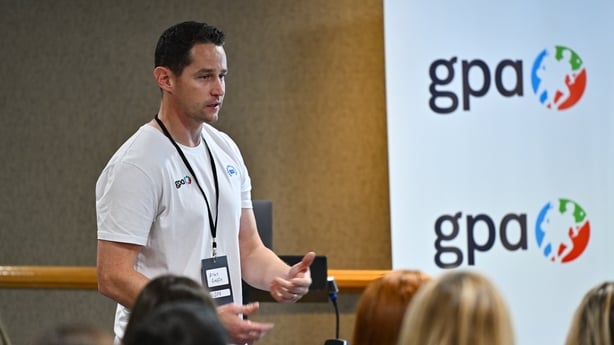
The GPA says the findings of its annual member survey, which were released last October, should be looked at in a broader context. Drug use, it says, is an issue in wider society.
"It’s not just a GAA or Gaelic games issue. It seems like it’s a societal issue which can be sometimes reflected in Gaelic games," says Arron Graffin, the GPA's Player Development Manager.
He says substance misuse is not more prevalent amongst elite athletes compared to the general population, but it can come under sharper scrutiny because of a player’s public profile.
"It can sometimes be highlighted with a more serious attention or public scrutiny because of a players profile," Mr Graffin adds.
The Ladies Gaelic Football Association and the Camogie Association both say supports are in place for their players through the GPA and also the GAA's Healthy Clubs programme.
Aideen Howlin, Gaelic Athletic Association Community Health co-ordinator for Leinster, says the GAA is a community-based organisation that works with expert partners, including local and regional drug and alcohol task force co-ordinators and An Garda Síochána, to deliver education programmes and signpost players and members towards services.
"We have the Irish Life GAA Healthy Clubs Programme, which supports clubs within the programme to adopt our substance use policy, which displays their commitment to signposting for players and members who may seek support," she says.
Luke Loughlin's treatment happened at Cuan Mhuire addiction treatment services in Athy, Co Kildare.
The number of people seeking help for addiction there has increased in recent years and cocaine is the biggest issue.
"We have people here presenting for treatment who come from all walks of life, all professions, all locations ... It is in every village and every town in Ireland" - Nicola Kelly, Cuan Mhuire
Nicola Kelly, manager of Cuan Mhuire's Athy centre for more than two decades, says more people are presenting for help and that this reflects a broader trend across Irish society.
Cocaine now dominates, Ms Kelly says. "It accounts for about 90% of the cases we treat … Cocaine is by far the biggest presenting issue."
What is striking, she adds, is not just the number of cases but who is affected.
"On the ground here, we are seeing absolute cross-societal problems with cocaine use. We have people here presenting for treatment who come from all walks of life, all professions, all locations. It is absolutely across the board. It is in every village and every town in Ireland," she says.
"Cocaine is by far the biggest presenting issue that we have here in Cuan Mhuire in Athy. We have four treatment centres and I have no doubt that they would echo my opinion on that as well. Everybody is finding the same problem."

"In the last five to six years, there has been a considerable increase in the amount of people looking to access treatment," she says.
"It's dual diagnosis. It could be alcohol and cocaine. It could be gambling and cocaine. It could be all three. And it's a range of ages"
Demand outstripping capacity
In Athy, which is one of five Cuan Mhuire treatment centres nationally, demand outstrips capacity.
"Currently, 109 men are on the waiting list here in Athy … and we have 60 women waiting on a waiting list."
She says that ten years ago there were just nine people on a waiting list.
While elite sport and inter-county player use has come under scrutiny because of the recent GPA survey, Ms Kelly stresses the issue is far broader.
"It’s across the board. It’s societal at the moment. Currently we have 80 men here in treatment. Out of that 80 men, we probably have ten people here who come from a sporting background. And, we have 70 men who are not involved with a sporting background"
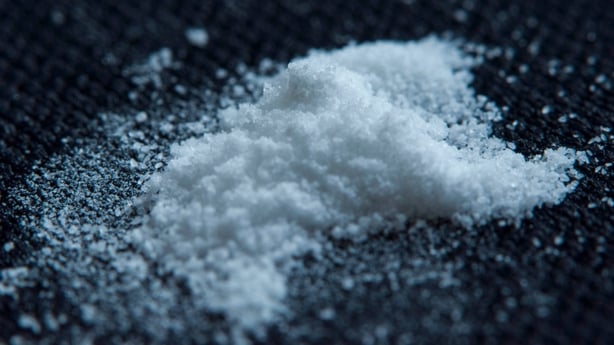
Of those in treatment, she says, the vast majority are there because of cocaine.
"About 90%," she says, adding that men are more likely to present for cocaine and drug addiction treatment. "Definitely men presenting for drug addiction is higher than it is for women," she says.
Among women patterns of addiction differ by age.
"What we see in Athy is that women who present here under the age of 40 very often present with issues for cocaine. Women who are over the age of 40 are not presenting with issues with cocaine. However, they are here in treatment for alcohol addiction or gambling addiction."
Ms Kelly stresses the trend is consistent addiction is not confined to any one cohort. "It’s across the board."
"It kind of rattled me a bit because I always had her"
— RTÉ One (@RTEOne) February 28, 2026
GAA Player Luke Loughlin chats to Tommy about the support he through his struggles #TommyTiernanShow | @tommedian pic.twitter.com/FNKXgqgmU9
For players like Luke Loughlin the pathway to Cuan Mhuire began with the help of the GPA and then the specialist treatment he received.
And today, looking back, Luke is grateful.
"The GPA were always there for me with counselling and getting me into treatment … they funded the treatment," he says.
"The GAA is amazing for its people, that's what makes it so amazing. No one in the GAA, especially in your own community or club, wants to see you do poorly or go through a tough time. And it's the people in your clubs that will help you out. Every club now is starting to get healthy clubs initiatives and well-being officers".
Luke's focus this week is on Westmeath facing Longford in the opening round of the Leinster Senior Football Championship on Sunday.
However, his biggest victory, for now, has been off the field. He is five years sober, free from alcohol, cocaine and gambling.
"I’m grateful to be sober. Grateful to be able to have a good relationship with my family. Grateful to represent my community … but I suppose at the back of all that I still have lots of feelings of shame and regret. I am very grateful, to be honest."
And, for someone who once felt there was no way out, a message he returns to again and again, especially for others dealing with addiction, is: "There's always a way back."