
The chief executive of Ryanair has warned that if the Dublin Airport passenger cap was to be reinstated it would result in "fewer flights" and "higher fares".
Eddie Wilson said the airline believes the 2007 restriction is "unlawful" and "contrary to EU US Open Skies Agreement".
He was speaking at a sitting of the Oireachtas Committee on Transport, which is holding a series of hearings as part of the pre-legislative scrutiny of the Dublin Airport (Passenger Capacity) Bill 2026.
Last month, the Cabinet approved draft legislation to lift Dublin Airport's 32 million passenger cap, which was a condition in a 2007 planning permission.
The restriction has been suspended by the High Court pending the outcome of legal proceedings referred to the Court of Justice of the European Union.
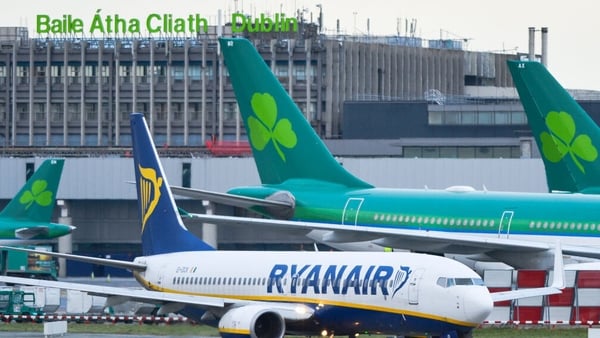
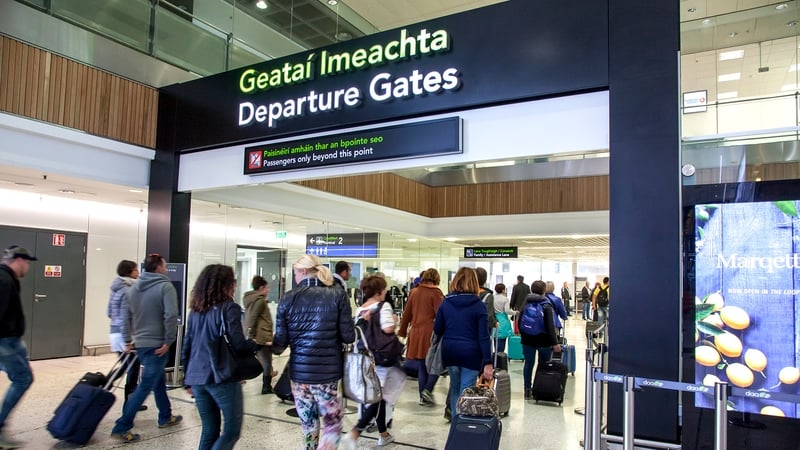
As a result, a record 36.4 million passengers passed through the two terminal buildings at Dublin Airport last year, far exceeding the restriction.
Mr Wilson told the committee said if the cap is not abolished and the number of passengers passing through the airport has to be cut back to 32 million, Ireland will lose out on new Ryanair aircraft and routes to the UK and other EU states.
"We have a fleet of in excess of 640 aircraft today. We're going to take a delivery of 300 aircraft over the next seven years, and the question is, where are they going to go?"
"With the cap as it is at the moment and that uncertainty, those aircraft can't be allocated to Dublin, but they're coming to Europe or indeed North Africa", he added.
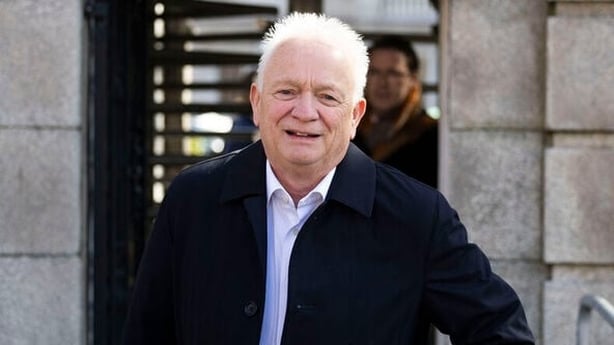
In his opening remarks to the committee, the Ryanair CEO said people that live near the airport, branded by the airline as "NIMBYs" who moved in the North Dublin area long after the airport opened, can't block national growth.
He also described the excessive noise claims from residents as "bogus" and he said local issues "can’t take over from national growth of a strategic asset".
Mr Wilson said the airline has carried out noise surveys in a number of areas including St Margaret's, Ballyboughal and Ashbourne.
He told the TDs and Senators that the surveys found that even with jets overhead, the areas were "just marginally over 50 decibels, which is well within the safe zone".
He later refused to withdraw his "NIMBYs" claim, insisting the description was "accurate".
Mr Wilson accused the government of failing to deliver on its on its promise made 16 months ago to abolish the cap, which he said needs to be "scrapped immediately".
Watch: Cap would result in 'fewer flights', warns Ryanair CEO
We need your consent to load this rte-player contentWe use rte-player to manage extra content that can set cookies on your device and collect data about your activity. Please review their details and accept them to load the content.Manage Preferences
The chief executive of Aer Lingus warned that any delay in removing the Dublin Airport passenger cap could result in "very significant capacity cuts" next year.
Lynne Embleton told the Oireachtas Transport Committee that a reinstatement of the restriction "could cause an increase in airfares".
In her opening address to TDs and Senators, the Aer Lingus boss described the passenger cap as "a historic anachronism that needs to be urgently removed".
Given that a record 36.4 million people passed through the two terminals last year, Ms Embleton said if the passenger cap was actually enforced, it would require a reduction of approximately 4.4 million passengers at the airport, which equates to over 12% of the current traffic levels.
"That would have a catastrophic impact on connectivity, on the airport, and on the wider Irish economy," she said.
"Enforcement of the cap would also impact supply and demand dynamics and could cause an increase in airfares."

She said any enforcement of the cap "would cause serious economic harm" and that "legislative intervention is justified" in the public interest.
According to Ms Embleton, "swift enactment and decisive use of the powers in the Bill will provide certainty and stability".
However, the Aer Lingus CEO warned that any delay to implementing the legislation "materially increases the risk of enforced capacity reductions".
"While the General Scheme provides the Minister with the power to revoke or amend the planning condition, that power only takes effect once the legislation is enacted and commenced and a ministerial order is actually issued."
Ms Embleton said severe cuts on seat capacity at Dublin Airport by the Irish Aviation Authority have been avoided only because of the legal proceedings initiated by airlines and the resulting stay imposed by the High Court, while the issue was referred to Europe.
With a ruling expected from the European Court Justice within months, she said "the duration of the current stay is therefore uncertain".
The Aer Lingus boss told committee members that if the stay were to be lifted and the passenger cap remains in place when the IAA makes its capacity declaration for the Summer 2027 season, which would be due in early October, then there is "a real risk of very significant capacity cuts".
"We therefore strongly emphasise to the committee the importance of early enactment and commencement, the urgent completion of any required environmental assessment, and the inclusion of clear, specified timelines throughout the process so that the minister can make the required order as quickly as possible".
Ireland 'risks losing connectivity' if cap not lifted
The director general of the International Air Transport Association (IATA) has said Ireland "risks losing connectivity that may not return" if the passenger cap at Dublin Airport is not abolished.
Willie Walsh, a former chief executive of Aer Lingus, British Airways and International Airlines Group (IAG), described the restriction as "outdated".
He said when Dublin Airport's capacity is constrained, "Ireland's international connectivity, competitiveness and economic growth are constrained with it".
Mr Walsh told members of the Oireachtas Transport Committee that the long standing passenger cap "now poses a real and immediate risk".
"It restricts route development, limits consumer choice and undermines Ireland's attractiveness for investment and tourism," he stated.
"Uncertainty around capacity means airlines are already evaluating alternative airports for growth, and to be clear, those airports are not in Ireland," he added.
He insisted the draft legislation is "both necessary and urgent".
"It replaces an outdated planning condition with a modern, transparent mechanism that enables the Minister to act when the cap is causing economic or connectivity harm," Mr Walsh said.
"That harm is happening today and will continue to impact Ireland's competitiveness, if not resolved quickly," he warned.
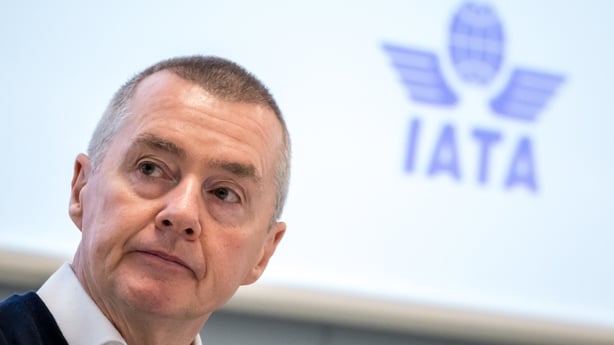
The IATA boss said timing is critical to removing the "current uncertainty" resulting from the passenger cap.
"Airlines have already begun planning for Summer 2027. They will make decisions this September, with Dublin Airport's capacity declaration due by 1 October. If certainty is not restored before then airlines will be forced to plan on the assumption that the cap remains," he said.
"Once capacity assumptions are embedded through the capacity declaration and slot allocation processes, they become difficult, if not impossible, to unwind. And once airlines aircraft crews and schedules are allocated to other routes, decisions are unlikely to be reversed. Ireland risks losing connectivity that may not return," he explained.
Mr Walsh said a "swift enactment and commencement" of the legislation is essential to protect Ireland's connectivity and economic resilience.
"IATA strongly supports urgent passage of this legislation. The risks of delay are significant and avoidable," he stated.
The association said it represents over 360 airlines that carry some 85% of the world's air traffic and the majority of airlines operating at Dublin Airport.
A4A warns of retaliation if Dublin Airport passenger cap not lifted
Meanwhile, a trade association representing US airlines has warned that "retaliation can be expected" if the Dublin Airport passenger cap is not permanently abolished.
The president and chief executive of Airlines for America (A4A), Chris Sununu, has renewed his call for the restriction to be "removed immediately".
He told the committee that the passenger cap is "no longer a planning constraint but a policy decision that if left in place, would be an economic disaster for the citizens of Ireland".
A4A represents both passenger and cargo carriers, including Delta, American Airlines, United, JetBlue and Air Canada, as well as FedEx and UPS.
In his address to TDs and Senators in Leinster House, the group's CEO claimed the passenger cap is a direct violation of the EU-US Open Skies Agreement and is bad for the Irish economy.
"Enforcing the passenger cap would cost the Irish economy somewhere between $6 and $10 billion in lost direct economic activity. That equates to more than half of your tourism spending here in Ireland," he said.
"This isn't about just stopping flights at the airport. The cap stands to stop the growth of your economy," he added.
Mr Sununu said it raises "a fundamental issue" with Ireland's international commitments.
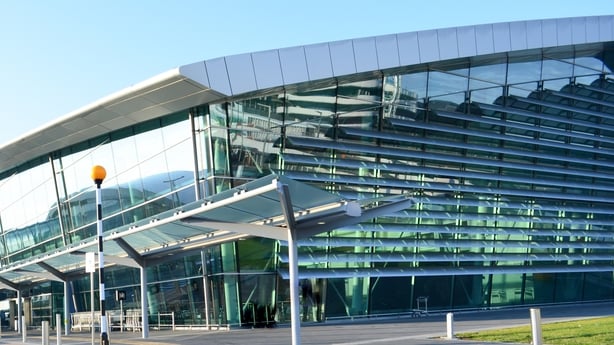
"Under the US EU Open Skies Agreement, both sides committed to a framework that allows airlines to compete freely without arbitrary limits on capacity. The passenger cap as currently applied violates that commitment. It was not designed and should not be applied as an aviation tool," he stated.
He warned that "whenever there is a disparate treatment of that partnership, then retaliation and rebalancing can be expected".
"Airlines are making decisions now where to deploy aircraft, open routes, invest over the next several years. Those decisions depend on confidence in that market access. Where that confidence is lacking, aircrafts move, capital moves, growth moves and those decisions are not easily reversed. This is why the timing matters," he stated.
The A4A CEO said the temporary stay on the restriction does not resolve the issue "with any sort of certainty".
"Only your legislative action can do that," he added.
Mr Sununu said he held recent meetings in the White House and the US Department of Transportation in Washington on the issue.
"I'm not here to speak on the government's behalf, but we can be clear about how these situations are viewed. When market access for US carriers appears constrained in ways that conflict with international agreements, it triggers a response," he said.
"With all the craziness we have going on in the United States with aviation, right here today this currently is our priority, and this is where folks are watching," he stated.
He claimed that not acting quickly to abolish the cap "introduces risk, not only for US carriers operating in Ireland, but for Irish carriers access to the United States, routes, frequencies, future growth all dependent on policy decisions made here," he added.