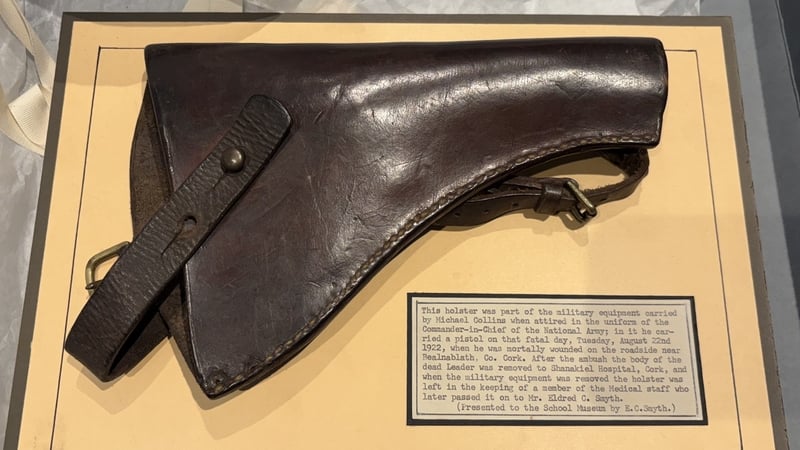

The holster said to be worn by Michael Collins when he was shot and killed is among items being loaned out by the Military Archives for public display.
The initiative is part of a drive to make its collections, usually kept in storage, more accessible for a wider audience.
Underground, in the vast concrete room, the hum of the air conditioner is constant.
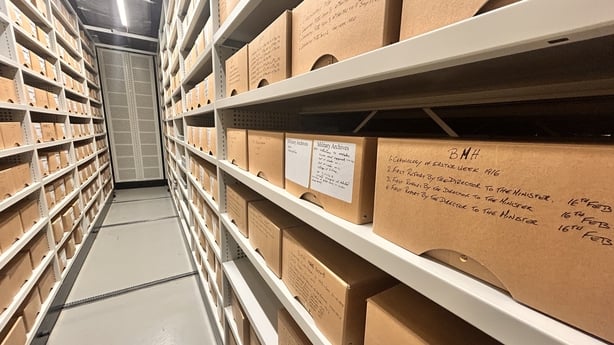
Conditions at the Military Archives at Cathal Brugha Barracks in Rathmines in Dublin, must be precise.
Made up of 21km of linear shelving, it is home to a huge number of files, providing historical insights into how the country was born.
Commandant Daniel Ayiotis is the officer in charge.
"We have hundreds of thousands of records covering the period from the establishment of the National Army right up to the present day. We also have some older collections and have material going back as far as the Battle of the Boyne," he said.
"The records that we hold here gives unprecedented insight into the fight for Irish independence and the subsequent years, but also the story of the Defence Forces during the 20th and 21st Century, as it moved into service overseas with the UN and became the physical embodiment of Irish foreign policy."
As well as documents, the archive is home to hundreds of physical artefacts too - a grenade training kit from the War of Independence, an original Proclamation, and much more.
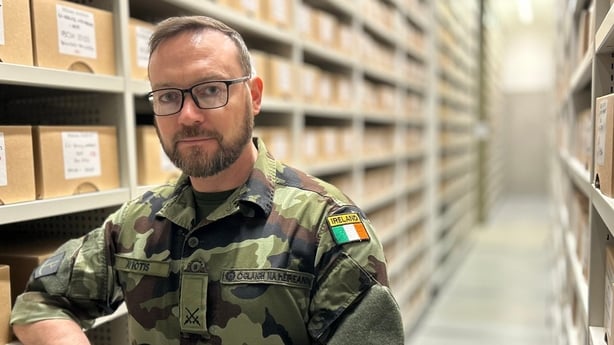
The items are usually kept in storage, but now they are being made more widely available, and loaned to museums for public display.
"Our ethos here at the Military Archives is that the material should be out. There is no point acquiring and preserving material that's not out there in public. So, our collaboration with the Little Museum is very much about maximising public access to the artefacts that we have here," Commandant Ayiotis said.
Among the latest items being loaned come from the Brother Allen collection, and includes a brown leather holster - purportedly the one Michael Collins was wearing when he was killed.
There's also a handwritten dispatch from Seán Mac Diarmada sent from the GPO on Easter Monday 1916, signed off "everything splendid".
The recipient of the items is the Little Museum of Dublin. Its curator, Daryl Hendley Rooney, is thrilled with the new items.
"We're delighted to launch a landmark partnership here at the Little Museum with the Military Archives, showcasing some incredible examples of treasures that people have rarely seen," he said.
"These are, in many ways, part of our culture, our history, our heritage. And to be in an archive where people can't see them is a great shame.
"In fact, the Brother Allen collection was donated to the Military Archives as a gift to the nation. But, if the nation cannot see those artefacts, they've lost their use. So here, we're able to celebrate the legacy of those items and to showcase them here for the next five years."
Among the other items going on display is a letter from Pádarig Pearse to Seán T Ó Ceallaigh, asking if he could give him and his brother a bed, the Friday night before the Easter rebellion.
There is also a sketch of Kilmainham Prison Chapel by Grace Plunkett Gifford, where she married Joseph Mary Plunkett before his execution.
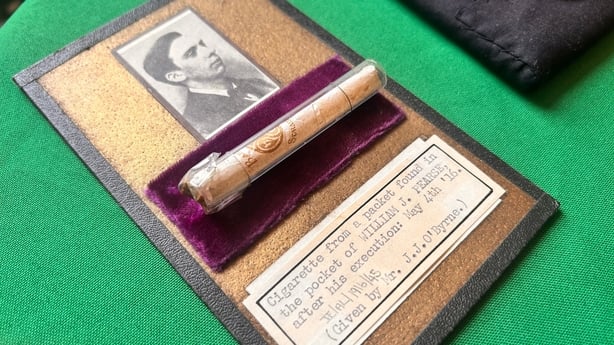
Other artefacts include a silk thread scapular worn by Countess Markievicz in prison, a cigarette from a packet found in the pocket of William Pearse after his execution in Kilmainham Goal, and a mounted 'Bloody Sunday' ticket, for the Dublin V Tipperary match at Croke Park on Sunday, 21 November 1920.
The Military Archives said more partnerships with museums are being planned, meaning a bigger audience, and wider understanding of the country's past.