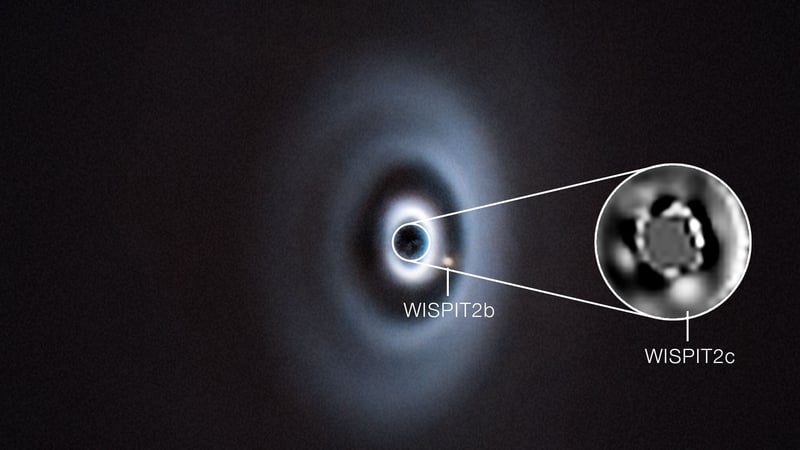

A Galway astronomer has led an international research team that has discovered a new planet, estimated to be five million years old and ten times the mass of Jupiter.
It has been located in the same system where another planet was located for the first time in 2025.
'WISPIT 2c' is in the constellation of the Eagle, which can be seen in the northern hemisphere between July and November.
Chloe Lawlor, a PhD student from the University of Galway’s Centre for Astronomy, made the discovery during ongoing research with German and Dutch colleagues.
The same team discovered 'WISPIT 2b' last year.
Both planets were detected using the European Southern Observatory’s Very Large Telescope (VLT), which is located in Chile’s Atacama Desert.
Ms Lawlor said the team suspected there might be more to discover after their initial finding but were uncertain if an object they detected was a large dust clump or a planet.
Using multiple telescopes to form a large virtual telescope, they were able to take a spectrum image, which revealed elements and molecules in the object’s atmosphere.
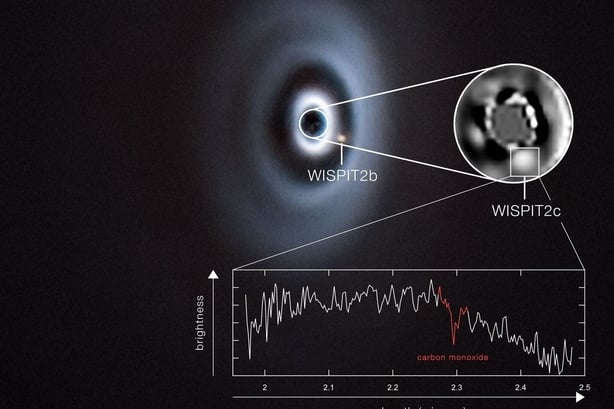
Further analysis of this "chemical fingerprint" showed carbon monoxide gas, something commonly found in the atmospheres of young planets.
"When we saw it, we knew we had something significant," said Ms Lawlor.
The gas leaves a strong and distinctive chemical signature in telescope data, providing the crucial evidence needed to confirm the discovery.
The planets are located in what is only the second known young multi-planet system.
It could resemble our Solar System, given the two gas giant planets that are in its multi-ringed dust disk.
WISPIT 2c is considered to be very young, based on temperature and its radius from the atmosphere spectrum.
It is twice as big as the previously detected WISPIT 2b and orbits four times closer to its host star, which makes it incredibly difficult to detect with ground-based telescopes.
The new discovery offers scientists a rare opportunity to study how massive planets form and evolve, shedding new light on the early processes that ultimately led to the formation of Earth.
Details of the research will be published in the Astrophysical Journal Letters.