

A dog warden has said that there has been a "dramatic rise" in dog attacks in recent years.
Vincent Cashman of Cork SPCA manages the dog warden service for Cork City Council.
"[Dog attacks] vary in severity, but we could have maybe five to six calls a week," Mr Cashman said.
"Even talking to colleagues that are involved in the dog warden services, definitely this winter has seen a dramatic rise," he added.
The calls come from dog owners themselves as well as An Garda Síochána, local authorities, the HSE and the victims.
Social Democrats TD Jennifer Whitmore told RTÉ's This Week that not only does dog control legislation need to be updated, there is also a need for what is in place to be "enforced properly".
Ms Whitmore added there is a lack of proper resourcing.
She said she believes many local authorities only have one dog warden, including her own constituency of Wicklow.
"Councils are underfunded to deal with this [dog attacks]," she said.
"It's very rarely that you see enforcement when it comes to whether it's animal welfare or for animal regulation."
Deputy Whitmore said that she believes the issue of dog control needs to be looked at holistically.
"I'd be very hesitant to blame any dog," she said, citing issues with how dogs are bred, housed, trained and treated by humans.
Mr Cashman said that sometimes the socialisation part of dog ownership is lacking and that is causing problems.
Both Mr Cashman and Deputy Whitmore said that although all dogs must be microchipped by law, many are not.
The most recent figures available show that in 2024 there were just over 60 dog wardens in the country.
The hiring of dog wardens is a matter for each local authority.

However, the Department of Agriculture has provided some money to local authorities since then to increase this number.
A separate capital fund was made available to local authorities over the past three years to improve dog warden facilities such as equipment, pounds and public signage.
None of this funding is guaranteed into the future.
Mr Cashman said the increased funding was a "very good start".
"It's an acknowledgement from the government that there is a problem there, that we are dealing with problem dogs. and that the wardens themselves need to be better trained, better equipped, and that there needs to be more of them to do their job properly."
In figures obtained by This Week, An Garda Síochána recorded 224 incidents of endangerment by animal last year.
An Garda Síochána does not categorise incidents by type of animal or breed involved.
A search of these incidents returned fewer than ten incidents mentioning an XL Bully.
Dog attacks puts grandmother in hospital
Áine (not her real name) was attacked by two dogs in North Dublin last summer.
The 75-year-old grandmother was out walking her own dog, her puppy and her three-year-old granddaughter in her local area when she was attacked.
"We were going along and as we were passing a doorway, some dogs came out and ran and attacked me and knocked me over," Áine told RTÉ's This Week.
A child opened his front door to his friend and dogs ran past him out of the house and towards Áine.
"They ran out between the child's legs," she said.
"They knocked me to the ground, and they got in between my legs.
"They were trying to get my little puppy.
"The bigger, heavier dog was leaning on my walking stick that I had. I could feel the bone snap in my leg and as I collapsed, my puppy got away and they ran after the pup."
It was a sunny morning and there weren’t many adults around when Áine was attacked.
"I lay on the ground, and I was looking for help and there was nobody around," she said.
A girl recognised her and ran into her house.
The fire brigade was called, and she was taken to hospital.
She did not come home for six weeks.
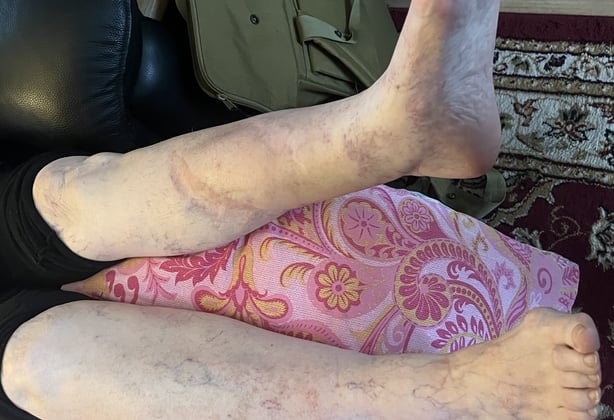
"I have six screws in my leg altogether, four down on my ankle and two on my knee, and I have rods as well to try and strengthen my leg.
"I can't walk far at all; my leg gets very painful.
"It's changed my whole life. I find that I get very tired.
"I find it very hard to sleep as well because... My leg, my ankle just doesn't like settling."
When Áine returned to the hospital, she gave an interview to dog wardens from Fingal County Council about her attack.
She also provided them with photographic and medical evidence of her injuries.
In a medical letter sent by Áine's doctor and seen by RTÉ, which was part of the submission to the dog wardens, Áine's doctor wrote that due to her underlying health conditions she could have died as a result of the dog attack.
During that interview with the dog wardens, Áine said that she was told that the dog owner was issued a €300 fine due to non-compliance with regard to dog control.
However, she says that after she was interviewed, she heard nothing more from the dog wardens.
Fingal County Council told RTÉ's This Week that it does not discuss individual cases.
According to the council's records, there were just over 50 dog attacks in Fingal last year, 26 of these were dog attacks on a person.
Most of the attacks recorded involved a dog on the restricted breed list.
Dog wardens can recommend several actions after they investigate an incident including the issuing of fines, seizure of the dog or a court order by the District Court such as a destruction order or control order.
"If you've been attacked by a dog and not knowing whether or not you're going to meet that dog again, whether there's been a monitoring of the situation, whether the dog has had training ... I think communication is really key in any of these things," Deputy Whitmore said.
"I do think that it's important that there's a level of transparency for people and victims of these attacks as well."
After the dog wardens visited her at her home, Áine said she did not hear anything else from them.
When one of her daughters followed up on her behalf, they were told that the case was fully investigated and closed.
Local representatives at both councillor and TD level that Áine contacted received the same response from Fingal.
Áine said this is not justice.
"Justice would be that the victim is to be included," she said.
"I'm the person that suffered. I'm the person that's suffering still. And I have nowhere to go."
She believes that Fingal County Council should have made an effort to speak to her directly about her case and let her know any outcomes that resulted from their investigation.