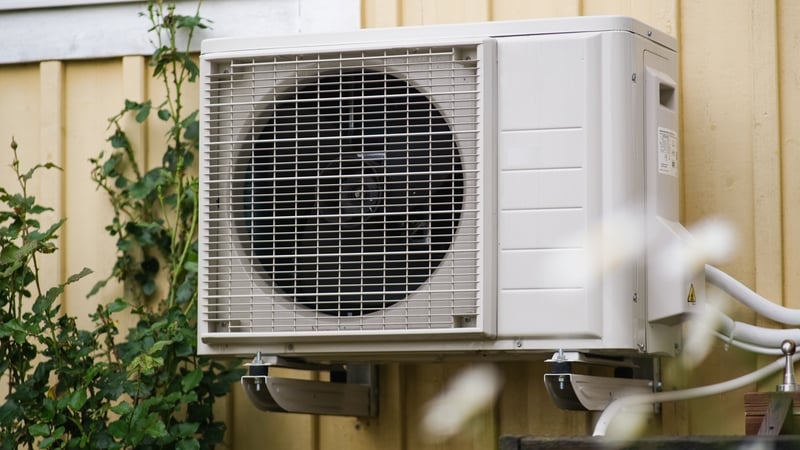
Ireland is significantly behind its targets for installing heat pumps and the deep retrofitting of homes, according to analysis by a think tank.
The Economic and Social Research Institute (ESRI) said that projections indicated that targets for retrofitted properties were unlikely to be met and that policies might be needed to boost the number of energy-efficient homes.
Ireland has committed to reduce its greenhouse gas emissions, as measured in 2018, by 51% by 2030, but environment minister Darragh O'Brien has acknowledged it will achieve only half of this target.
The Environmental Protection Agency has projected that Ireland will reduce its emissions by 23% by 2030, assuming it implements in full its current plans and policies.
The Government's Climate Action Plan 2025 sets a target to install 400,000 heat pumps in existing homes and 200,000 heat pumps in new dwellings; and to upgrade 500,000 homes to a Building Energy Rating (BER) of B2 or higher.
Deep retrofits, deemed as bringing a home to an energy rating of B2 or higher, had reached 11.5%, or 57,932, of the 2030 targets by the end of 2024.
And there have been 14,194, heat pump installations, which is 3.5% of the 2030 target.
"We find that progress is lagging considerably behind that required to achieve the stated targets," the report said.
"Assuming this same acceleration is maintained every year until 2030, total deep retrofits by 2030 are projected to reach nearly 334,000, or 66.7% of the target, while total heat pump installations are projected to reach nearly 51,400, or 12.9% of the target."
The analysis said barriers to implementation included high capital costs and disruption, with more than 40% of homeowners saying they had no interest in changing their home's properties or layout.
The report said the median cost of a deep energy retrofit ranged from €22,914 for an apartment to €66,503 for a detached house, with the portion of the cost covered by the homeowner ranging from €16,378 to €42,900.
In the rental market, the cost of deep retrofitting a rental property from a C rating was €30,000, while a deep retrofit from a G rating was €43,000.
The report said that the rental market suffered from the "split incentives" problem: a resident homeowner benefits from reduced bills and an increase in property value after an energy retrofit; but a tenant benefits only from the former and in most circumstances, the landlord only benefits from the latter.
The ESRI also said research and analysis indicated BER ratings could "deviate considerably from actual consumption" as they were based on predicted rather than actual energy use.
It also cited an Irish study that found households consumed around 10,869kWh/year, and that this "does not vary considerably" whether it is an A-rated house or a G-rated house.
"In an Irish context, (Coyne and Denny 2021) find that theoretical energy use is, on average, 17% below actual energy use, and this difference varies by the BER rating of the dwelling," the ESRI said.
"These findings correspond to those of (Meles et al 2023; 2024), where BER is shown to have a lesser than expected predictive power on energy consumption and heat loss."
The research said policy changes could be considered to address the shortfall in heat pump and retrofit targets, including a switch to lower-cost carbon fuel, making retrofit schemes and loans more accessible to lower-income families, and more flexible energy options such as heat storage.
Dr Muireann Lynch, senior research officer at the ESRI, said: "This review synthesises the empirical evidence on residential heat decarbonisation progress and challenges in Ireland.
"It highlights substantial shortfalls in delivery and discrepancies in performance metrics to date.
"In this context, additional policy measures may warrant consideration."
Dr Niall Farrell, associate research professor at the ESRI, said: "The study examines barriers to retrofit uptake and tracks progress in deployment.
"Projected trends point to a likely shortfall in emissions savings relative to climate objectives.
"Drawing on multiple data sources and recent studies, the analysis highlights key evidence gaps that are crucial for tracking real-world outcomes against climate targets."
Ireland will fall short of renewable energy targets
Ireland will fall short of renewable energy targets up to 2030, the Cabinet heard yesterday.
The State met its "baseline" renewable energy target of 16% in 2024 but is projected to fall short of interim targets in 2025 (27.6%) and 2027 (33.6%), according to a memo brought to Cabinet.
The overall ambition is a renewable energy share of 43% in 2030.
A Government spokesman said: "Ireland will fall short of our renewable energy targets up to 2030.
"These targets are based on the share of renewable energy in gross final energy consumption in the electricity, heat and transport sectors."
The spokesman said further analysis of available "options" is being undertaken, including paying a financial contribution to renewable energy projects in other EU member states in return for a "statistical allocation" of the energy produced.
He added: "The priority will still remain supporting domestic renewable generation.
"Further analysis is going to be undertaken to assess the potential value and cost effectiveness of these mechanisms."