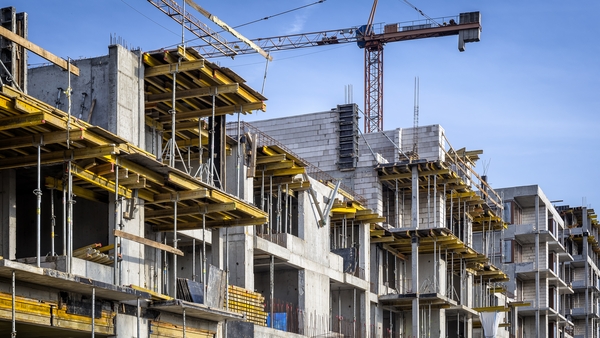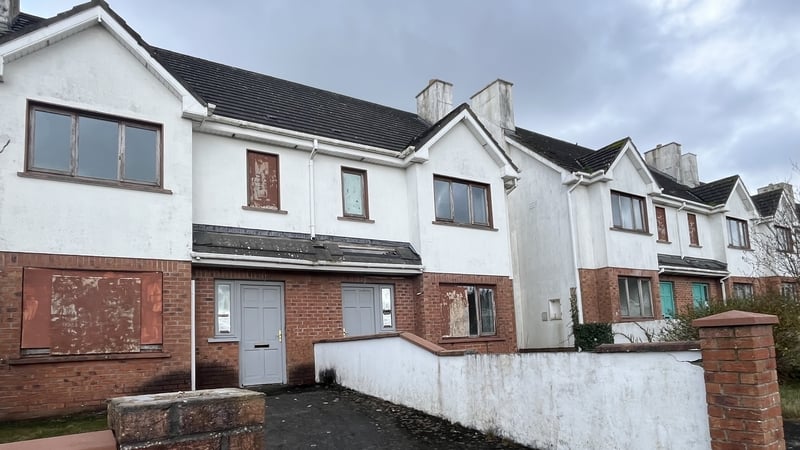

Nearly 20 years on from the financial crash, almost 60 ghost housing estates remain across Ireland.
RTÉ's This Week programme asked all 31 local authorities how many ghost estates, officially known as "unfinished housing developments", remained on their books.
Of the 27 that responded, there were 58 ghost estates reported.
Donegal had the highest number of ghost estates at 12, followed by Tipperary with ten and Leitrim with seven.
Twelve local authorities no longer contain any ghost estates.
The local authorities that did not respond were Galway County Council, Cork City Council, Mayo County Council and Offaly County Council.
In 2021, there were 123 ghost estates. In 2023, it was reported there were 75 left. Today at least 58 remain.
We need your consent to load this rte-player contentWe use rte-player to manage extra content that can set cookies on your device and collect data about your activity. Please review their details and accept them to load the content.Manage Preferences
Ghost estates emerged near the end of the Celtic Tiger when estates were being built and only partially occupied.
After the 2008 recession, around 3,000 housing estates that were under construction ceased development and became known as ghost estates.
Partially constructed housing estates that were once seen as an indicator of growth became a sign of decline.
"When the credit crunch started to happen, construction just really stopped in a lot of places," Associate Professor of Geography in Trinity College Dublin, Dr Cian O'Callaghan explained.
According to a 2009 study, co-authored by Dr O’Callaghan, home vacancy in the country, including holiday homes, was estimated at over 300,000.
The Government’s current housing target is for the construction of 300,000 homes by the end of this decade.
Taking in charge
Gillian Moore moved into her home in Glen Court estate in Emly, Co Tipperary, in 2007.
After 18 years as a ghost estate, it was officially 'Taken in Charge' by Tipperary County Council last year.
When an estate is under construction, it is considered private land.
After it is developed with streetlights, roads and other public amenities, it goes through a process called 'Taken in Charge’ and the relevant local authority maintains those public goods.
Residents like Ms Moore were left in a limbo as their council was not responsible for maintaining facilities. She remains in negative equity on her house.
Glen Court did not have working streetlights in the estate until 2018, 11 years after Ms Moore and her family moved there.
"So we were living here approximately 11 years in the darkness," Ms Moore said.
"We had severe issues with the sewage, raw sewage basically coming up through manholes on the roadways and up through people's drains in their gardens.
"When you'd contact the council and report this, the excuse you were given [was] that the estate wasn't Taken in Charge," Ms Moore said.
The homeowners of Glen Court submitted a Taking in Charge application to Tipperary County Council in 2013.
"It took until 2025 for the estate to actually be Taken in Charge by the local authority, which to me is quite disgraceful," Ms Moore said.
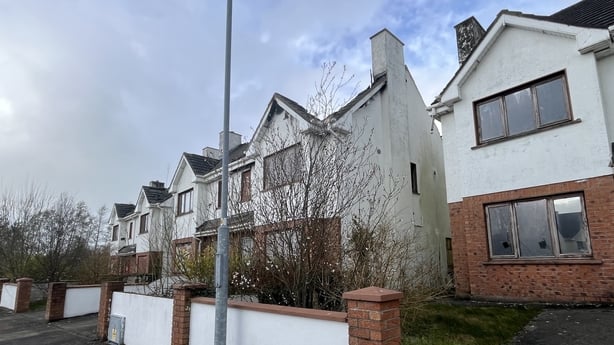
Twenty-three properties on the estate have never been occupied and are derelict.
After the estate was Taken in Charge, those houses were put on the derelict sites register.
In a statement, Tipperary County Council said that they have met with the residents of Glen Court to determine a course of action for the properties that will be "sympathetic to the needs of the existing residents".
"The estate has been included as part of the programme to address derelict sites, and it is anticipated that derelict sites levies will issue in the coming weeks.
"Once this process is complete, the next steps are to finalise how best to bring these properties back into use," the council said.
Ms Moore hopes that the houses will be renovated and purchased by owner-occupier families like her.
She said she is very proud of Emly, she describes it as a great place to live and she loves her home.
Ms Moore, along with members of Emly Tidy Towns, has been maintaining the front gardens of the vacant houses.
"We just try to keep them looking as best as we possibly can," she said, "and deter your attention from these eyesores".
A lot of anti-social behaviour has been associated with the derelict properties in the estate. Several were burned out or had windows smashed, and roofs caved in.
In Tipperary, one of the ten remaining ghost estates is Kilnamanagh Manor in Dundrum.
"This was all supposed to be built, a huge, big development here, from what I remember," said Fine Gael councillor Mary Hanna Hourigan.
Fourteen houses were built on the site and there is a large fallow field behind them where more houses were meant to be built.
Tipperary County Council said that planning permission for 37 units to complete the development has been granted and is valid until this November.
"I've been inside some of [the built houses] some time ago and they really are beautiful houses, very well constructed," Cllr Hourigan said.
"I know unfortunately, for the homeowners here, their sewage did back up in recent weeks, and the council very kindly did come out," she added.
"People are paying their property tax here, so you know they're fully entitled to be able to ring the local authority or ring their local councillor if they have an issue but if it's a private estate and it hasn't yet been Taken in Charge by the local authority, then they're not obliged to assist you," added Cllr Hourigan.