
Thousands of Irish holidaymakers are among the hundreds of thousands of air passengers who have been left stranded due to the unrest in the Middle East.
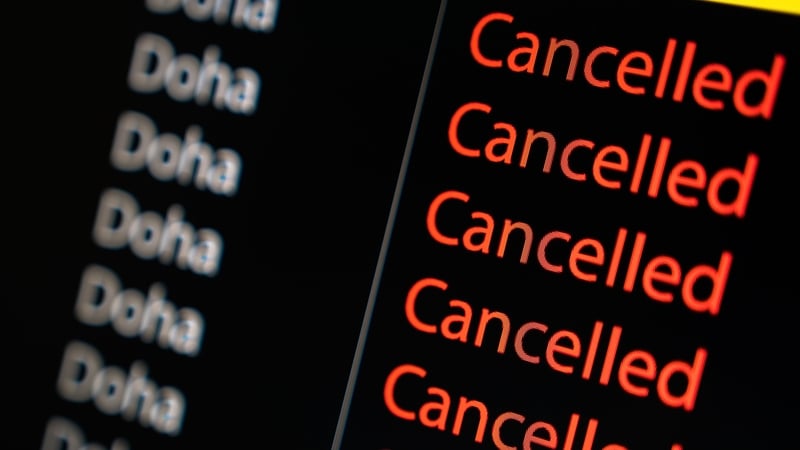
Thousands of flights have been cancelled worldwide due to the conflict, as the aviation industry faces its biggest challenge since the Covid-19 pandemic.
More than 50 flights have so far been cancelled to and from Dublin Airport alone, since Saturday morning.
Qatar Airways, Emirates and Etihad Airways operate direct flights to and from Doha in Qatar, and Dubai and Abu Dhabi in the United Arab Emirates.
Five of the carriers' aircrafts are currently grounded at Dublin Airport, after airspace and airports in parts of the Middle East were closed.
The fourth consecutive day of closures includes Dubai Airport, which is the world's busiest international hub, through which many Irish people transit on to Asia and Australia.
Media Relations Manager of Dublin Airport operator daa Graeme McQueen said Dublin Airport is a connecting hub for a lot of Middle Eastern flights.
Speaking yesterday, he said: "We've had 23 flights cancelled across Saturday and Sunday, and another 12 today, so that's a significant number of passengers, probably talking in and around 10,000 passengers impacted so far."
He said there is "uncertainty" about what will happen in the days ahead.
"The airlines need to make decisions, but they can't do that until they see what happens to the airspace in the Middle East, so it is a bit of a waiting game for the days ahead, unfortunately."
Mr McQueen said neither the daa, nor the airline knows when services will resume.
"Normally, on a day like today, we'd have around 3,000 passengers going between Dublin and the Middle East and vice versa," he added.
"We five aircraft parked on stands. They're ready to go when the time comes. But we just don't know when that time will be at the moment."
In terms of the advice for intending passengers, Mr McQueen said people who are due to fly in the coming days should "stay in contact with your airline".
"They'll be able to tell you whether your flight is going to run or not."
As well as people who had plans to travel abroad, Mr McQueen said there are many people trying to get home to Ireland from locations such as Australia and Dubai.
"We have a lot of connections here in Dublin. People fly all over from all over Europe and the UK to get to Dublin and then onwards to the Middle East and to places like Australia. So, there's a lot of people looking to rebook at the moment, but they obviously don't know when airspace is going to reopen. So that's difficult.
"I know the airlines are working very, very hard to make sure that everyone's accommodated in hotels and if they can rebook, they will. I know they've got very generous extensions on the rebooking period, so up until the middle of the month, you can rebook."
Emirates
Emirates began operating a limited number of flights from Dubai yesterday evening.
It said it was accommodating "customers with earlier bookings as a priority, and those who have been rebooked to travel on these limited flights".
Emirates said customers who could avail of the flights were contacted directly, and it said others should not go to the airport unless they were notified.
All other Emirates flights remain suspended until further notice, with updates being published on its official social media channels.
"The safety and security of our passengers and crew remain our highest priority."
Qatar Airways
In its latest update, Qatar Airways said its flight operations "remain temporarily suspended due to the closure of Qatari airspace".
The airline said it will resume operations once the Qatar Civil Aviation Authority announces the safe reopening of Qatari airspace.
It said a further update will be provided at 9am local time (12pm Irish time) on Wednesday, 3 March.
Etihad Airways
Etihad said its scheduled commercial flights to and from Abu Dhabi remain suspended until 2pm local time (6pm Irish time) on Wednesday, 4 March.
It said some repositioning, cargo and repatriation flights "may operate in coordination with the UAE authorities and subject to strict operational and safety approvals".
It is also advising intending passengers not travel to the airport unless they have been contacted directly by the airline and advised to do so.
"Guests holding Etihad tickets issued on or before 28 February 2026, with original travel dates up to 7 March 2026, may rebook free of charge onto Etihad-operated flights up to 18 March 2026."
It also said customers due to travel on all Etihad flights until 7 March may request a refund through its website or through their travel agent.
"Safety remains our absolute priority, and services will operate only once all safety criteria are met."
Airports in region key transit hubs - ITTA
The Irish Travel Agents Association said while the Middle East is not a particularly popular destination for holidaymakers from Ireland, the airports in the region are key transit hubs.
Paul Hackett, Chief Executive of Click&Go and Vice-President of ITAA, said on any given day between 2,500 and 3,000 passengers are "either traveling to or transiting each way through the three airports that are impacted".
He said the disruption from the unrest is having a significant impact on the travelling public, which he said includes "people who are living in the UAE at present and want to commute back to Ireland, travellers who are leaving Ireland to get to the Middle East for holidays or transiting through the Middle East, and passengers trying to get back from destinations globally that will transit through Dubai, Abu Dhabi and Doha".
The ITAA Vice-President described the current situation as "very fluid" and said there are a lot of questions that cannot be answered currently.
He has advised intending passengers to "follow the Department of Foreign Affairs advice, follow your travel agents’ advice, speak to your airline, speak to your travel agent, speak to the local authorities".
"Stay safe, stay indoors and keep your phone charged and register with the DFA if you're resident abroad or traveling abroad at present," he added.
Travel insurance 'bit of a grey area' in war situations
In terms of travel insurance, Mr Hackett said it was a "bit of a grey area" in war situations.
"In most situations, a situation of war which is unexpected is most likely not going to be covered by their insurance.
"The liability is when a flight's cancelled, you're going to get a refund. In a situation of war, it's what's deemed unexpected and extraordinary circumstances. So, anything beyond the cancellation and rerouting is really the limit of the airline's responsibility at present."
"The limitations get quite complicated, depending on the origination of the flight and where that airline is based."
For people who have to incur expenses as a result of the disruption, the advice is to "be reasonable, if you can" and "ensure that you’re keeping receipts, so that in the event that you can process a claim, it's going to be easy and straightforward for you to do so".
"It's a really unfortunate situation for travellers, be it traveling for visiting friends and relatives, for leisure or for business, try and understand that nobody has the answers right now and that everybody is trying to do their best in these difficult situations," he said.
The Irish Aviation Authority has advised passengers to check the latest travel advice from the Department of Foreign Affairs and to confirm their flight status directly with their airline before travelling to the airport.
The IAA said people who are currently abroad and cannot return home should contact their airline for information on the assistance and support available.
It is advising passengers due to travel to or through the Middle East to stay in close contact with their airline and the DFA for the latest updates before travelling.
EU regulations
Under EU laws, passengers impacted by flight cancellations or delays have specific rights.
However, the IAA said rights vary depending on the circumstances of the journey, including the airline operating the flight and the airport of departure.
Under EU Regulation 261/2004, passengers departing from an EU airport on flights operated by EU and non-EU carriers are covered by EU passenger rights legislation.
They include the entitlement to a refund within 7 days if your flight has been cancelled or if you no longer wish to travel.
If you do still wish to travel, your airline must re-route you at the earliest opportunity or at a later date of your choice and provide meals, refreshments, and accommodation where necessary.
"If the airline cannot immediately provide these services due to exceptional circumstances, it should reimburse reasonable costs you incur."
Passengers arriving into an EU airport on flights operated by EU carriers are also covered by the legislation but the cover does not extend to passengers arriving into an EU airport on flights operated by non-EU carriers.
"Regardless of whether EU law applies, the IAA strongly encourages airlines to make every reasonable effort to minimise the impact on passengers."
The IAA said passengers travelling on a package holiday "may have additional protections under package travel legislation".
"If the disruption means your holiday cannot proceed as planned, your tour operator must offer an alternative holiday, if available, or provide a full refund of the package price."
The IAA said people can contact the Competition and Consumer Protection Commission "for advice on enforcing your consumer rights relating to package holiday refunds".
The authority said while it recognises the impact the current disruption is having, "passengers are unlikely to be entitled to fixed-sum compensation under EU Regulation 261/2004".
"The situation in the Middle East is likely to be considered an extraordinary circumstance. Extraordinary circumstances do not affect your rights to care, assistance, refunds or re-routing, but they do mean compensation is unlikely to apply."
Impacted passengers are being advised to stay in contact with their airline, with updates being posted online and on social media channels.