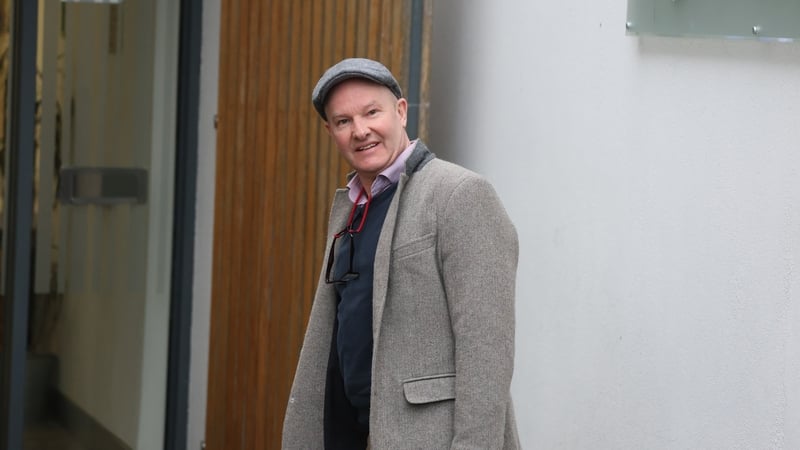

Dublin GP Marcus de Brun has asked the Fitness to Practise committee to drop the allegations against him, based on what he said is a lack of evidence.
His submission to dismiss the case was made this afternoon at the Irish Medical Council inquiry.
Dr de Brun is accused of ten counts of professional misconduct including alleged criticism of public health guidelines, lockdowns and the wearing of facemasks and Covid-19 vaccines.
He made the request after the committee returned their decision to reject his application for a witness to be summoned to the inquiry to explain the process around the Preliminary Complaints Committee (PCC).
The inquiry heard Dr de Brun explain how it was necessary to hear an explanation of the PCC process and the information that it had regarding his case.
He said he hoped the committee is aware that the PCC had other options to deal with this in "other appropriate ways" if they had all the facts.
Professor Deirdre Murphy said the committee was satisfied that sufficient material went before the PCC, that it was a prima facie case and the seriousness threshold was met.
Dr de Brun stated "existence of that threshold is not established by referral alone and must be grounded in some evidence. "There is no evidential foundation. No factual witness," he stated.
"I emphasise this submission invites the committee to recognise in the absence of evidence, it cannot lawfully proceed," he said.
In response to Dr de Brun's submission for the case to be dismissed, barrister Neasa Bird who is representing the Medical Council, told the committee that it is "quite plain and apparent that there is evidence before you".
She said the allegations against the GP relate to his tweets and his attendance at a rally.
"He accepts that the tweets are his tweets. As a matter of fact, that they are his tweets, that is proven evidence. It is accepted and not denied that he was at a rally and made the comments and there is evidence of that," Ms Bird said.
She said "these are allegations which are capable of meeting the threshold of professional misconduct."
After considering Dr de Brun’s submission for just under half an hour, the committee returned their decision, stating that "in light of the totality of evidence" they are satisfied he has a case to answer.
Professor Murphy said they came to the decision after taking legal advice and after reviewing the evidence that they received during the first four days of the inquiry in September.
Dr de Brun, who is representing himself, is due to give evidence tomorrow morning.
He had previously described the use of Covid-19 vaccines in children as a "crime against humanity".
The allegations against him also relate to comments he made at a rally in 2020 when he was accused of failing to wear a facemask and observe social distancing.
Dr de Brun, who ran a family practice in Rush in north Co Dublin, rose to prominence online due to his outspoken criticism of the State's handling of the pandemic.
He ended his HSE contract due to the way in which the pandemic was handled.
The Medical Council claims Dr de Brun's actions and comments undermined public health guidelines.
An application was made by Dr de Brun to have the evidence of Professor Colin Bradley excluded from the inquiry.
Dr de Brun had told the inquiry in September that it would be unfair if Professor Bradley’s evidence was admitted because it lacked independence.
The inquiry today heard Dr de Brun had made further submissions since then, outlining the reasons why he believed his evidence should be excluded from the inquiry.
His complaints focused on Mr Bradley's methodology, his language and his use of evidence of another witness.
This morning, committee chair Professor Deirdre Murphy said they had the benefit of hearing Professor Bradley's oral testimony and also cross-examination by Dr de Brun.
Dr de Brun said "the matter for the committee is deciding on the independence of Professor Bradley".
He said the CEO of the Irish Medical Council is entitled to retain expert advice to frame, moderate or work through allegations.
However, he added: "In doing so the independent expert becomes involved in the exigency of litigation."
Inquiry satisfied no breach of objectivity in expert's evidence
Barrister Neasa Bird BL, who is representing the CEO of the Irish Medical Council, said they rejected the submissions made by Dr de Brun.
She said that Dr de Brun had suggested that there was a process whereby Professor Bradley was acting as a legal medical advisor to Medical Council.
She said he had "acted independently".
She also said there was "no crafting of a case" by the expert witness and he had been asked to provide his independent opinion.
"It is entirely proper that the CEO calls an expert to give their opinion as to whether the conduct has fallen short…or whether it is disgraceful.
"That is routine. That is normal practice and is not improper as has been suggested by Dr de Brun. There is no absence of independence.
"Rather, Professor Bradley was asked to give his view."
She said decisions were taken on which allegations should be proceeded with and which should not and there was nothing "sinister" about this.
"There is no solicitor-led shaping allegations. Documentation and all the material does not bear that allegation in any way shape or form," she said.
The committee deliberated for over one hour on Dr de Brun's application.
Professor Murphy said they had decided they were satisfied that there was no breach of the fundamental principles of objectivity and that they were satisfied "beyond doubt" not to exclude the evidence of Mr Bradley.
During this morning's hearing, Dr de Brun had also outlined the personal toll this inquiry has had on him and the length of time it has taken for it to proceed. Professor Murphy acknowledged this.
"We acknowledge the difficulty for you personally in the delays and we would wish that not to be the case," she said.