Ever thought about having something a little different as a pet, such as a snake, a bearded dragon, or a tortoise?
The NSPCA has warned about a lack of education and regulation around keeping exotic animals as pets.
It has renewed its call for a positive or prohibited list of species that can be kept - something the Government says it has no plans to introduce.
Aaron McElroy visited two rescue centres caring for exotic pets.
A serval cat has a new home in Co Wexford after being found in a back garden in Co Roscommon.
Secret Valley Wildlife Park and Zoo cares for animals that have been involved in the pet trade, been used in circuses or experimented on in labs.
Zeus, the serval, first spent time in a cattery and is a new arrival, having been found in December.
"Poor old Zeus wandered into somebody's back garden up in Roscommon before Christmas and he’s ended up here," said Secret Valley owner Ann O'Connor.
"He was more than likely bred in Ireland. There’s always somebody out there who will manage to breed these, or get these animals in," she added.
A serval is a medium-sized wildcat with markings similar to that of a cheetah. They are native to Africa and prey on small birds, reptiles and rodents.
Servals need to be treated like the dangerous animals that they are, said Ben Buckley, a zookeeper at Secret Valley.
"You wouldn't keep a serval as a pet because they are still classed as a wild animal. They are classed as a category one animal in zoos. You wouldn't really want a wild animal in your home," he added.
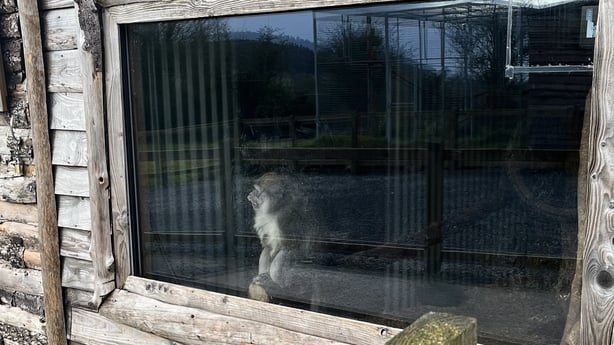
Oscar, a crab-eating macaque, is another resident at Secret Valley, having previously lived in Co Donegal.
"I think he was bought as a birthday present for a little girl," said Ms O’Connor.
"They had him for a long, long time and realised he's not the best pet to have. So they looked to have him moved somewhere more suitable."
Macaques are not suitable to have as pets, she said.
"They are very, very strong. They have very big teeth. They can be docile for a while and then the next thing, they'll pounce. They are too intelligent. They'll always be one step ahead.
"There’s probably somebody out there who can get you whatever you want, which is really bad," said Ms O’Connor.
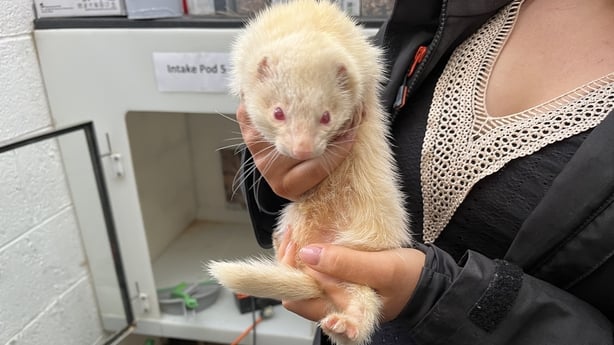
Demand for the services of exotic animal rescues and sanctuaries is reported to be constantly high.
The Small Animals and Exotics Centre at the National Society for Prevention of Cruelty to Animals (NSPCA) in Rathfarnham in Dublin opened to the public in 2024.
At any one time there can be between 50 and 60 animals in the care of the centre.
Rabbits and guinea pigs make up most animals there, but it also houses reptiles, birds and fish.
Current residents include Oven Chip, the leopard gecko, and Wagamama, the ferret.
In 2024, the centre cared for 260 animals. That number rose to 348 in 2025.
The scale of exotic animals in Ireland cannot be accurately measured because they are often kept out of sight, said NSPCA Chief Inspector Conor Dowling.
"The numbers are comparatively low but you don't want to read too much into that. Although we don't hear about it. It would be underestimating the problem that is out there with these animals."
The Convention on International Trade in Endangered Species of Wild Fauna and Flora (CITES) protects around 6,600 animal species from over-exploitation.
The NSPCA said that similar rules should be introduced for animals that are not endangered.
Ireland is "way behind" on regulation of exotic animals and even lacks rules on keeping big cats like tigers, said Mr Dowling.
"We would be advocating for a permitted list of species that could be kept, so that you've got limited numbers of animals that are not going to be dangerous, not going to pose a danger to the public and they're relatively easy to keep.
Mr Dowling said that having such a list would make it easier to enforce and monitor what animals are entering the country.
"The reality is, why does somebody need to have a venomous snake? Why does somebody need an animal that is potentially dangerous? I don't think there’s any reason for it, except perhaps something for their ego."
In response to a written parliamentary question, Minister for Agriculture Martin Heydon said that the Department of Agriculture "has no plans to introduce a positive or a prohibited list for exotic animals".
A knowledge gap in caring for exotic animals contributes to them being mistreated or neglected, said Caroline Mothersill, manager of the NSPCA's Small Animal and Exotics House.
The issue generally comes from where the animals are being bought, she said.
"You can just order them from a supplier. There's no checks, no regulations. For the animals that aren't on CITES, they can just be ordered in from the UK or wherever."
Ms Mothersill said that all exotic animals need different care, which needs to be considered when purchasing.
An example given was a desert species, such as a bearded dragon, whose correct set up could cost almost €1,000.
"People sometimes say 'I can go to a pet shop and they'll give me a set up for €200’. Yes but your reptile is going to get sick but there's no law to say they can't live in that.
"They don't suffer in the same way mammals do. You could have a tortoise living 20 or 30 years and you think it's happy and healthy, but it may not be," she said.