


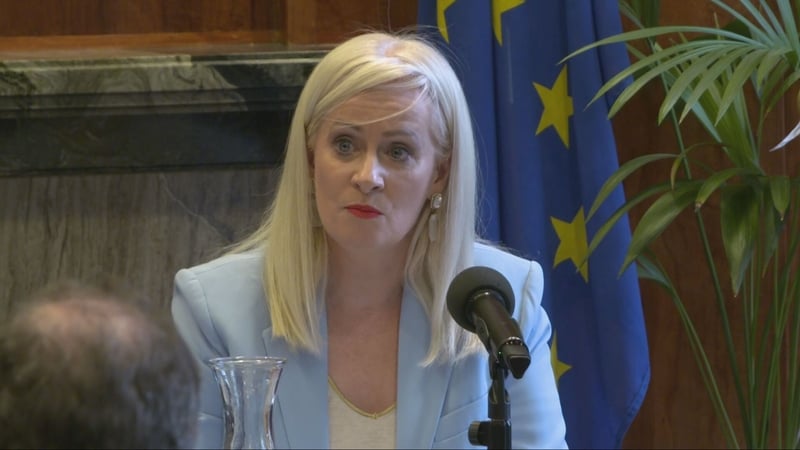
The Minister of State with responsibility for Artificial Intelligence Niamh Smyth has said that both Irish and EU laws have been broken in relation to AI generated child abuse images.
Concerns about the misuse of AI intelligence tool Grok are growing, with the app being widely condemned for creating sexually explicit images of adults and children.
The minister has requested a meeting with X about the issue.
Speaking on RTÉ's Today with David McCullagh, Ms Smyth said it is clear in Irish law that child abuse images are illegal. She said it is "deeply worrying" that X is facilitating the chatbot Grok and the images that have been created are "absolutely appalling".
"Whether they're real images or computer generated, which is what we're talking about here, it is a criminal offence to distribute them on platforms," Ms Smyth said.
"As far as I'm concerned the law has been broken here in Ireland. The EU law, European law has been broken too. We also know that under the Digital Services Act, the European Commission is responsible for these large online platforms."
Ms Smyth added that she is confident that Coimisiún na Meán are doing their role in engaging with the European Commission to "ensure that this is stopped and working closely with Grok to ensure that that happens".
Ms Smyth said she will sit down with the Taoiseach in the coming days to discuss the issue, after Mr Martin yesterday condemned the Grok AI tool, describing it as "shocking".
She urged anyone exposed to such images to report them.
She said she wrote to X yesterday to request a "face to face" meeting but has had no response yet.
"We are talking about the protection of our children ... people are worried, concerned.
"I know within Fianna Fáil we have done online surveys around this and there are staggeringly high figures - which are hardly surprising - in terms of how parents are concerned about online content," she said.
"But what we've seen over recent days with Grok takes it to a completely new level - a new level that certainly isn't acceptable within the Irish system, or should not be."

Online safety charity says 'AI girlfriend' apps must be prohibited for minors
Meanwhile CyberSafeKids' CEO Alex Cooney said the charity unequivocally support national calls for an urgent and total ban on 'nudify' and 'pornify' applications, and any other AI-based tools capable of generating deepfake sexual images of both children and adults.
"There is no legitimate purpose, no social benefit, and no positive outcome associated with this technology. Its sole function is exploitation, abuse, and harm," she said.
Ms Cooney stressed that it is also imperative that these nudification tools and 'AI girlfriend' apps are categorically prohibited from being accessed by children under 18 years of age, through the app stores, search engines, or advertising.
She said the CyberSafeKids’ address to the Joint Committee on Children and Equality on 18 December last year recommended that Ireland follow the UK and Australia's lead in introducing legislation explicitly prohibiting AI tools to generate or manipulate sexualised images of minors.
"We further urged the Committee to consider adopting Denmark’s innovative approach of extending copyright protection to an individual's body, facial features, and voice as a means of clamping down on the creation and dissemination of deepfakes," she said.
Ms Cooney said the current AI Act fails to adequately address the unique and heightened risks that AI systems pose to children, including "hyper-personalised influence, emotional manipulation, and the blurring of boundaries between automated agents and real people".
"As with social media regulation, the framework is fundamentally reactive rather than preventative. It does not mandate safety-by-design and is therefore already outdated," she said.
She added that children are interacting daily with systems that the law does not yet properly recognise or regulate.
Ms Cooney added that a critical failing is that generative AI Chatbots are not classified as 'high-risk’ in relation to children.
"The events surrounding X’s AI Chatbot Grok this week demonstrate precisely why this must change," she said.
"This case should serve as an opportunity for immediate regulatory intervention, including the imposition of a strict deadline for remedial action with the credible threat of further sanctions such as geo-blocking for non-compliance.
"Despite Grok's exposure and widespread public backlash over generating sexualised, non-consensual images of women and underage girls, Elon Musk’s artificial intelligence company has raised $20bn in its latest funding round, which was announced earlier this week. Once again, this starkly illustrates the disconnect between commercial success and accountability.
"From both the Child Trafficking and Pornography Act 1998 and the Harassment, Harmful Communications and Related Offences Act 2020 ("Coco’s Law"), this represents a clear-cut case of illegality."
Ms Cooney added: "As of today, CyberSafeKids will no longer maintain a presence on the platform X."
Women's Aid quits X over 'devastating' impacts of online violence
Women's Aid, a national organisation working to prevent and address the impact of domestic violence and abuse including coercive control in Ireland, said it will no longer maintain a presence on the platform X from today.
"The organisation has watched the increased levels of unchecked hate, misogyny, racism and anti-LGBTI+ content on the platform with growing unease and concern.
"The current scandal which has seen the creation and sharing of AI deepfakes, non-consensual intimate imagery, and production of child sexual abuse material by X's own AI Grok, in breach of the platforms own guidelines and regulations is a tipping point.
"This online violence against women and children - especially girls - has often devastating real life impacts and we no longer view it as appropriate to use such a platform to share our work," it said in a statement.
Adding: "This has not been an easy decision. Women’s Aid was an early user of social media, including Twitter/X since 2009.
"We have engaged with and informed our supporters of the prevalence and impact of domestic abuse, promote our frontline support services to those affected and push for positive social change."
INTO calls for 'immediate action' to protect children
The Irish National Teachers' Organisation (INTO) has also called on the Government and the EU to take "immediate action" to protect the safety and wellbeing of children and women.
INTO President Anne Horan said: "The platform now facilitates the creation and sharing of AI-generated deepfakes, non-consensual intimate imagery, and the production of child sexual abuse material through X's own AI system, Grok."
"The circulation of this harmful content, much of which is in breach of the platform's own rules, endangers children and young people as well as adults, with potentially devastating consequences for children’s mental health," Ms Horan added.
Ms Horan said the majority of INTO's membership is female.
"It is utterly unacceptable that legislators have failed to act decisively against a platform that is now facilitating the spread of illegal sexual material, including non-consensual intimate imagery and child sexual abuse material," she added.
