


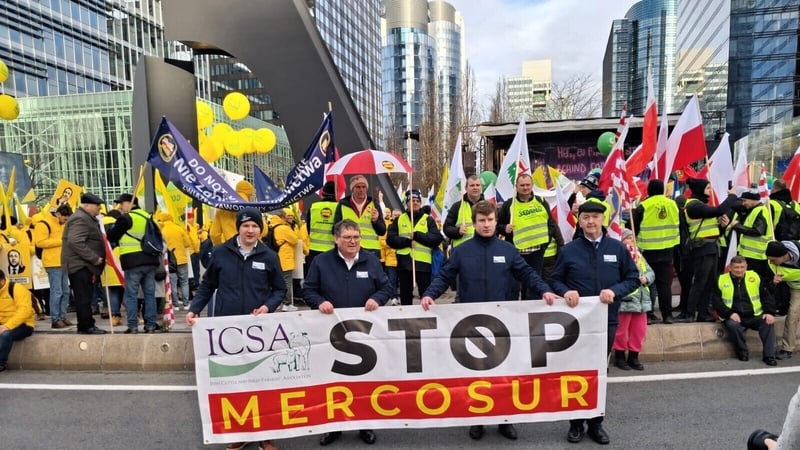
Confirmation that Brazilian beef containing banned hormones entered the Irish food chain should be a "wake-up" call for the Government, the Irish Farmers' Association has said.
It comes as the EU is set to vote on ratification of the EU-Mercosur trade deal on Friday.
If approved, the deal would allow Mercosur countries to export up to 99,000 tonnes of beef into the EU at a much-reduced tariff rate of 7.5%, as well as 180,000 tonnes of poultry.
This has led to concerns amongst farmers of cheap South American beef flooding the EU market, which they say could be of inferior quality.
The Department of Agriculture has confirmed that it was notified by the Food Safety Authority of Ireland on 12 December that 128kg of the implicated beef, which is the subject of a recall, was distributed to three food business operators in Ireland.
The beef - from animals treated with oestradiol, a growth-promoting hormone banned in the EU - was part of consignments sent to Northern Ireland where a food business operator distributed the beef to the three operators in the Republic in September.
The HSE was made aware of the notification and the department said that the FSAI has verified that none of the beef remains in the Irish market.
IFA President Francie Gorman said that an EU audit "which uncovered these hormones is getting worse and worse, with more EU countries being embroiled. The EU must publish the full details of this immediately and before there is any vote on the Mercosur deal."
Earlier, Minister for Agriculture Martin Heydon said he is opposed to Ireland supporting the EU-Mercosur trade deal.
This puts him at odds with Taoiseach Micheál Martin, who said this morning that "a lot of progress" had been made in efforts to provide further support to European farmers, concerned about the impact the trade deal will have, particularly on the beef sector.
Watch: Taoiseach says 'progress' made on Mercosur deal
Asked if the Government could end up supporting the agreement at a vote by member states on Friday, Mr Heydon said: "That'll be a decision to be made collectively by government, but people won't be surprised to know that I view Mercosur negatively."
Mr Martin added that the Government will "continue to engage with our partners in Europe on this and we will make a decision on this towards the end of the week".
Mr Heydon is in Brussels to attend an extraordinary meeting of EU farm ministers, who are addressing issues related to Mercosur and to the future of the Common Agriculture Policy (CAP).
European Commission President Ursula von der Leyen was due to fly to Brazil on 20 December to ratify the trade agreement, which has been 25 years in the making.
However, the signing was paused following last-minute concerns expressed by Italian Prime Minister Giorgia Meloni.
The commission appeared to have won the support of Italy after Ms Meloni welcomed a letter sent by Ms von der Leyen yesterday proposing to accelerate €45 billion of support for farmers, describing it as a "positive and significant step forward".
Italian Agriculture Minister Francesco Lollobrigida said the European Union was now proposing to increase spending on Italian agriculture in 2028-2034 rather than to cut it.
Italy's support for Mercosur would most likely tilt the balance in favour of a weighted majority of countries supporting the deal on Friday.
It is understood that the Irish Government now believes that Italy will vote in favour.
We need your consent to load this rte-player contentWe use rte-player to manage extra content that can set cookies on your device and collect data about your activity. Please review their details and accept them to load the content.Manage Preferences
Speaking to RTÉ News, Mr Heydon appeared to acknowledge that a blocking minority was not going to be possible.
He said: "I met with some [farm minister] colleagues this morning. The Polish [minister] … previously already expressed the view that if the blocking minority is falling away, we have to continue to work to get the best possible safeguards, because it takes more than one country to be able to stop this, and if there aren't enough to stop this, then you do need those safeguards in place for our farmers."
He said concerns remained about the risks to the beef sector and to the EU’s animal health and food safety standards, known as sanitary and phytosanitary (SPS) controls.
"The concerns that general consumers have - we need absolute assurances around our SPS standards, which are non-negotiable. We don't allow hormone fed beef into Europe. We don't allow our farmers to use crop promoters in the production of beef, and the recall of products has been a real big concern for consumers, beyond farmers.
"Those concerns all have to be absolutely addressed, irrespective of whether there's a trade deal around the tariff rate of which produce comes in.
"We know that 200,000 tons of Mercosur beef come into Europe already, just at a higher tariff rate.
"From a Government perspective, we have been true to our programme for government commitment, which has been working with like-minded countries who have voiced that opposition in the past, and I've continued to do that at every meeting here in Brussels over the course of the last year," he added.
The Mercosur trade deal: All you need to know
Independent TD Michael Healy-Rae said the Taoiseach's earlier comments were "not helpful".
"Whatever anyone else does, we should vote against, that's our stance. For the Taoiseach to say what he said was not helpful."
It is understood the Taoiseach, Tánaiste and the leader of the independents in Government Seán Canney held an online meeting today to discuss the Mercosur deal.
They agreed to have further discussions tomorrow.
The regional independents and the Healy-Raes also met online today.
'Major concerns'
Fianna Fáil MEP Billy Kelleher said he has had "major concerns" over the Mercosur deal for a long time, and the quality of beef from South America that would entering the EU.
Speaking to RTÉ's Drivetime programme, he said: "We've had some scares in recent times...with products coming in that were found to be sub-standard in terms of antibiotic content being found in meat.
"Also growth promoter content as well, so that in itself is very concerning.
"And it's not just concerning from the point of view of the beef industry in Ireland, but this is also to do with consumer sentiment and public health and safety and the undermining of confidence in our food standards in the European Union," he said.
Mr Kelleher also said there were issues "around the climate, the incentivisation of the destruction of the Amazonian rain forests, the displacement of indigenous people".
"These are all issues that could result as a consequence of the Mercosur agreement as it is presently drafted," he said.
Farmers 'significantly concerned' by Mercosur deal
President of Macra na Feirme Josephine O'Neill said that Irish farmers are "significantly concerned" by the Mercosur deal.
She said that Macra na Feirme will be encouraging Irish consumers to buy Irish beef and products when Brazilian beef is available for purchase.
Speaking on RTÉ’s Morning Ireland, she said: "We will be urging our Irish consumers to choose Irish products that are produced to the highest standards and to support Irish farmers, because we need to ensure that our young farmers have an economically viable business going forward."
Ms O’Neill said that the deal poses a significant threat to the economic viability of Irish farms.
"If we look at young farmers specifically, they're already operating on very tight margins, as are all farmers, to produce high-quality products, and that is very different to what's happening in Brazil.
"Their meat has been produced to completely different standards. And when we look at the potential for this deal to flood the Irish market with an influx of beef and poultry, that has a strong likelihood to drive down the prices to place farmers at a direct competitive disadvantage and threaten their livelihoods."
She said the agreement has the "likelihood to drive our young farmers into extinction".
"If we don't have young farmers, we are losing the backbone of our rural communities," Ms O’Neill added.
